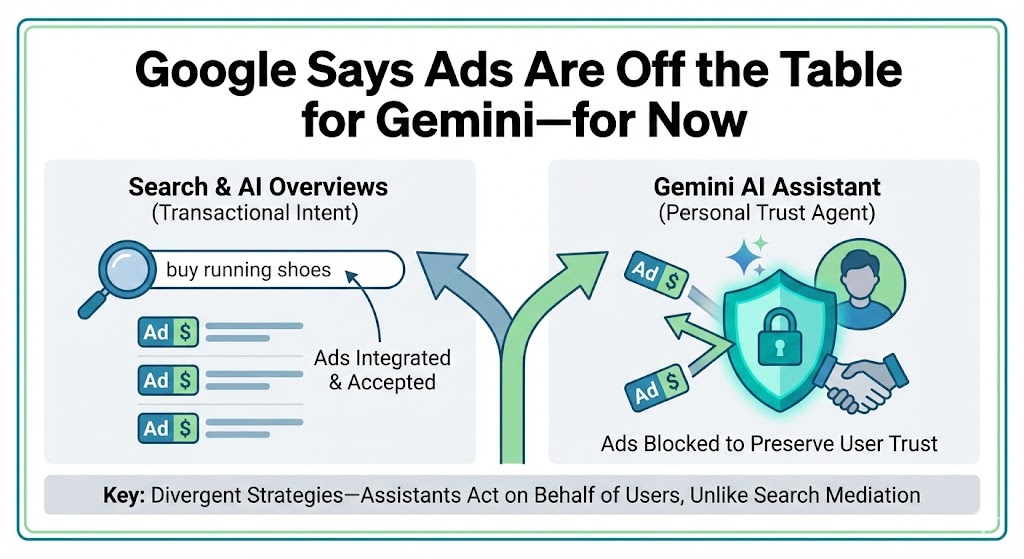
Google has no current plans to introduce advertising into its Gemini AI assistant, according to DeepMind CEO Demis Hassabis, who says unresolved questions around trust make monetization fundamentally different from search.
Speaking at the World Economic Forum in Davos, Hassabis framed AI assistants as a more personal category of technology—one that is expected to act on behalf of the user rather than mediate between users and advertisers.
Assistants are not search
Hassabis emphasized that Gemini should be understood as a distinct product category, separate from Google Search. While search is designed around explicit queries and commercial intent, he described AI assistants as systems meant to work in the user’s interest across a broader range of tasks.
In that context, he questioned how advertising could coexist with the expectation that an assistant is acting solely for the individual using it.
He said the industry has yet to resolve how ads fit into an assistant model without undermining confidence in the system’s recommendations.
A contrast with recent moves by OpenAI
The comments arrive as OpenAI prepares to test advertising within ChatGPT for logged-in users on its free and Go tiers in the United States. Hassabis acknowledged that advertising has long funded consumer technology, but said moving too quickly could carry risks.
He noted that poorly implemented ads in an assistant environment could weaken the user relationship, even if advertising can be valuable when aligned with intent.
Search advertising continues to expand
Hassabis drew a clear distinction between assistants and search when asked about Google’s broader advertising strategy. Google has already introduced ads into AI Overviews within Search, arguing that user intent in search queries makes advertising appropriate and useful.
Google began rolling out ads in AI Overviews in late 2024 and has since expanded their presence, maintaining that revenue performance is comparable to traditional search ads.
According to Hassabis, that model does not translate cleanly to AI assistants, where intent is often implicit, evolving, or personal rather than transactional.
Reinforcing Google’s public stance
This marks the second time in recent months that a senior Google executive has publicly stated that Gemini is not slated for advertising. In December, Google Ads leadership pushed back on reports suggesting Gemini ads were planned for 2026, calling those claims inaccurate.
Hassabis’s remarks add strategic context to that position, suggesting Google is prioritizing long-term trust and utility over near-term monetization for its assistant.
What to watch next
Google’s position leaves open the possibility that advertising could eventually appear in Gemini, but only if a model emerges that aligns with user expectations and preserves confidence in the assistant’s role.
Whether that stance holds may depend on how users respond to ads in competing AI assistants—and whether those implementations succeed without eroding trust.
For now, Google appears content to monetize AI where intent is explicit, while keeping Gemini ad-free as it defines what a trusted assistant should be.