
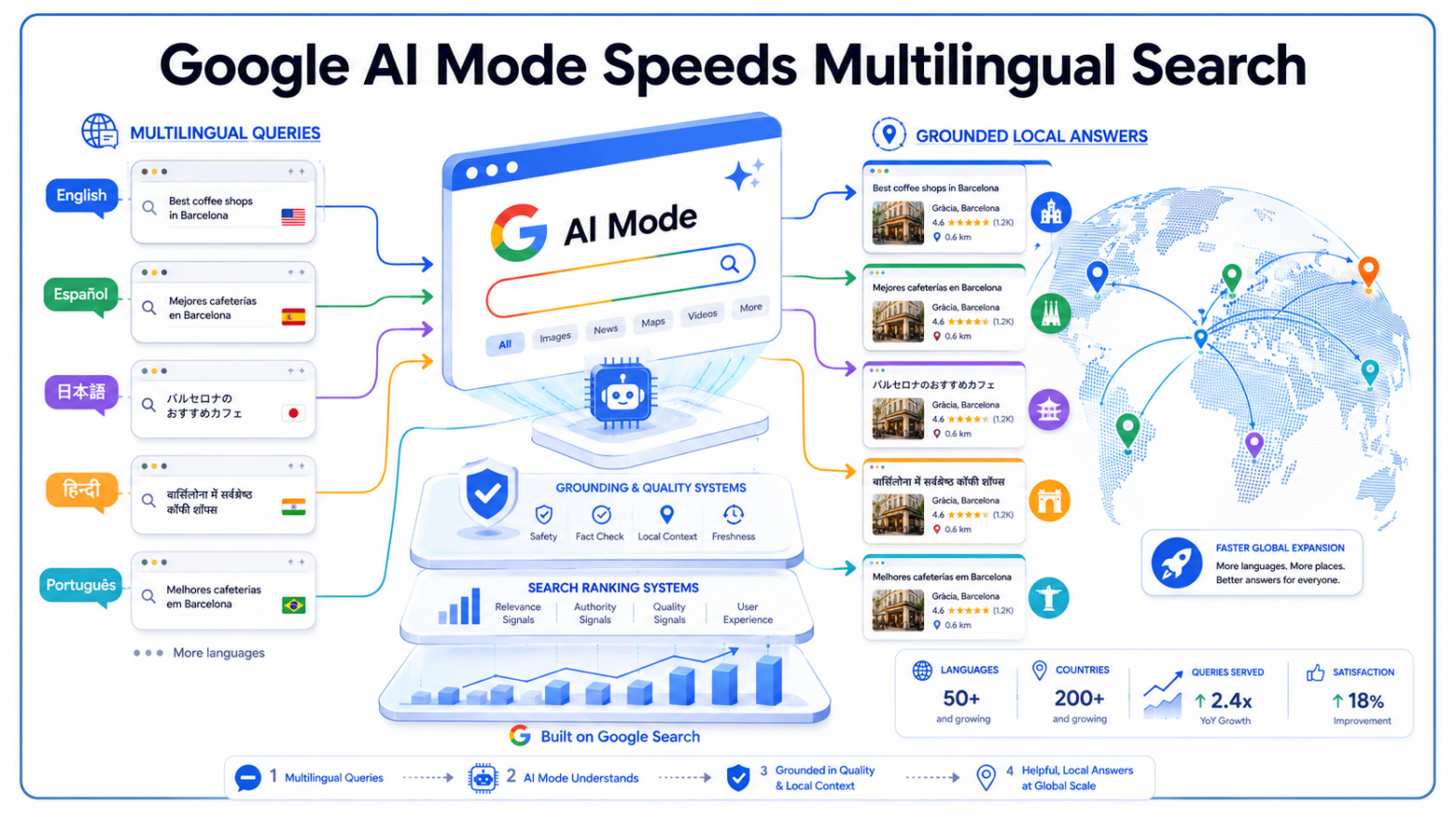
Google’s AI search rollout is no longer moving like a traditional Search feature. The company is positioning AI Mode as a system that can travel across languages faster because the underlying models were built to understand more than English from the start.
That shift matters for publishers, SEOs, and international brands watching Google’s AI search products move beyond early U.S.-centric testing and into broader markets.
In post-I/O comments, Liz Reid, Google’s VP and Head of Search, said AI Mode’s multilingual model architecture has reduced some of the friction that previously slowed global launches. Google has not published a fresh country-by-country rollout timeline tied to those remarks, but its recent product updates show the direction clearly: AI Mode is becoming a global Search layer, not a limited experiment.
The Old Search Rollout Playbook Is Getting Compressed
Search features used to arrive unevenly.
A product could appear in the U.S., move through English-speaking markets, then take months or years to reach additional languages. That pace reflected the complexity of localization, ranking quality, policy review, and interface changes across different markets.
AI Mode appears to be changing that pattern. Reid said the feature reached “many, many countries, in many, many languages” within a few months, arguing that the models behind AI Mode are more multilingual by design.
Google’s own product history backs up the broader pattern, even if the company has not released a full benchmark comparing AI Mode with older Search rollouts. In September 2025, Google said AI Mode was expanding to Hindi, Indonesian, Japanese, Korean, and Brazilian Portuguese. A month later, Google announced availability in more than 35 new languages and over 40 new countries and territories, bringing AI Mode to more than 200 countries and territories total.
The important change is not just translation.
Google described the expansion as requiring an understanding of local information, language nuance, and context. That framing is central to how the company is explaining AI Mode’s international growth: the feature is expected to interpret intent across language and location, not simply convert an English answer into another language.
Local Context Is Now Part Of The AI Answer Layer
AI Mode’s international expansion also raises a practical question: how does Google decide what information is useful in different places?
Reid said Google uses existing Search ranking work to help ground AI Mode responses based on location. That lines up with Google’s Search Central documentation, which says generative AI features in Search are rooted in the company’s core ranking and quality systems. Google describes retrieval-augmented generation as a grounding method that relies on Search ranking systems to retrieve relevant, up-to-date web pages from the Search index before AI-generated responses are assembled.
For marketers, that point is more important than the model architecture itself.
Google is not describing AI Mode as detached from Search. It is presenting the experience as an AI interface built on top of the same broad infrastructure that has long determined crawlability, indexing, ranking, quality, and relevance.
Location-aware grounding has existed in traditional Search for years. A restaurant query in Toronto should not behave like the same query in Tokyo. A legal, health, retail, or service query often carries local meaning even when the wording is nearly identical.
AI Mode brings that same challenge into generated answers. The difference is that users may now ask longer, more specific, multi-part questions and expect a synthesized answer rather than a list of blue links.
That raises the stakes for accurate local signals, clear business information, and content that matches regional intent.
I/O Added Agents, Not A Clean Rollout Calendar
The latest comments follow Google’s Search announcements at I/O 2026, where the company presented AI Mode as a more capable interface for complex tasks.
Google’s May 2026 Search update introduced AI agents in Search, a redesigned intelligent Search box, and easier movement between AI Overviews and AI Mode. Google said the new Search box was starting to roll out in all countries and languages where AI Mode is available.
That detail is easy to miss.
The redesigned Search box is not being framed as a U.S.-only interface change. It is tied to the current AI Mode footprint, meaning users in supported languages and locations are part of the same product direction.
Google also used I/O to describe AI Mode as a place where users can search across modalities, including text, images, files, videos, and Chrome tabs. The company’s broader I/O recap positioned Search as one of the products being rebuilt around models, agents, and task completion.
What Google did not provide was a detailed public schedule for every AI Mode feature by market.
That leaves a familiar gap for SEOs and publishers: Google is clear about product direction, but less specific about timing at the country, language, and feature level. The practical result is a rolling transition rather than a single launch date.
Multilingual SEO Has Less Room For Thin Translation
Google’s messaging around AI Mode creates a sharp distinction between multilingual content and translated content.
A page translated word-for-word into multiple languages may satisfy basic language coverage, but it may not satisfy local intent. In AI Mode, where answers are grounded in indexed web content and shaped around complex prompts, shallow localization becomes more visible.
Google’s recent Search Central guidance for generative AI features keeps the advice anchored in familiar SEO principles: make content crawlable, maintain a clear technical structure, create useful content for people, and avoid producing pages mainly to manipulate ranking or AI responses.
The international version of that guidance is straightforward. Brands need pages that reflect how users in a region actually search, compare, buy, evaluate, and phrase problems. That can include local terminology, market-specific examples, regulations, pricing context, availability details, and service-area clarity.
For global brands, AI Mode’s faster language expansion may shorten the window between a Search interface change and its effect on international visibility. Teams that previously treated non-English SEO as a secondary localization project may face pressure to align content quality, structured information, and regional relevance sooner.
The change is especially relevant for ecommerce, local services, travel, education, finance, and healthcare-adjacent information, where user intent can shift dramatically by market.
Marketers Should Watch Search Behaviour, Not Just Feature Labels
The practical impact for marketers is not that every site needs a new “AI Mode strategy” overnight. Google’s own guidance continues to frame AI visibility as part of Search visibility, not a separate optimization system.
The immediate work is more operational: monitor how branded and non-branded queries behave in priority markets, keep location and product details accurate, strengthen language-specific pages that already earn qualified traffic, and avoid mass-producing generic translated pages that add little beyond the source version.
For publishers, the same logic applies to editorial coverage. Useful regional context, named sources, original reporting, and clearly structured pages are more likely to survive a Search environment where AI systems retrieve, compare, and synthesize content from multiple sources.
That does not guarantee inclusion in AI Mode. Google does not guarantee indexing, ranking, or display in generative AI features.
But the direction of the product is now visible. AI Mode is scaling through languages faster than many older Search features, and Google is tying that expansion back to its existing ranking and grounding systems.
For international SEO teams, the question is no longer whether AI search will remain concentrated in one market. It is how quickly the next supported language changes the search experience their audience already uses.