
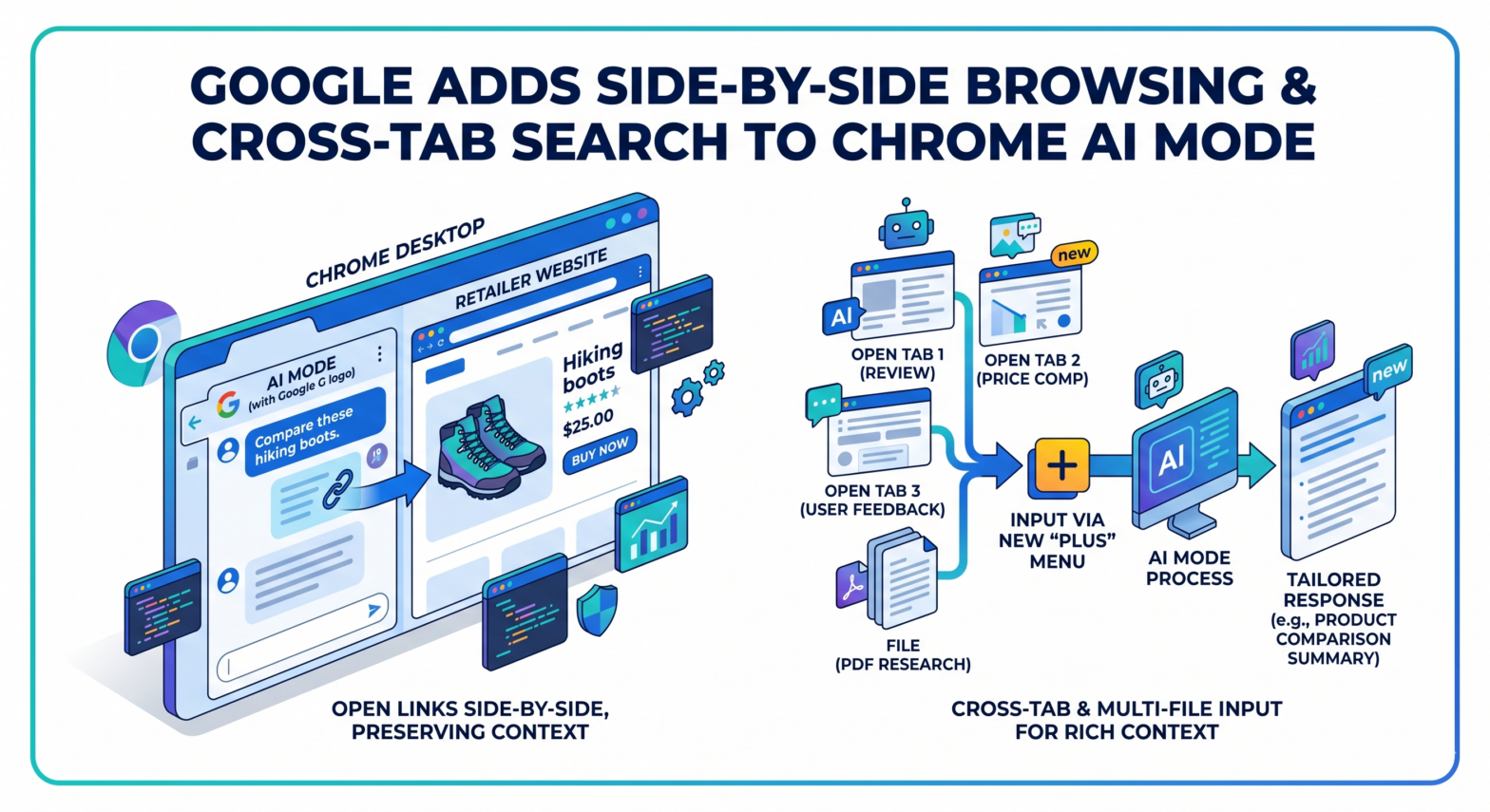
Chrome users in the United States now have access to a redesigned AI Mode experience that keeps web pages and AI search results visible at the same time. Google announced the changes on April 16, 2026, in a post on the Google Search blog, introducing two core capabilities: a split-screen browsing view on Chrome desktop and a cross-tab search tool available on both desktop and mobile.
Split-Screen View Replaces Tab-Switching for AI Mode Users
When using AI Mode on Chrome desktop, clicking a link now opens the web page side-by-side with AI Mode, rather than replacing the AI panel with the destination page. Google states the goal is to make it easier to explore relevant websites, compare details, and ask follow-up questions while preserving the context of the original search.
Previously, clicking a link from an AI Mode response would open a new tab, forcing users to juggle between windows. Now, the linked webpage opens directly alongside the AI Mode conversation. This persistent layout allows users to explore source material, verify details, and ask contextual follow-up questions without losing the thread of their original query.
Once a user opens a retailer's website alongside AI Mode, they can ask specific questions, for example, about a product's ease of cleaning, and AI Mode will use context from the page and from across the web to generate an answer. Google confirmed in the April 16 blog post that early testers reported the side-by-side layout helped them stay on task without constantly switching between windows.
Cross-Tab Search Extends AI Mode to Existing Open Tabs
On Chrome desktop or mobile, users can tap the new "plus" menu in the search box on the New Tab page, or the existing plus menu within AI Mode, to select recent tabs and add them to a search. Users can mix and match multiple tabs, images, or files, such as PDFs and bring that context into AI Mode searches.
The new plus menu in the Chrome search box, available on both desktop and mobile, lets users attach recently opened tabs to their AI Mode queries. Images and files, including PDFs, can be mixed in as well, giving users more control over the context they bring to any given search.
A user studying for an exam can bring in context from open tabs containing class notes, lecture slides, and academic papers, and ask for additional examples to illustrate a concept. AI Mode will use those tabs to provide a tailored response and suggest more sites to explore.
AI Mode Tools Now Accessible from the Plus Menu
Powerful tools in AI Mode, including Canvas and image creation, are now accessible wherever the new plus menu appears in Chrome. These tools, previously only accessible within AI Mode, are now reachable from the plus menu anywhere it appears in Chrome.
Availability
The redesigned AI Mode, with split-screen view, cross-tab search, and enhanced tool integration, began rolling out on April 16, 2026. It is initially available for English-language users in the United States on Chrome for desktop, Android, and iOS. Google has confirmed it will expand the updates to more places around the world soon.
What This Means for Marketers and SEOs
The shift from tab-based navigation to a persistent AI panel alongside live web pages has direct implications for how users engage with search results and publisher content. When AI Mode surfaces a web page and holds it in a split view, users may spend more focused time on individual pages while simultaneously querying AI for additional context, a browsing pattern different from traditional click-through behaviour. Marketers investing in content depth and page-level relevance signals may find this workflow increasingly important, as AI Mode draws on page content directly when generating follow-up answers. The cross-tab and multi-file input feature also suggests that users conducting research-intensive tasks, comparison shopping, academic work, or competitive analysis now have a structured path to synthesize content across multiple sources without leaving Chrome.
Google confirmed in its April 16, 2026, Search blog post that all features described are live in the United States, with no announced date for international expansion beyond the indication that a broader rollout is planned.