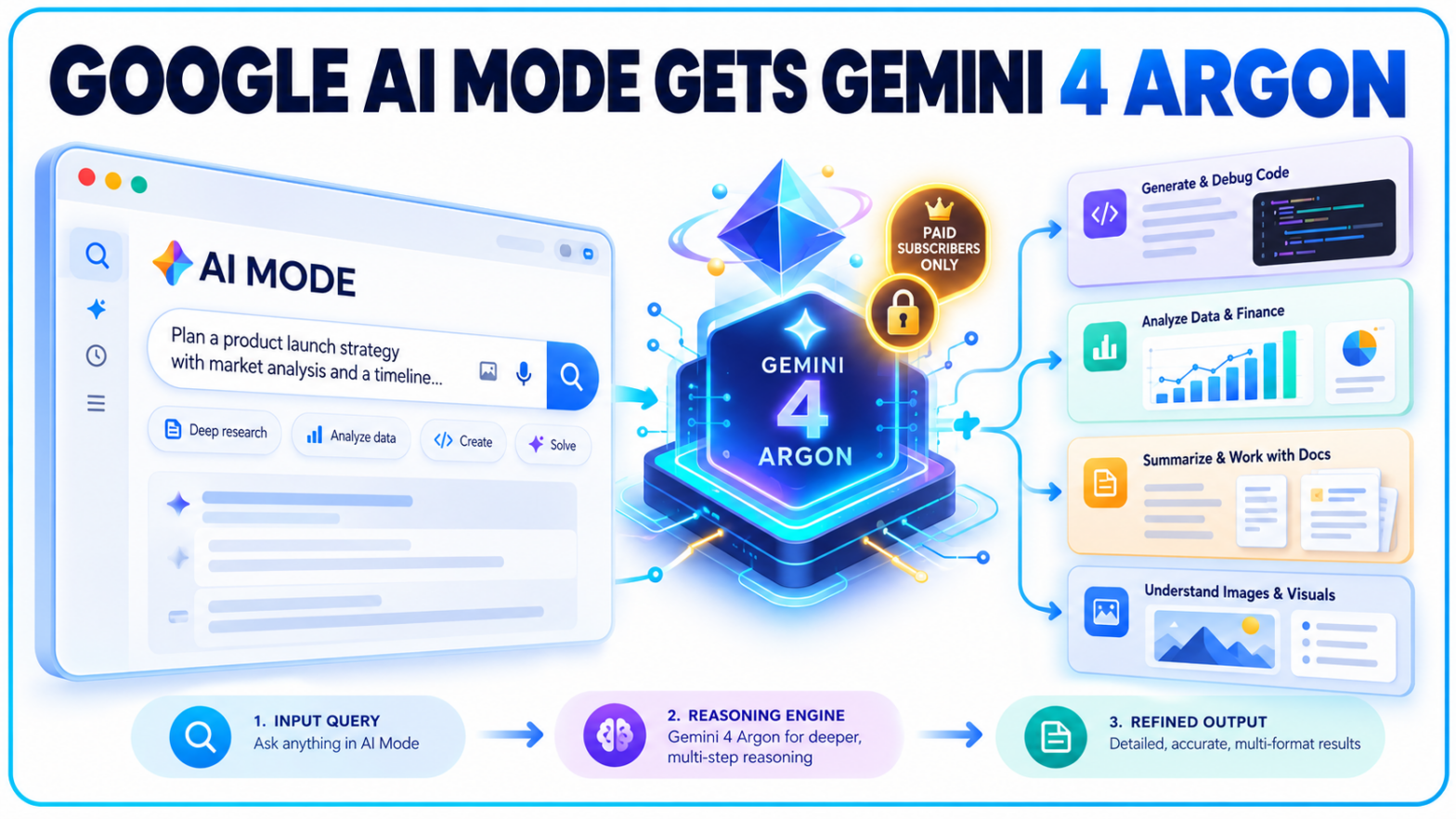
Google Search is getting a more powerful AI model, but not everyone will have access to it. Gemini 4 Argon is now rolling out in AI Mode for paying subscribers, bringing more advanced reasoning and multi-step problem-solving capabilities directly into Google's search experience.
The October 13, 2026, release expands Argon beyond its earlier restricted availability, making the model accessible through Google AI Pro and Ultra subscriptions. Developers and enterprise customers can also access it through Google's AI platforms.
For search marketers, the distinction matters. Google is introducing a more capable reasoning model into Search without announcing a replacement for the AI experience available to every user.
Google AI Mode Gets a More Powerful Model for Paid Subscribers
Google confirmed the expanded rollout in its official Gemini 4 Argon announcement, identifying AI Mode and the Gemini app as two of the consumer products receiving the model.
Access is available to Google AI Pro and Ultra subscribers globally. The announcement does not extend Argon access to users on Google's free plans.
The distinction separates access to AI Mode itself from access to Google's newest reasoning capabilities.
Google has been steadily expanding the models and functions available through Search. In September, the company introduced Gemini 3.8 Flash to AI Mode for paid subscribers, continuing a series of changes intended to improve complex reasoning and conversational interactions.
Argon represents another step in that progression.
Unlike conventional search queries, which often involve finding a specific answer or webpage, AI Mode supports extended conversations in which users can refine questions, introduce additional constraints and explore related information.
Argon is designed to handle these longer interactions with greater precision.
Google has not announced that Gemini 4 Argon will become the default model for all Search users. Nor has it confirmed that the launch changes the underlying model used for AI Overviews in standard Google Search results.
For now, the confirmed consumer rollout is tied to paid access.
Complex Search Questions Are the Focus of Gemini 4 Argon
The central improvement Google is promoting is Argon's ability to sustain reasoning across demanding, multi-step tasks.
Its capabilities extend across coding, financial analysis, legal research, cybersecurity and scientific work. Google says the model can maintain context while processing complex instructions and combining information from multiple sources.
Within AI Mode, those improvements are relevant to questions that cannot be resolved through a single straightforward answer.
A user researching software platforms, for example, might ask Google to compare several products against a detailed set of operational requirements, revise the comparison after adding new conditions and explain the trade-offs.
Such interactions require the model to preserve earlier context while incorporating additional information.
Google also says Argon performs better at following detailed instructions and interpreting complex requests.
The model supports advanced multimodal understanding, allowing it to work with different forms of information, including documents and visual material.
Google's broader AI Search expansion has already introduced interfaces designed to accommodate more than traditional text queries, including images, files and conversational follow-ups.
Argon strengthens the reasoning technology available within that evolving environment.
Its capabilities are not limited to search-related tasks. Google says its API supports a unified input-output token limit of one million tokens, intended to accommodate extensive reasoning and longer workflows.
That technical specification applies to the API and should not be interpreted as a confirmed equivalent limit for interactions within Search.
Argon's Wider Launch Follows Two Weeks of Restricted Access
The October rollout also marks a substantial change in how Google is distributing its latest frontier model.
When Google first introduced Argon on September 30, access was initially restricted to selected cybersecurity professionals through its Fairwind Program.
Google said the controlled release would allow it to evaluate the model's advanced capabilities and strengthen safeguards before broader distribution.
That initial restricted launch has now progressed into public availability for eligible subscribers and commercial access for developers and businesses.
The distribution extends across several Google products.
Developers can access Argon through the paid Gemini API in Google AI Studio, while enterprise customers can use Google's business and development platforms. Google AI Ultra subscribers also have access through Google Antigravity.
Google is charging developers an introductory rate of $2 per million input tokens and $10 per million output tokens. According to the announcement, those rates will increase to $4 and $20 respectively after November 30, 2026.
Those figures are API usage prices, not the monthly costs of Google AI Pro or Ultra subscriptions.
Google is also expanding its Fairwind Program to additional cybersecurity partners, preserving a separate access pathway for organizations using Argon in advanced defensive security work.
The broader release indicates that Google is ready to distribute the model beyond its initial testing group, although specific capabilities and access conditions still vary by product.
Stronger AI Benchmarks Do Not Establish Changes in Search Rankings
Google has released extensive performance information to support Argon's launch.
According to the company, Argon ranks first on the Vals Index, an evaluation covering professional tasks in finance, coding, legal research and taxation.
Google also reports improvements in software engineering, complex document analysis, visual reasoning and autonomous workflows.
These evaluations offer evidence of the model's capabilities in specialized tasks. They do not establish how Argon will change search rankings, website citations or organic traffic.
That distinction is particularly relevant to publishers and SEO professionals.
A model that follows complex instructions more accurately could produce different responses when users ask detailed questions. However, Google has not published evidence showing that Argon's introduction changes how websites are selected, ranked or cited within AI Mode.
The company has also not announced new publisher eligibility requirements, indexing rules or technical SEO recommendations associated with Argon.
Model performance and search visibility are separate questions.
A benchmark measuring coding accuracy or professional reasoning does not directly measure whether a particular webpage will receive more exposure in AI-generated search responses.
Google has provided a Gemini 4 Argon model card through its official announcement for further technical and safety information, but its public rollout information does not establish a new ranking framework for Search.
AI Search Visibility Testing Gains Another Variable
For SEO teams, the immediate practical implication is the introduction of another model option into the search experience.
Brands monitoring Google AI Mode can examine how Argon responds to relevant informational and commercial queries, particularly those involving detailed comparisons, multiple requirements or extended conversations.
Differences in responses can be documented, but they should not automatically be attributed to changes in organic ranking.
Model selection, subscription eligibility, query wording and the information available during a search can all affect the responses users encounter.
Measurement remains important. Google has already expanded AI search visibility reporting through Search Console, allowing website owners to examine performance across AI-powered Search experiences.
Those reporting capabilities provide a separate view of search exposure, while direct testing can help marketers observe differences between available AI models.
Argon's release does not establish a new reporting metric or guarantee improved visibility for any particular website.
It also does not alter Google's published guidance that website content must remain accessible and eligible for indexing to appear in Search.
For marketers, the rollout adds another consideration when evaluating AI-generated responses, without introducing a confirmed change to established SEO requirements.
Google's October 13 announcement makes Gemini 4 Argon available to Pro and Ultra subscribers through AI Mode and the Gemini app, alongside broader developer and enterprise access. The company has not provided a date for extending the model to free Search users or announced changes to AI Overviews as part of this release.