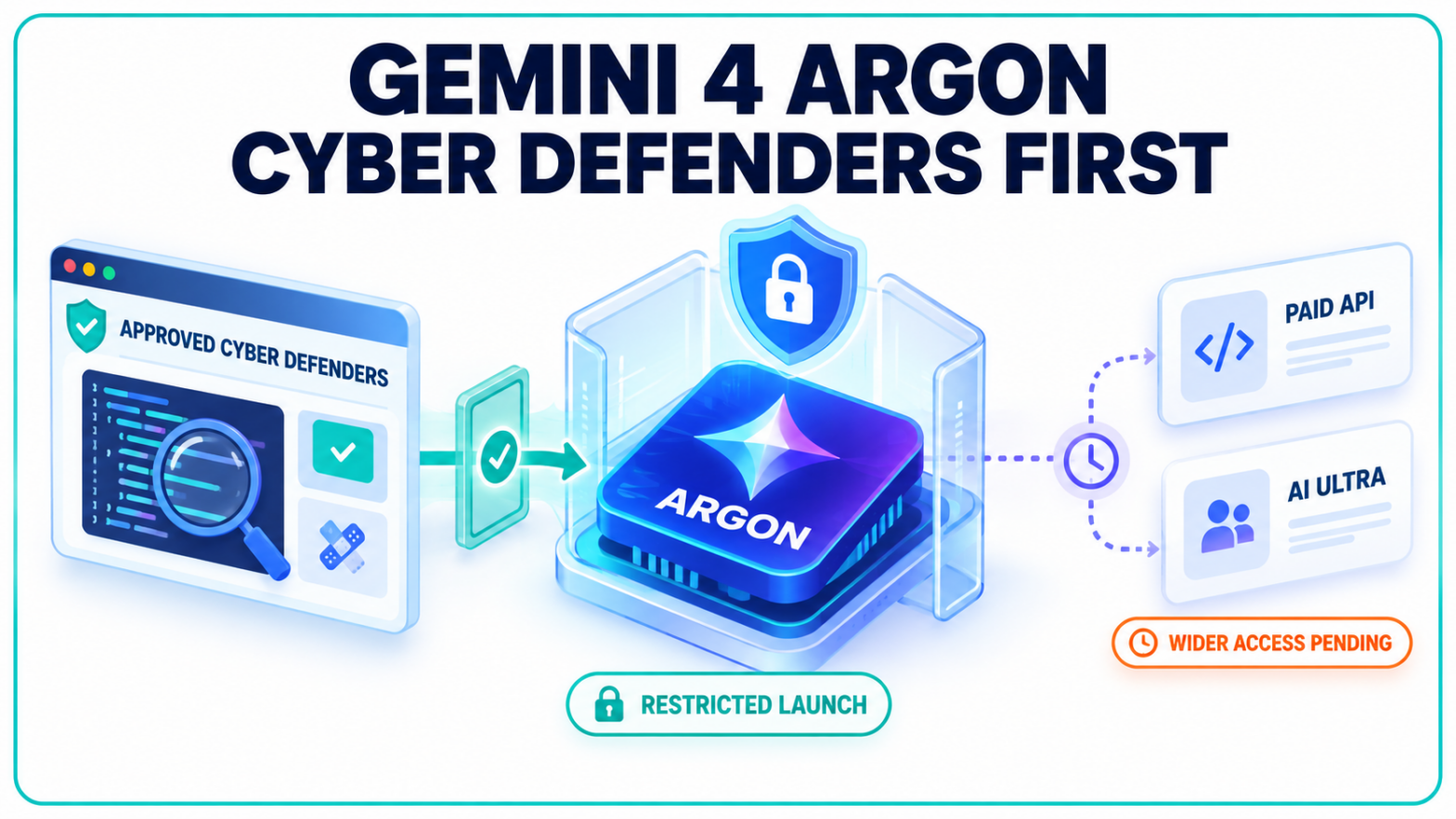
Google’s next Gemini model is reaching cybersecurity teams before everyday users. Gemini 4 Argon, unveiled September 30, begins with restricted access while marketers and developers wait for a broader release.
The immediate change is who can test it. Google’s launch announcement points to paid API customers and Google AI Ultra subscribers for wider availability, but gives no firm release date. Google says it is gathering early feedback and strengthening safeguards before expanding access.
Gemini 4 Argon Opens Behind a Controlled Gate
The first external route runs through Google DeepMind’s Fairwind Program, which gives approved cyber defenders early access to advanced models. Its priorities include governments, healthcare providers, telecommunications services and other organizations responsible for essential infrastructure.
Fairwind lists more than 650 partners globally. That number describes the programme’s overall network; Google says a selected set of partners receives Argon.
Membership also carries limits on use. Participating organizations may grant Argon access only to internal cybersecurity, incident response or penetration testing teams. They must track employee access and use, apply access controls and use phishing-resistant multifactor authentication.
Access cannot be shared, redistributed or sold.
Google vets applicants’ security history and ethical record. Permitted activities include authorized threat simulations, reverse engineering and malware analysis for defensive or academic research. Selected partners can use Argon on its own or with CodeMender, Google’s agent for automating software fixes.
That distribution model puts security operations at the centre of the initial release. A company’s participation in Fairwind does not establish access for its marketing department or other business teams.
AI Agents Get a Bigger Output Ceiling
Argon’s output limit rises to one million tokens from the previous 64,000, according to Google. This is the amount the model can generate, rather than a description of how much input it can accept. Google connects the increase to sustained reasoning on longer tasks.
That distinction matters when assessing AI agents. An agent carrying out a multi-step assignment may generate reasoning, call tools and revise its work before returning a result. More output capacity gives those sequences additional room; it does not establish how reliably a particular assignment will be completed.
Google’s cybersecurity capability page describes Argon navigating complex codebases to discover vulnerabilities and producing validated fixes. It also describes black-box penetration testing: examining a running website and its public behaviour without access to the application’s source code.
Those are distinct tasks. Reviewing source code exposes the implementation directly. Testing a live site requires the system to infer possible weaknesses from what it can observe and then produce evidence to validate them.
Google reports an 85.8% score for Argon on its internal real-world vulnerability discovery test, compared with 71.0% for Gemini 3.8 Flash Cyber. On Wiz’s penetration testing benchmark, the reported scores are 70.9% and 58.2%, respectively. These figures describe security evaluations, not marketing performance.
The Benchmark Table Has More Than One Leader
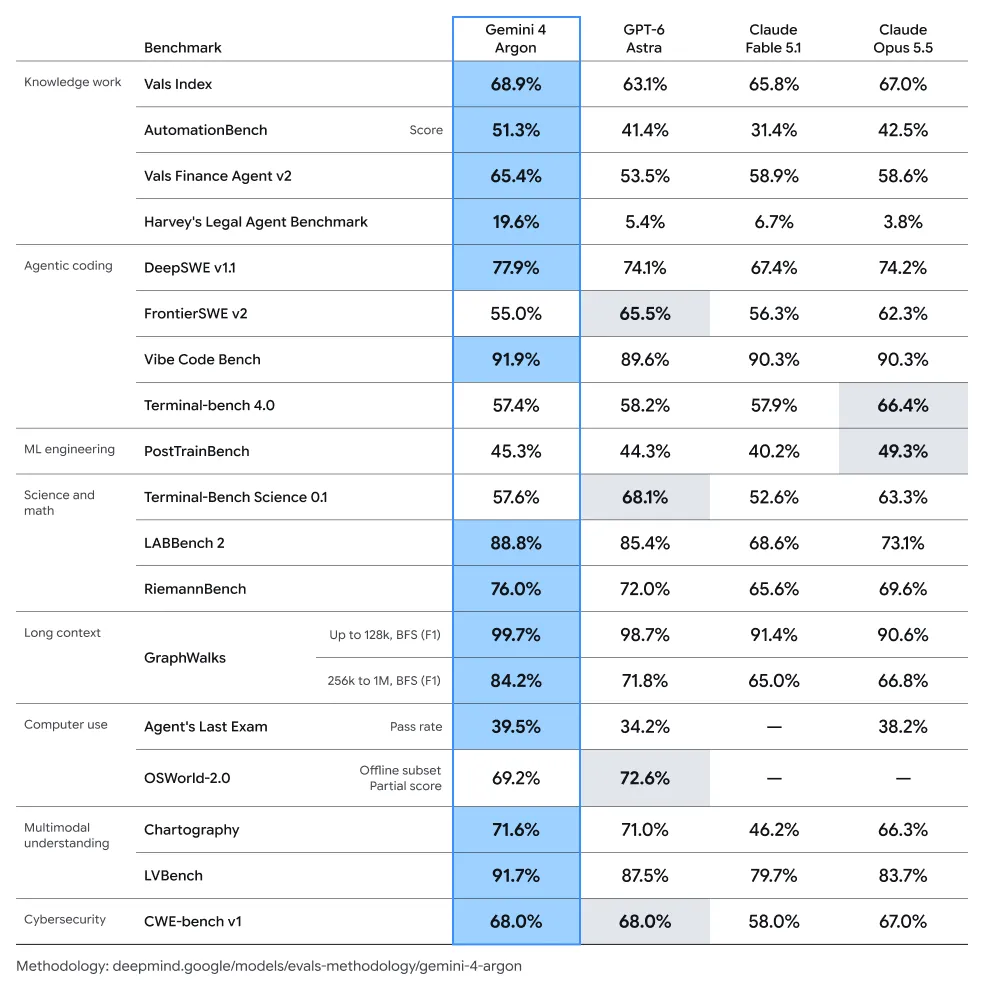
Google’s published results support a narrower reading than a blanket claim of superiority. On its Gemini model page, Argon scores 77.9% on DeepSWE v1.1, ahead of the three competing models shown in that comparison. It also leads that table on AutomationBench at 51.3%.
Other tests reverse the order.
Argon scores 55.0% on FrontierSWE v2, below GPT-6 Astra at 65.5%, Claude Fable 5.1 at 56.3% and Claude Opus 5.5 at 62.3%. Its 57.4% score on Terminal-bench 4.0 also trails all three. The reported advantage depends on the task being measured.
Google’s evaluation methodology explains another qualification: the comparison combines different sources of evidence. Some Argon scores are calculated internally, while others come from benchmark providers. Non-Gemini results generally come from model providers’ own reported numbers unless otherwise specified.
For DeepSWE, Google calculated Argon’s result using a mini-swe agent harness. It drew competitors’ results from a public leaderboard and system cards. AutomationBench results use a private test set and come from Zapier’s public leaderboard.
The methodology generally uses the highest thinking settings for Argon. Those test conditions are relevant to interpretation because an application’s runtime, available tools and reasoning settings can differ. A leaderboard score does not measure a campaign’s conversion rate, content accuracy or cost per completed marketing task.
Gemini API Pricing Arrives Before General Access
Google’s announced introductory rates are $2 per million input tokens and $10 per million output tokens, with a 95% cached-input discount. The announcement does not specify when introductory pricing ends.
The Gemini API is already a route for developers building custom agents. Argon’s announcement adds a future model option to that discussion, with access still subject to Google’s staged release.
For marketing teams, model evaluation normally depends on the actual workflow: factual accuracy in research, consistency in generated copy, tool permissions, response time and total usage cost. Argon’s restricted launch leaves most teams without the hands-on access needed to measure those factors. Published benchmarks provide context, but they cannot substitute for testing against the data and tasks an application will use.
AI Mode Has a Separate Rollout History
Google previously brought Gemini 3.8 Flash into AI Mode for paid subscribers. The Argon announcement does not identify a corresponding Search rollout or a change to Google Ads.
For SEOs, the relevant boundary is the product deployment. An underlying model announcement alone does not document a change to search rankings, referral traffic or how a website appears in Search.
Google’s Argon model page lists safeguards covering harmful requests, indirect prompt injection, monitoring of model actions and isolated execution environments. Its broader Frontier Safety Framework sets protocols for identifying capability levels, detecting them during development and preparing mitigations, with external involvement where appropriate.
Google has not assigned a public launch date. Its next named audiences are paid API customers and Google AI Ultra subscribers.