

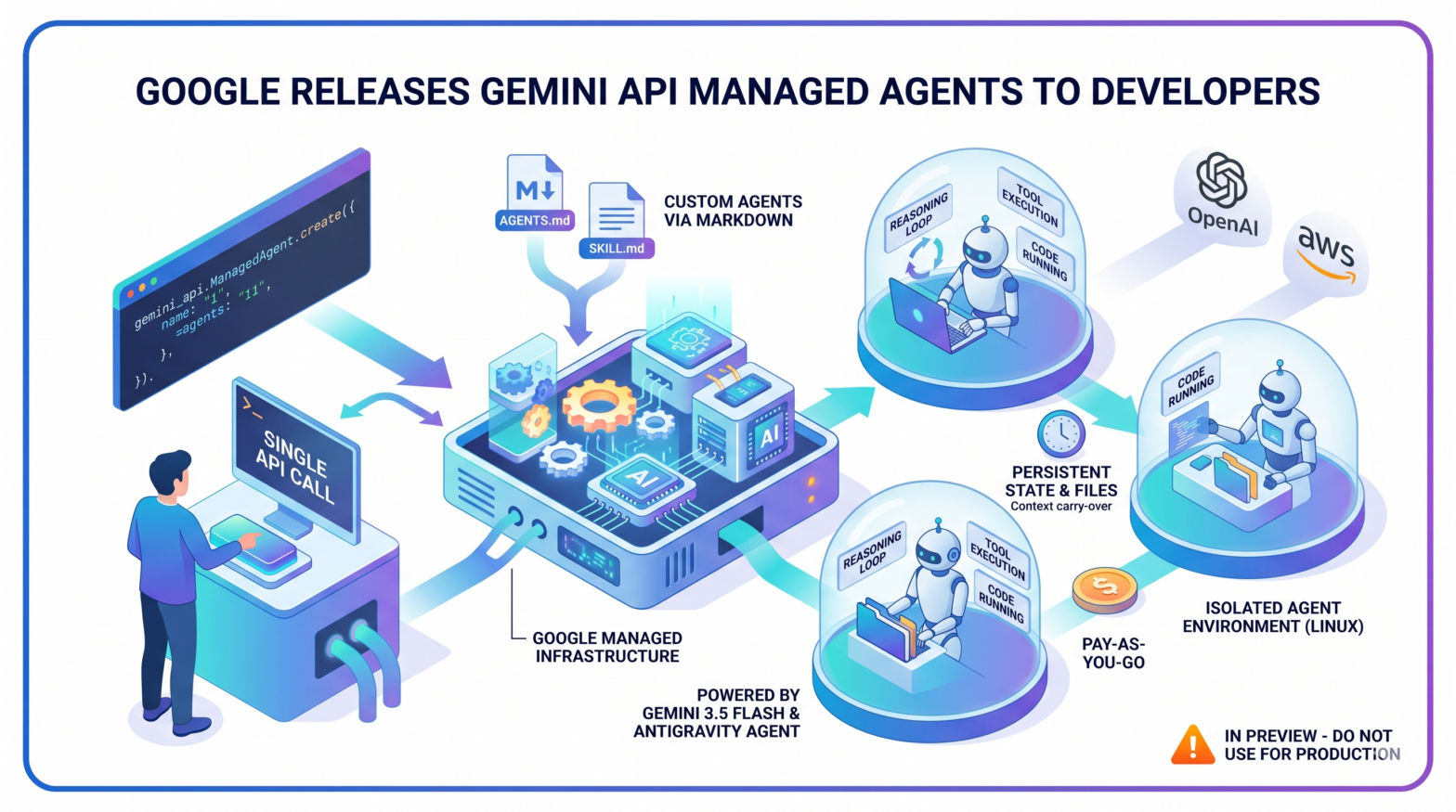
Developers can now build and deploy fully autonomous AI agents on Google's infrastructure without managing their own execution environments or orchestration layers. Google announced Managed Agents in the Gemini API on May 19, 2026, as part of its Google I/O 2026 developer keynote, confirming in its official Google for Developers blog post that the feature entered preview the same day.
What the Announcement Covers
The launch makes Managed Agents available in the Gemini API, enabling developers to spin up an agent with a single API call that can reason, use tools, and execute code in an isolated, ephemeral Linux environment. The feature is powered by the Antigravity agent, built on Gemini 3.5 Flash, and is accessible via the Interactions API and in Google AI Studio.
Developers using the Managed Agents feature gain access to the same agent harness technology and infrastructure that powers Google's own agents, which has been co-optimized with Gemini models, particularly Gemini 3.5 Flash.
For enterprise customers, Google has also added support for Managed Agents in the Gemini API on the Gemini Enterprise Agent Platform, which remains in private preview.
How the Agent Runtime Works
The Managed Agents feature provides infrastructure-level isolation for agent execution. With a single API call, developers can spin up an agent that reasons, uses tools, and executes code in an isolated Linux environment.
Unlike a standard chat request that produces a single output, an Antigravity interaction is an agentic workflow. A single request triggers an autonomous loop of reasoning, tool execution, code running, and file management.
Each interaction creates a persistent environment that developers can resume in follow-up calls, with all files and state intact, enabling seamless multi-turn sessions. This distinguishes the Managed Agents model from earlier stateless API calls, where context and file state did not carry between requests.
Pricing follows a pay-as-you-go model based on the underlying Gemini model tokens and the tools the agent uses. Unlike standard Gemini model calls, the Antigravity agent runs through multiple autonomous loops per interaction and can accumulate a high number of tokens.
Defining Custom Agents
Developers can extend the Antigravity agent with their own instructions and skills. Rather than writing complex orchestration code, they can define everything in markdown files, specifically AGENTS.md and SKILL.md, and register them as a managed agent.
The Managed Agents API on Agent Platform is described in Google's documentation as a config-driven, REST-first API for building autonomous agents inside a fully managed sandbox. Developers create and manage agent configurations and sandbox environments, including mounted sources such as skills and artifacts, using the Agents API, and interact with deployed agents at runtime via the Interactions API.
Custom agent templates are also available in the Google AI Studio Playground, enabling developers to get started without writing configurations from scratch.
Context: Deep Research and the Enterprise Agent Platform
Deep Research became Google's first managed-agent product in December 2025, and Google introduced the Gemini Enterprise Agent Platform at Cloud Next on April 22. The Managed Agents launch at I/O 2026 extends that infrastructure to third-party developers building their own agents.
Managed Agents in the Gemini API make this technology accessible to a broader developer base, while the enterprise platform continues on a more limited-access path. Google is using that staging to push managed agents that run on Google's infrastructure, in a model where the vendor also runs the execution layer, maintains state between steps, and removes infrastructure overhead from the customer team.
Google has framed the Gemini Enterprise Agent Platform as a comprehensive platform to build, scale, govern, and optimize agents, an evolution of Vertex AI that brings model selection, model building, and agent-building capabilities together with new features for agent integration, DevOps, orchestration, and security.
Competitive Landscape
Google's Managed Agents launch positions the company within a rapidly consolidating market for hosted agent infrastructure. Anthropic has framed managed execution around long-running work and harness design, AWS has added stateful MCP client capabilities to Bedrock AgentCore Runtime for multi-turn agent sessions, and OpenAI has also been expanding agent tooling for developers.
Practical Implications for B2B and SaaS Teams
For enterprise marketing, sales, and operations teams, Managed Agents reduces the technical barrier to deploying AI agents for multi-step, automated workflows. Because the execution environment, state management, and sandboxing are handled by Google's infrastructure, product and development teams can focus on defining agent behaviour rather than building or maintaining the underlying runtime. Teams evaluating custom agent deployments for customer service, lead qualification, or internal automation should note that the feature is currently in preview, and Google's own documentation advises against using it for production purposes until the preview reaches general availability.
Google's developer documentation advises that users review the agent's actions and outputs before relying on them in any sensitive workflow, and exercise caution when granting agents access to external systems or data to prevent unintended actions that cannot be undone.