

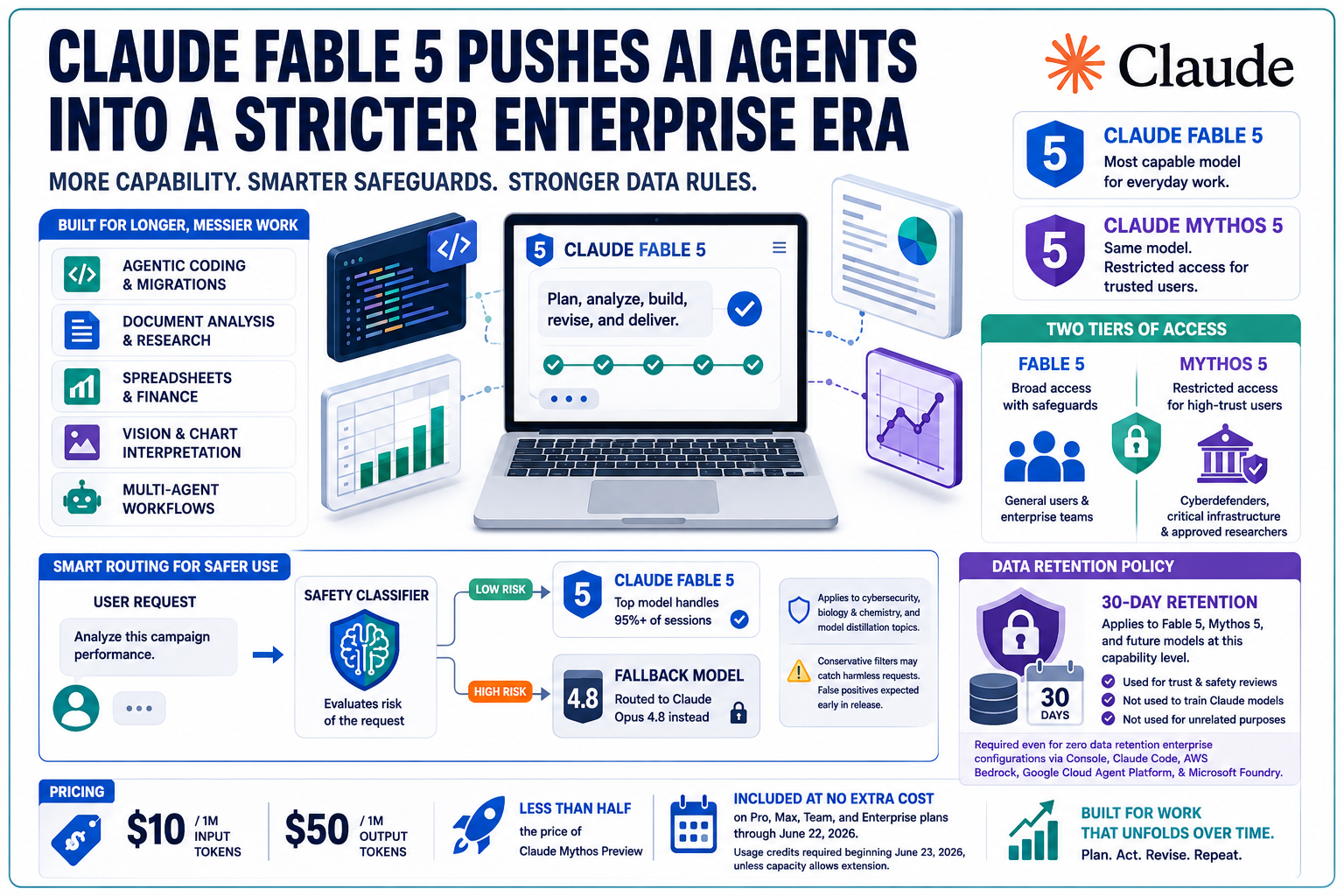
AI models are no longer just getting smarter.
They are being released with switches, fallbacks, classifiers, access tiers, and data policies that may matter as much as the raw benchmark scores.
Anthropic has launched Claude Fable 5, its most capable generally available model to date, alongside Claude Mythos 5, a restricted version of the same underlying model intended for selected cyberdefenders, infrastructure providers, and future trusted research partners. The release marks a sharp turn in how frontier AI is being commercialized: greater autonomy for everyday work, paired with tighter controls where that autonomy could create risk.
For marketers, agencies, developers, and enterprise teams already building AI into production workflows, the launch is less about another model name and more about a new operating reality.
The AI agent stack is getting stronger.
Access is getting more conditional.
Claude Fable 5 Is Built for Longer, Messier Work
Claude Fable 5 is being positioned as Anthropic’s strongest broadly available model, with performance gains across software engineering, knowledge work, vision, scientific research, and long-context tasks.
The emphasis is not only on faster answers. Anthropic’s announcement centers on longer-horizon work: tasks that require planning, persistence, interpretation, and revision across many steps. That includes codebase migrations, document-heavy analysis, chart interpretation, scientific figure reading, and vision-based app reconstruction.
For digital teams, that matters because many marketing operations are not single-prompt tasks anymore. Campaign audits, analytics investigations, CRM cleanup, content inventory reviews, conversion analysis, and landing page QA often involve multiple systems, uneven data, screenshots, spreadsheets, and incomplete instructions.
Claude Fable 5 appears designed for that kind of operating environment.
Anthropic said the model’s lead over earlier Claude models grows as tasks become longer and more complex. Early testers described stronger performance in agentic coding, prototyping, finance reasoning, spreadsheet work, and multi-agent workflows. Those areas sit close to where many agencies and in-house teams are already experimenting with enterprise AI.
That connects directly to the broader shift TechWyse has tracked around Claude Opus 4.8 and dynamic workflows, where AI systems are increasingly being evaluated by their ability to coordinate work rather than simply generate text.
Fable 5 continues that trajectory.
The model is not just answering.
It is being trained and tested for work that unfolds over time.
The More Capable Model Is Not Always the One That Answers
The most unusual part of the launch is not the benchmark story. It is the routing layer.
Anthropic says Claude Fable 5 uses new safeguards that can detect certain categories of risky requests and hand those responses to Claude Opus 4.8 instead. The fallback applies to topics including cybersecurity, biology and chemistry, and model distillation.
That creates a split experience.
For most users, Fable 5 will behave as the top model in normal use. Anthropic said more than 95% of Fable sessions currently avoid fallback. In flagged sessions, however, the response comes from Anthropic’s next-most-capable model rather than Fable 5 itself.
That is a notable product decision.
Instead of simply refusing more sensitive requests, Anthropic is trying to preserve usefulness while limiting exposure to the model’s highest-risk capabilities. The company acknowledges the safeguards are conservative and may catch harmless requests, with false positives expected during the early release period.
For business users, the practical effect is clear enough: advanced AI access may become less uniform. A prompt about campaign analytics may get Fable. A prompt about technical systems, security, or regulated scientific work may trigger a fallback.
That matters for teams designing repeatable workflows. Agentic systems are often judged by consistency. If the model behind a workflow can change based on topic classification, teams need testing that accounts for routing, not just headline model capability.
The same issue is already visible across the marketing technology stack, where AI features are becoming embedded into campaign, creative, analytics, and search systems. Google’s move to integrate Gemini into advertising workflows, including features covered in TechWyse’s reporting on Google Marketing Live 2026, shows how AI decision layers are becoming part of daily execution.
Anthropic’s approach adds another layer: AI capability gated by risk classification.
Mythos 5 Shows Where Open Access Stops
Claude Mythos 5 is the same underlying model as Claude Fable 5, but with safeguards lifted in some areas for approved users.
That access is narrow. Anthropic said Mythos 5 will initially be deployed through Project Glasswing in collaboration with the U.S. government, serving cyberdefenders and critical infrastructure providers. A broader trusted access program is planned, including a future biology program for selected researchers with biology and chemistry safeguards removed while cyber safeguards remain in place.
The distinction between Fable and Mythos is important because it separates model capability from model availability.
Anthropic is not saying the strongest version of the system should be available to every user in every context. It is saying the same model can be packaged differently depending on risk, use case, and user trust level.
That may become a common pattern across frontier AI.
General users get the model with policy controls. Approved partners get deeper access. Sensitive domains move into verified programs. Enterprise procurement teams begin asking not only “which model is best?” but “which capability tier are we actually allowed to use?”
For marketers, the direct impact is less about cybersecurity access and more about vendor strategy. AI tools used for content, analytics, paid media, sales operations, and workflow automation may increasingly contain invisible restrictions based on domain, customer type, geography, or compliance profile.
Agencies that build reusable AI processes across clients will need to know when a model’s limits are product limits, safety limits, or account-level limits.
Those are different problems.
Enterprise AI Now Comes With Data Retention Trade-Offs
Anthropic also introduced a 30-day retention requirement for traffic on Mythos-class models, including Fable 5, Mythos 5, and future models with similar or higher capability levels.
The company says retained prompts and outputs will be used for trust and safety purposes, not to train new Claude models or for unrelated uses. The policy applies to organizations using zero data retention configurations in Claude Console, Claude Code with zero data retention in Claude Enterprise, or Claude through platforms such as AWS Bedrock, Google Cloud Agent Platform, and Microsoft Foundry with zero data retention.
Consumer plans are not affected in the same way because Anthropic already retains inputs and outputs for safety purposes on those surfaces.
This is where the frontier model race collides with enterprise privacy expectations.
Many businesses adopted zero data retention as a baseline requirement for sensitive AI use. Anthropic is now drawing a boundary around higher-capability models, arguing that some misuse patterns only become visible when prompts and outputs can be reviewed across multiple requests.
For enterprise buyers, that creates a trade-off: access to stronger models may require accepting temporary retention, additional controls, and different review terms.
That trade-off will matter for legal, healthcare, finance, SaaS, and agency environments handling client data. It also echoes a broader issue in enterprise AI adoption, where model capability is only one part of deployment. Governance, logging, permissions, and vendor data policies are now part of the buying decision.
In practical terms, marketers and SEOs using advanced AI agents should treat model selection as an operational control, not just a productivity choice. Teams handling client accounts, private analytics exports, CRM records, unpublished creative, or proprietary research need documented rules on what can be entered into AI systems, which workspaces are approved, and whether a model’s retention policy fits the use case.
That is not speculation. It is basic risk management as AI moves from drafting support into business process execution.
Pricing Puts Frontier Agents Closer to Production Work
Claude Fable 5 and Claude Mythos 5 are priced at $10 per million input tokens and $50 per million output tokens. Anthropic said that is less than half the price of Claude Mythos Preview.
Fable 5 is available through the Claude API using claude-fable-5. It is also being included on Pro, Max, Team, and seat-based Enterprise plans at no extra cost through June 22, 2026. Beginning June 23, usage on those subscription plans will require usage credits unless capacity allows Anthropic to extend the included window. The company says it intends to restore Fable 5 as a standard part of subscription plans once capacity permits.
The pricing and rollout structure suggest Anthropic expects heavy demand.
It also shows how frontier models are moving from occasional premium use into higher-volume operational testing. A more capable model at a lower price changes the economics of long-running AI agent workflows, especially for teams experimenting with multi-step analysis, coding, reporting, and workflow orchestration.
Marketing teams are already seeing a similar pattern across platform-native AI tools. In paid media, Google’s move toward AI-assisted campaign construction and reporting has made model capability part of everyday campaign operations, not a separate innovation lab project. The new Gemini-powered Google Ads reporting dashboards reflect that same direction.
Claude Fable 5 adds pressure from the independent model layer.
The question for teams is no longer whether AI can produce useful drafts or summarize reports. It is whether AI agents can safely handle longer workflows that include judgment, data interpretation, tool use, and revision across multiple steps.
Anthropic is betting they can.
With Fable 5, it is also betting that the safest path is not full access for everyone, but capability packaged with routing, retention, and trust-based access controls from launch.