
Enterprise AI is moving out of the demo room.
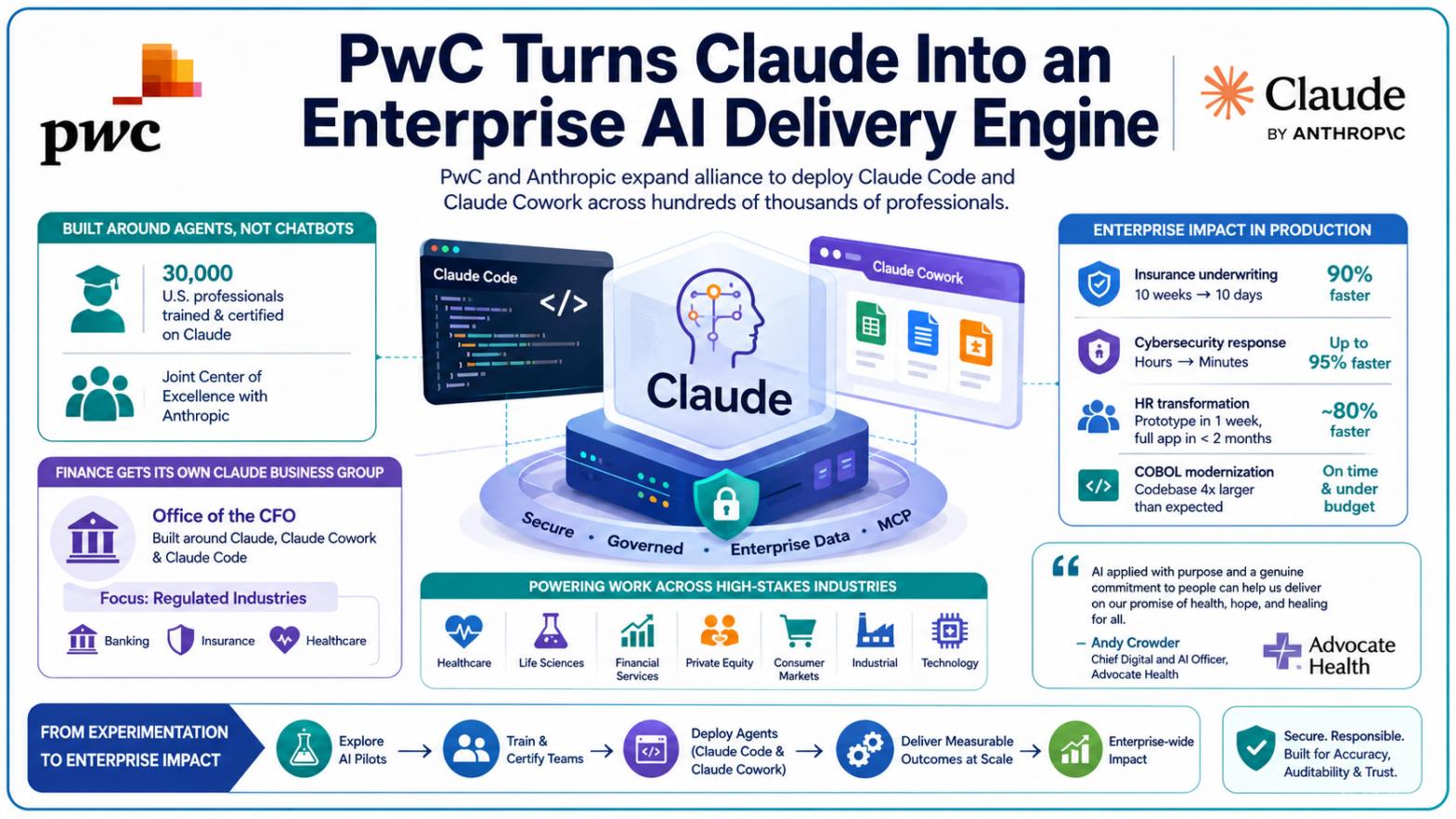
PwC and Anthropic are expanding their alliance around Claude, with PwC preparing to use Claude Code and Claude Cowork across U.S. teams before extending access toward a global workforce of hundreds of thousands of professionals.
The move is not being framed as another assistant rollout. It is a bet that AI agents can sit inside the work of consulting, finance, software modernization, deal execution, cybersecurity, and regulated industry operations.
The Firm Is Building Around Agents, Not Chatbots
The expanded alliance gives PwC a deeper deployment path for Anthropic’s Claude products across both internal work and client delivery. PwC said it will establish a joint Center of Excellence with Anthropic and train and certify 30,000 U.S. professionals on Claude.
That training piece matters.
Large companies have spent the past two years testing generative AI tools with uneven results. The next phase is less about giving employees access to a model and more about teaching teams how to engineer, supervise, and govern systems that complete work across multiple steps.
PwC is aiming that work at three areas: technology builds using Claude Code, deal-making supported by AI agents, and the reinvention of business functions such as finance, supply chain, HR, and engineering.
The companies also pointed to more than $2 trillion in technical debt across enterprise operations as part of the problem they want to address. That figure gives the announcement a specific target: old systems, manual processes, and operating models that were not built for AI-native workflows.
Finance Gets the First Standalone Claude Business Group
PwC is launching a new finance business group, the Office of the CFO, built around Claude.
The group will pair PwC’s finance transformation work with Claude, Claude Cowork, and Claude Code. Its first focus will be regulated industries, including banking, insurance, and healthcare, where financial workflows require tighter controls, auditability, and accuracy.
The work can range from narrow finance tasks to broader redesigns of how a finance organization operates. PwC said it has already used Claude internally for journal entries, variance analysis, RFP support, and annual planning optimization through Claude Code.
That internal use is central to the pitch. PwC is presenting itself as a “Customer Zero,” testing Claude inside its own operations before applying the same approach to client work.
There is also a reciprocal piece. PwC said it has supported Anthropic’s CFO office as it scales operations, controls, and international payroll.
Deals, Code, and Cybersecurity Are Already in Production
The alliance is being positioned around live deployments rather than future pilots.
PwC said client work using Claude is already active in professional sports operations, insurance underwriting, mainframe modernization, HR transformation, and cybersecurity. Reported delivery improvements across those deployments reach up to 70%.
The examples are specific. Insurance underwriting cycles were reduced from ten weeks to ten days. Cybersecurity incident response moved from hours to minutes. A stalled HR program produced a working prototype in one week and a full application in under two months. A COBOL modernization project involving a codebase four times larger than expected is tracking on time and under budget.
Those are the kinds of operational claims enterprises will watch closely. Not because every company will see the same results, but because they show where AI agents are being pushed first: complex, document-heavy, rules-driven, and technically constrained workflows.
Advocate Health Brings the Scale Question Into View
Healthcare is one of the clearest tests for enterprise AI adoption. It has massive administrative complexity, high compliance requirements, and little tolerance for unreliable automation.
Advocate Health, one of the largest health systems in the United States, is among the organizations moving toward full-scale deployment with PwC and Anthropic across its 167,000-person workforce.
"At Advocate Health, we believe this is one of the most consequential moments in the history of health care, and that AI applied with purpose and a genuine commitment to people can help us deliver on our promise of health, hope, and healing for all,” said Andy Crowder, Chief Digital and AI Officer at Advocate Health."
"Our collaboration with Anthropic and PwC isn't about deploying technology for its own sake—it's about building the foundation that allows our 167,000 teammates to do more for every patient, in every community we serve, including the rural communities that need us most."
The healthcare deployment reflects a broader industry focus for the alliance. PwC and Anthropic are also targeting life sciences, financial services, private equity, consumer markets, industrial companies, and technology firms.
Claude Moves Deeper Into the Consulting Stack
For Anthropic, the PwC expansion strengthens Claude’s position inside large-scale services delivery.
Claude is already available in ChatPwC, the firm’s internal AI assistant. PwC also has active AI incubation pods in Finance, Supply Chain, and Deal Making. Claude Cowork is expected to extend that reach into everyday productivity tools such as spreadsheets, word processing, and presentation software, while connecting to enterprise data through Anthropic’s Model Context Protocol.
That integration layer is important. Enterprise AI systems are only useful when they can work with the data, files, permissions, and tools employees already use. Otherwise, they remain separate interfaces that require people to copy, paste, verify, and reconcile work manually.
Dario Amodei, Anthropic’s co-founder and CEO, tied the expansion to high-stakes industries.
"PwC has been leading AI's expansion into the parts of the economy where accuracy and reliability are non-negotiable—financial services, healthcare, life sciences, cybersecurity—and the results are clear. Insurance underwriting that took ten weeks now takes ten days. Security work that took hours now takes minutes. We're excited to put Claude in the hands of hundreds of thousands of people across PwC's workforce."
Paul Griggs, PwC’s U.S. Senior Partner and CEO, described the market shift as one from experimentation to deployment.
“The conversation around AI has shifted from possibility to execution. Clients are looking for ways to apply AI that are secure, responsible, and capable of delivering measurable outcomes in complex business environments. Our collaboration with Anthropic brings together advanced AI capabilities and PwC's industry experience to help organizations move from exploration to enterprise-wide impact with greater confidence,” Griggs said.
What Marketers and Digital Teams Should Watch
For marketing, sales, and digital operations teams, the practical impact is not that Claude is replacing traditional campaign tools. The more relevant change is how enterprise AI agents may reshape internal execution. Teams that rely on finance approvals, compliance reviews, sales enablement, data analysis, proposal development, web operations, and reporting could see AI move into the workflows around marketing rather than only the creative layer. That makes governance, source data quality, and cross-functional process design more important than prompt experimentation alone.
The Hard Part Is Operating the System
The expansion puts PwC among the large consulting firms trying to turn AI agents into a managed enterprise service, not a standalone software license.
That distinction will matter as more companies move beyond pilots. Building an agent is one task. Keeping it aligned with business rules, audit needs, data permissions, human review, and changing systems is another.
PwC and Anthropic are now tying Claude to the operating model itself: trained consultants, certified teams, finance transformation, deal execution, code modernization, and client deployments in regulated industries.
The next measure will be whether those production examples can hold up as usage spreads from specialist teams to hundreds of thousands of professionals.