



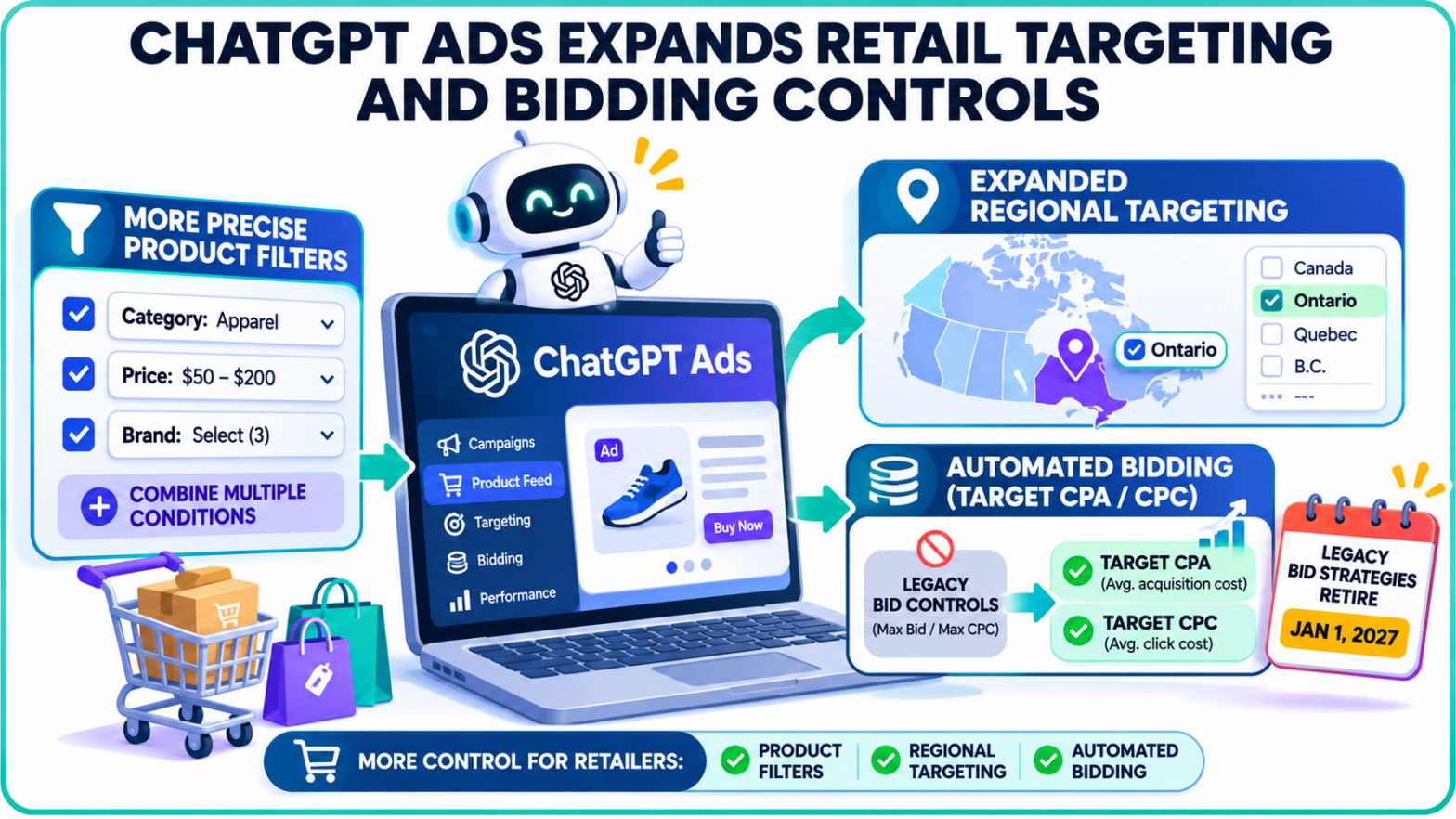
Advertisers are gaining more control over which products appear in ChatGPT ads. But they're losing direct control over how much the platform bids in individual auctions.
OpenAI's latest advertising updates bring more flexible product filtering, newly announced regional targeting options and automated bidding strategies built around average acquisition and click costs. The changes follow the November 9 rollout of Target CPA and Target CPC, with the older maximum-bid strategies scheduled to disappear on January 1, 2027.
For e-commerce advertisers, the distinction is significant. Campaign setup can become more precise about inventory and geographic coverage, while bidding decisions increasingly depend on OpenAI's automated delivery system.
The latest additions also expose a documentation gap. OpenAI's November 12 advertiser update describes expanded regional targeting for product feeds, but its public campaign guidance still lists country-level restrictions for new product-feed campaigns.
Retailers Can Apply More Precise Product Filters in ChatGPT Ads
Uploading an entire catalogue doesn't mean every product belongs in the same advertising campaign.
A retailer might want to advertise winter clothing separately from summer inventory, exclude lower-margin products or build campaigns around particular brands. Until now, ChatGPT Ads offered product filtering, but advertisers had less flexibility in combining conditions on individual product attributes.
The November 12 update expands those controls.
Advertisers can now combine multiple conditions on the same product field when defining the products eligible to appear within an ad group.
Consider a retailer carrying products across several price categories. More flexible filtering could help the business build a product set around a defined price range rather than relying on a broader catalogue selection.
The capability adds another layer to ChatGPT product feed campaigns, which allow retailers to generate advertisements using structured catalogue information.
According to OpenAI's product feed documentation, these campaigns use uploaded product information to populate advertisements with relevant titles, descriptions, images and landing pages.
Retailers select a feed, establish product filters and configure an ad template before launching an ad group.
OpenAI also supports custom catalogue labels through the ads_metadata field. Businesses can use those labels to organize products by attributes such as product line or bidding tier.
The new filtering options offer more ways to combine selection criteria without changing the underlying structure of the product catalogue.
There is an operational distinction: product filters determine which inventory can appear in an ad group. They do not independently determine which users will see those ads.
Regional Targeting Is Expanding, but OpenAI's Documentation Hasn't Caught Up
Geographic targeting presents a different challenge for retailers.
A business might serve customers across Canada but offer delivery for certain products only in Ontario. Another retailer could have separate distribution arrangements for different regions.
Campaigns that target an entire country can struggle to reflect those boundaries.
In its November 12 advertiser update, OpenAI described a new ability to target specific regions or markets within a country for product feed campaigns.
The announced feature would let advertisers align eligible audiences more closely with the geographic areas their businesses actually serve.
However, there is an unresolved discrepancy.
OpenAI's publicly available campaign targeting documentation currently states that new product-feed campaigns support geographic targeting and exclusions only at the country level.
Its Ads Manager campaign setup guidance contains the same restriction, even while describing more granular geographic targeting for other campaign types.
Those documents had not been reconciled with the November 12 advertiser announcement as of November 13.
Advertisers should therefore check which locations are available in their accounts rather than assume every newly announced targeting option is operational.
There's another important difference between product labels and audience geography.
An inventory label identifying a product as suitable for Ontario does not automatically restrict the advertisement to Ontario users. Actual geographic delivery depends on the campaign's location settings.
OpenAI's existing targeting guidance makes that distinction explicit.
Target CPA and CPC Replace Fixed Bid Ceilings With Average Cost Goals
The bidding changes affect how advertisers manage campaign spending.
Under the legacy system, Max Bid and Max CPC allowed advertisers to establish ceilings for individual auction bids. The newer strategies give OpenAI's system more freedom to adjust bids while pursuing a specified average cost.
Two approaches are available.
Target CPA applies to conversion campaigns. Advertisers establish the average amount they want to spend on a conversion, such as a purchase or lead submission.
Target CPC applies to click campaigns. Advertisers specify their desired average cost per click.
Neither strategy guarantees that individual results will meet the target.
For example, an advertiser choosing a $40 Target CPA could receive conversions costing more or less than $40. OpenAI adjusts bids and campaign delivery in pursuit of the average goal, but the actual average acquisition cost can still exceed it.
The same principle applies to Target CPC.
OpenAI's official bidding guidance confirms that targets are performance goals rather than fixed prices or maximum charges.
The change also separates bidding strategy from billing method. A campaign optimized for purchases isn't necessarily billed for completed purchases. Charges may still be based on clicks or impressions, depending on the applicable billing configuration.
TechWyse previously covered the transition from maximum bids to Target CPA and CPC, which took effect for qualifying new campaigns on November 9.
The November 12 update reinforces that transition while introducing additional controls for product advertisers.
Intelligent Bidding Keeps Automation at the Centre of Campaign Delivery
OpenAI is also changing the name of its existing automated bidding option.
Maximize Results, previously called Autobid, is now known as Intelligent Bidding.
The underlying approach remains unchanged.
Advertisers define their campaign objective and budget, while OpenAI automatically adjusts auction bids and delivery to pursue the desired outcome.
Unlike Target CPA or Target CPC, Intelligent Bidding does not require an advertiser to establish a specific average-cost target.
The distinction gives advertisers two different ways to use automation: prioritize results within an available budget or guide the system toward a selected average acquisition or click cost.
OpenAI has been expanding these capabilities for several months. Earlier ChatGPT Ads automated bidding updates introduced deeper conversion optimization and more platform-level targeting options.
Conversion data now plays a larger role in determining campaign delivery.
For Target CPA campaigns, OpenAI recommends confirming that the Pixel or Conversions API is receiving the selected conversion events. Its Event Quality Score can help identify data-quality problems, although strong event quality doesn't necessarily indicate sufficient conversion volume.
OpenAI also cautions that aggressive cost targets and weak conversion signals can restrict delivery and leave campaign budgets unspent.
For paid media teams, the practical implication is a shift in daily campaign management. Inventory eligibility, geographic targeting, conversion tracking and recent acquisition costs need to be reviewed alongside automated bidding performance. A lower reported CPA is not sufficient evidence of improvement if the campaign is generating substantially fewer conversions.
January 2027 Brings a Hard Deadline for Legacy Bidding
The transition is already underway for new campaigns.
Since November 9, advertisers have been able to select Target CPA or Target CPC when creating qualifying campaigns or updating existing ones.
Existing campaigns using Max Bid or Max CPC can continue operating during the transition period, but those strategies are scheduled for retirement on January 1, 2027.
OpenAI has also established a separate transition schedule for advertisers using its advertising API.
Beginning November 18, the company recommends using dedicated Target CPA and Target CPC fields when creating campaigns or changing bidding strategies through integrations.
Legacy bidding fields will remain supported through December 31. However, their behaviour changes for certain campaign-creation and ad-group updates beginning November 18.
Values submitted through those older fields for these operations will be interpreted as average-cost targets rather than maximum auction bids.
The distinction matters for advertisers using third-party software or custom campaign-management systems. An integration that continues submitting the same numerical bid value could produce a different bidding configuration.
The legacy fields are scheduled for deprecation on January 1, 2027.
OpenAI has not established that the new strategies will universally reduce advertising costs or improve conversion performance.
The confirmed changes concern campaign controls, bidding methods and the retirement of older settings.
Product filtering is becoming more flexible, regional targeting has been announced but remains inconsistent with public documentation, and average-cost bidding is replacing individual bid ceilings.
The next scheduled milestone is November 18, when legacy API bidding fields begin changing behaviour for specified campaign-management operations.