
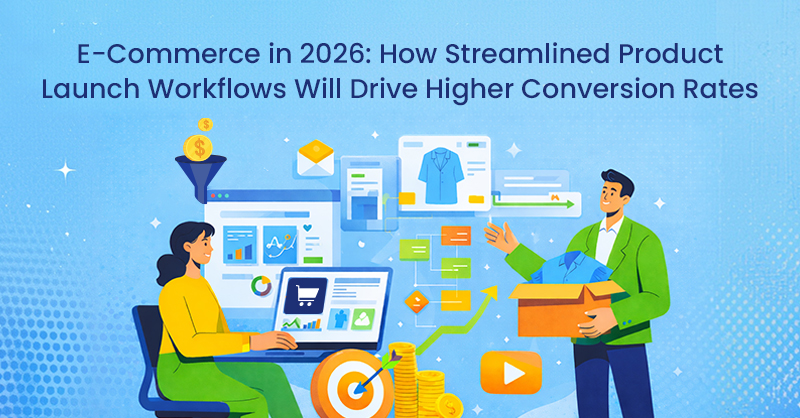
In 2026, a slow or sloppy product launch will cost you more revenue than rising CAC, platform fees, or even increased competition. The brands that will dominate are the ones with better workflows; faster, cleaner, more aligned product launches that convert attention into sales with precision. Not necessarily those with better products.
This is reality. Conversion rates are no longer just influenced by marketing or creativity. They’re influenced by something much more fundamental: how efficiently and accurately you execute the launch itself.
If your team is still launching products through scattered spreadsheets, Slack threads, endless revisions, unclear ownership, and conflicting deadlines, you’re losing money you don’t even realize you’re losing. A streamlined product launch workflow is now one of the most powerful conversion levers in e-commerce, and it will be the difference between market leaders and everyone else.
Let’s break down exactly why.
The Evolution of Product Launch Workflows: From Chaos to Clarity
Why Traditional Launch Processes Are Breaking Down
A decade ago, product launches were simpler. Fewer channels, fewer moving parts, fewer stakeholders. Today, the landscape is unrecognizable. Launching a product now requires coordinated execution across ecommerce platforms, marketplaces, paid channels, organic content, email marketing campaigns, influencers, SEO, and retail partners. Every channel has its own formats, rules, and timing requirements. Every team has its own priorities. Every stakeholder has a different interpretation of “ready.”
The result? Chaos disguised as productivity.
Where Most Teams Still Struggle
If your team is struggling with task trackers, Google Docs, Slack pingstorms, and version chaos in multiple drives or folders, you’re not alone. The old way of launching products simply doesn’t work anymore. It’s too slow, too fragmented, and too error-prone.
How 2026 Marked a Turning Point
Between 2024 and 2026, ecommerce teams began embracing AI forecasting, no-code automation, centralized content hubs, multi-channel publishing systems, and real-time performance dashboards. Suddenly, workflows that once required a dozen tools and countless manual steps became streamlined, predictable, and dramatically faster. And because they were faster and more consistent, they converted better.
Brands adopting modern workflows have reported launch timelines shrinking, error rates dropping significantly, and conversion rates jumping by double digits during the critical first 30 days of a new product release. This isn’t just operational efficiency. It’s a conversion strategy. Workflow is no longer something that sits behind the scenes. It’s now a front-line growth driver.

Source: Freepik
What a Streamlined Product Launch Workflow Actually Looks Like
The Central Command Center That Replaces Chaos
Forget the buzzwords. A streamlined launch workflow isn’t simply “more automation” or “better organization.” It’s a fully unified system where planning, execution, content, communication, and optimization all happen in one coordinated flow.
The first major component is a centralized command center. This single hub becomes the source of truth for your entire launch. Every task, asset, deadline, dependency, and status update lives inside one environment. Instead of switching between ten different platforms, your team works together in one cohesive space. Clarity replaces confusion. Accountability replaces guesswork. Momentum replaces bottlenecks.
You can use workflow platforms like Notion or Monday to consolidate tasks, assets, deadlines, and approvals into a single, always-up-to-date command center. These tools allow teams to visualize launch progress, reduce miscommunication, and eliminate the need for dozens of disconnected spreadsheets or document folders. When your entire launch ecosystem operates from one hub, clarity becomes your default operating mode.
AI Automation That Removes Friction
The second component is intelligent automation. Teams aren’t manually building checklists anymore or trying to remember every step they need to complete. AI generates the launch plan automatically, based on the product type, category, and historical data from your past launches. It assigns deadlines, flags missing assets, adjusts timelines when delays occur, and triggers approval flows without human intervention.
Many teams build their first automation layer using tools like Zapier or Make, which let you automate repetitive workflows without touching a line of code. Things like assigning tasks, triggering approvals, updating databases, or syncing content between apps can all happen automatically through effective workflow automation, reducing manual effort and improving launch speed. Even light automation dramatically cuts launch overhead and frees your team to focus on creative work that actually moves conversion.
A Single Source of Truth for All Content
Next comes content consistency. If you’ve ever discovered four versions of a product description or contradictory feature lists in different channels, you know how damaging inconsistency can be. Streamlined workflows eliminate this entirely. Nowadays, brands store their product information, creative assets, descriptions, titles, and messaging in a single unified content hub. Any update you make pushes instantly across Shopify, Amazon, Walmart, TikTok, Meta, Google, and email tools.
Elevating this consistency further becomes easier when businesses integrate a 3D product configurator, allowing customers to view and customize products in real time while ensuring every detail and variation is automatically synchronized across every sales channel.
Predictive Readiness and Conversion Insights
Finally, streamlined workflows offer real-time readiness scoring and predictive analytics. This means the system can assess your launch before it happens, evaluating asset completeness, listing strength, SEO alignment, inventory sufficiency, and anticipated conversion performance.

Source: Freepik
Why Streamlined Workflows Drive Higher Conversion Rates
Speed: The Most Underestimated Conversion Lever
Here’s where everything comes together. Conversion lift is no longer driven solely by creative excellence or ad optimization. Streamlined workflows produce higher conversion because they make brands faster. Faster time-to-market translates directly into more revenue. Trends move fast. Competitors move faster. If your launch takes twelve weeks and theirs takes six, you lose visibility, momentum, and potential customers.
Accuracy: How Clean Data Builds Trust
The second driver is accuracy. Inaccurate or incomplete product data creates friction that destroys conversion. When specs are unclear, images are inconsistent, or descriptions don’t align across platforms, customers hesitate. And hesitation kills sales. Clean, consistent data reduces returns, improves marketplace ranking, and helps algorithms correctly categorize your product so it’s shown to the right shoppers. Even small fixes, like standardizing dimensions or aligning feature bullets across channels, can lift conversion noticeably, because customers feel confident they know exactly what they’re buying.
Consistency: The Secret to Storytelling That Converts
The third driver is creative consistency. A cohesive message across all channels, ads, listings, landing pages, and emails builds trust and accelerates purchase decisions. When customers see the same promise, the same benefits, and the same visual identity everywhere they interact with your brand, their confidence skyrockets. Inconsistent messaging, on the other hand, forces shoppers to stop and interpret, and every moment of interpretation is a moment where conversion drops. Consistent storytelling creates memory. When the same narrative hits them on TikTok, Google, Amazon, and email, recall builds, and recall is what makes buyers return, recommend, and ultimately choose you over similar products with louder but less coherent marketing.
Predictability: Fewer Surprises, Better Customer Experiences
The final driver is operational predictability. Conversion doesn’t end with the click; it carries through fulfillment, communication, and the overall customer experience. A huge part of operational predictability is having all supplier information locked in early. Many teams still waste days chasing specs, images, and requirements from multiple suppliers, and every missing detail becomes a potential launch delay. Tools like Content Snare make this painless by gathering all those assets automatically, organizing them in one place, and following up with vendors so your team doesn’t have to. When supplier inputs arrive complete and on time, launches run smoother, and customers feel the impact of clearer listings, faster shipping, and fewer post-purchase surprises.
Inside a 2026 Product Launch Workflow: A Step-by-Step Breakdown
Step One: AI-Driven Pre-Launch Intelligence
- Every successful launch starts with clarity. AI evaluates search demand, competitor activity, customer sentiment, pricing opportunities, and seasonality to identify where the product can gain a competitive advantage.
- It highlights revenue potential and pinpoints the messaging angles and differentiators most likely to convert.
- This early intelligence gives teams a strategic foundation (not guesswork) to build the launch on.
Step Two: A Unified GTM Brief
- Once the insights are in place, AI generates a unified, ready-to-execute GTM brief so every team starts aligned.
- It assembles audience insights, keywords, positioning, visuals, messaging frameworks, and timelines into one shared source of truth.
- Because everyone is rowing in the same direction from day one, creative rework drops dramatically, and execution moves faster.
Step Three: High-Speed Content Creation and Distribution
- With a clear brief, AI accelerates content development by drafting PDP descriptions, titles, landing-page sections, emails, and ad variations in minutes, and this process becomes even faster when teams use an AI ad maker to instantly generate platform-ready creatives.
- It also supports visual creation or enhancement, giving teams polished image sets without the typical bottlenecks.
- Everything is formatted automatically for each channel, ensuring accuracy at scale, and when paired with a strong SEO strategy, this jump-starts visibility and traction immediately.
- This stage flows even faster when supplier materials, such as specs, images, and requirements, are collected and organized upfront instead of trickling in late.
Step Four: Execution With Real-Time Monitoring
- After launch, a centralized command center tracks listing quality, search rankings, ad performance, inventory levels, and customer signals as they happen.
- If something breaks or underperforms, the system catches it instantly, enabling proactive fixes that preserve momentum and prevent conversion drop-offs.
Step Five: Rapid Post-Launch Optimization
- The first 72 hours determine the trajectory of the entire launch. High-performing teams use this window to refine pricing, adjust messaging, rotate creative, and reallocate budget based on what’s resonating.
- Analytics tools like Google Analytics 4 reveal friction points in real time, showing exactly where customers hesitate and where your team should adjust next.
- Fast insights fuel fast improvements, and those early optimizations compound into significantly higher conversion throughout the launch cycle.

Source: Freepik
What Streamlined Workflows Look Like in the Real World
It’s easy to talk about workflow efficiency in theory. It’s a different story when you see what happens inside real brands once the chaos disappears and launches finally run the way they’re supposed to. Here’s how streamlined workflows are reshaping outcomes across e-commerce.
How a DTC Brand Increased First-Week Revenue
A fast-growing DTC apparel brand slashed its launch timeline from twelve weeks to seven by pulling every task, asset, and approval into a single workflow hub. No more wandering across spreadsheets or waiting for missing files. Once the team moved in sync, they hit seasonal trends earlier, executed cleanly, and captured a surge of demand that had previously slipped past them.
How a Marketplace Brand Cut Listing Errors
A home goods marketplace seller had long battled mismatched listings across Amazon and Walmart. Descriptions didn’t match, specs drifted, and assets lived in a half-dozen folders. When they switched to a centralized content hub, everything was updated from one source of truth. Listing errors dropped nearly overnight, search ranking improved, and conversion lifted across their top SKUs. The brand didn’t overhaul its strategy; it simply removed the friction that had been sabotaging it quietly for years.
How a Beauty Brand Boosted Conversion
A beauty company running campaigns across twelve channels struggled to keep messaging aligned. Social posts said one thing, ads said another, and the PDP didn’t match either. Once they adopted a unified workflow system, every channel finally pulled from the same brief and the same assets. Storytelling tightened. Click-through rates climbed. Customers felt a coherent narrative instead of scattered signals. Conversion rose, powered entirely by consistency.
The Metrics That Prove Workflow Drives Conversion
If you want to measure workflow impact, start with time to market. Shorter timelines almost always correlate with higher conversion. To understand the true effect of your workflow changes, consider measuring incrementality, tracking the additional lift in conversions or revenue generated beyond what would have occurred naturally. Next, track listing accuracy and completeness. Fewer corrections mean less lost revenue.
Monitor SKU-level conversion before and after workflow optimization. The changes will be obvious. Watch return rates and customer complaints because they drop when your content becomes clearer and your operations more predictable. Finally, evaluate internal efficiency metrics such as approval times and revision cycles. Streamlined workflows improve all of them.
How E-commerce Teams Can Streamline Their Launch Workflow
Let’s sum up what your next steps should look like. Think of workflow optimization as a transformation, not a tune-up. Start by mapping your launch process from end to end; not to document what’s happening, but to expose what shouldn’t be happening. Look for the moments where work stalls, information gets lost, or teams make assumptions instead of decisions. Those friction points become your roadmap.
From there, build a single operational backbone that everything plugs into. Your goal is simple: one place where launches live, one place where truth lives, one place where progress is visible. When the entire team shares the same view, execution automatically becomes cleaner.
Then layer in automation with intention. Don’t automate for efficiency alone; automate to remove human error, eliminate rework, and keep launches moving even when teams are busy. The best automations are the invisible ones: the reminders you no longer have to send, the tasks you no longer have to assign, the updates that happen on their own.
Finally, shift from reactive planning to predictive decision-making. Use insights to sequence launches more intelligently, allocate resources to the SKUs with the highest upside, and proactively spot risks before they cost you time or conversion.
Conclusion
The brands that win in 2026 won’t be the ones with the biggest teams or the flashiest ads. They’ll be the ones with the best workflows.
Streamlined product launch workflows influence everything that matters to conversion: speed, consistency, accuracy, customer experience, and the ability to optimize quickly.
If you want higher conversion rates this year, don’t just tweak your ads or refresh your creativity. Fix your workflow. It’s the most overlooked and most profitable lever in e-commerce today.
For the latest digital marketing news, check out our blog. To book an appointment, call 866-208-3095 or contact us here.