
You’ve built an email list, set up automations, and planned a campaign. Before you press send, though, you need to know whether each contact gave your business permission to hear from you through that channel.
Two of Canada’s key privacy and electronic marketing laws set the rules behind that question. PIPEDA, along with substantially similar provincial privacy legislation in some provinces, governs how personal information is collected, used, and disclosed. CASL governs when commercial emails and text messages can be sent. Together, they shape the path from a person’s first form submission to every follow-up message that follows.
This guide explains the practical side of PIPEDA and CASL for marketers: how to collect and document consent, maintain usable contact records, and build email and SMS workflows that support compliance.*
What PIPEDA and CASL Mean for Your Email and SMS Marketing
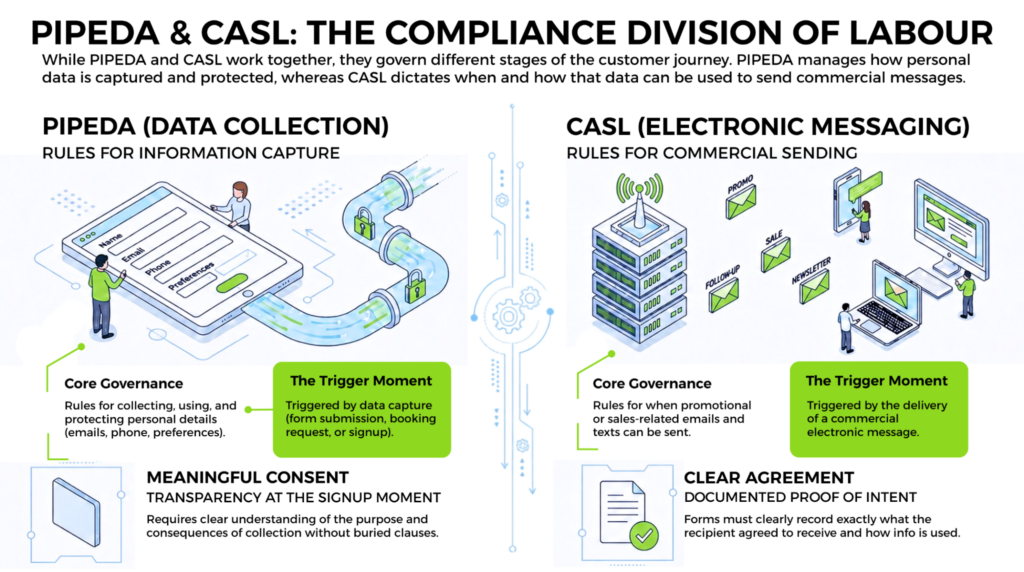
PIPEDA sets rules for how your business collects, uses, and protects personal information, such as names, email addresses, phone numbers, inquiry details, and preferences. CASL sets rules for when you can send promotional or sales-related emails and text messages.
In practical terms, PIPEDA applies when someone shares their information through a form, booking request, newsletter signup, or similar interaction. CASL, on the other hand, comes into effect when you use that information to send a commercial message. Your forms and contact records should make it clear what the person agreed to receive and how their information will be used.
PIPEDA also requires meaningful consent. People should understand the nature, purpose, and consequences of the collection, use, or disclosure they’re agreeing to. For marketers, the key information should appear close to the signup moment: what information is being collected, why it’s being collected, how it will be used, and what choices the person has. A buried sentence in a privacy policy isn’t enough to make the process clear.
What Happens When Your Compliance Records Are Weak
Weak compliance practices create legal and operational risk at the same time. If the permission record is missing, the business may not be able to prove that a contact agreed to receive commercial electronic messages. CASL places the burden of proof on the sender, so “but they were in our database” isn’t a strong defense.
When records are unclear, your team may need to exclude contacts, pause SMS sends, or manually clean lists before a campaign. That creates extra work and makes it harder to communicate confidently with people who have already expressed interest in your business.
How to Build a PIPEDA- and CASL-Compliant Email & SMS System
A PIPEDA- and CASL-compliant marketing system is a lot easier to manage when obtaining permission is built into the workflow before campaigns are planned.
The idea isn’t to make every form long and complicated and full of intricate legal jargon (looking at you Terms and Services Agreements no one ever reads) but to ensure the consent of every contact is recorded consistently across your CRM, email and SMS platforms, and unsubscribe system.
Step 1: Designing Compliant Lead Capture
Start where a person shares their information. This could include:
- A newsletter signup form
- A lead magnet download
- A quote request form
- An appointment booking form
- A webinar registration page
- A checkout or purchase page
- A local service inquiry form
Use plain opt-in language that tells people what they’re signing up for. If they’re only requesting a quote, don’t secretly add them to a promotional newsletter. If they’re signing up for SMS appointment reminders, don’t treat that as permission for promotional texts unless the form clearly explains it.
Practical opt-in language could look like this:
The examples below illustrate consent wording only. A CASL-compliant request for express consent must also include the prescribed identification and contact information.
“Yes, I agree to receive marketing emails from [Business Name], including tips, offers, and updates. I can unsubscribe at any time.”
“Yes, I agree to receive text messages from [Business Name] about promotions and service updates. Message and data rates may apply. I can opt out at any time.”
Keep email and SMS opt-ins separate where possible. People may be comfortable receiving emails but not texts, or they may want transactional SMS reminders without agreeing to promotional SMS campaigns.
Separate choices create clearer records and better segmentation.
Compliant lead capture checklist:
- Use an empty checkbox or other clear opt-in action.
- Don’t use pre-checked boxes for express consent.
- Explain what the person will receive.
- Separate email and SMS opt-ins where the channels have different uses.
- Link to the privacy policy close to the signup point.
- Store the opt-in event in the CRM or marketing platform.
Step 2: Documenting Permission Clearly
Because CASL requires senders to prove consent, documentation needs to be part of your marketing workflow right off the bat.
At minimum, your system should record:
- The date and time permission was given
- The form, page, event, checkout, or source where permission was collected
- The exact opt-in language shown at the time
- The approved channel, such as email, SMS, or both
- Whether the consent was express or implied
- The contact’s unsubscribe or opt-out history
Keep these records in one reliable place. If your opt-in wording changes, retain a record of the version each person saw when they signed up.
Step 3: Structuring Your CRM for Compliance and Performance
Your CRM should do more than store names and contact details. Before you send a campaign, it should help your team quickly confirm who is eligible to receive it and who opted out.
Include fields that help your team confirm who can receive a campaign, segment contacts, and understand each lead’s source:
- Email permission status
- SMS permission status
- Permission source
- Permission date
- Implied consent expiry date, where applicable
- Lead source
- Customer type
- Service or product interest
- Last engagement date
- Unsubscribe status
This structure helps prevent avoidable mistakes. A landscaping company, for example, could segment contacts by “lawn care inquiry,” “maintenance customer,” and “newsletter opt-in” rather than send the same spring promotion to every email address in its database.
Clear contact records can also help you avoid showing ads to existing customers or people who have opted out, while making it easier to see which marketing efforts lead to qualified inquiries.
Step 4: Sending Emails and SMS Within CASL Rules
Before sending an email or text as part of a marketing campaign, confirm that the person can receive it and that the message meets CASL requirements. You need to answer three questions:
- Do you have valid permission?
- Does the message identify who is sending it?
- Does the message include a clear unsubscribe mechanism?
Consent can be either express or implied. Express consent means the person has clearly agreed to receive commercial electronic messages. Under CASL, that consent doesn’t expire unless the person explicitly withdraws it.
Implied consent only applies in specific situations. A common example is an existing business relationship, such as a recent purchase, contract, inquiry, or application. Government of Canada and CRTC guidance notes that implied consent is generally time-limited: certain purchases or written contracts may support implied consent for up to two years, while inquiries or applications may support it for up to six months.
If you aren't sure whether implied consent applies, it’s safer to ask for express consent through a proper opt-in process.
Better safe than sorry.
Each promotional message should clearly say who it’s from and include up-to-date contact information. The unsubscribe option should be easy to find, simple to use, and processed within 10 business days (i.e. don't make people hunt for* *that unsubscribe link, then click through ten different "are you SURE you want to unsubscribe?" questions only to still be receiving messages from you for the next month).

“For the last time, YES I am sure I want to unsubscribe!”
Source
On the back end, unsubscribe data should also stay in sync across your email, SMS, CRM, and other marketing tools instead of being stored in just one place.
Step 5: Building Lifecycle Campaigns With Compliant Data
Once permission is documented properly, you can send more relevant follow-ups based on the channel a person chose, what they asked about, and where they are in their relationship with your business. For example:
- Welcome emails for new subscribers
- Quote or consultation follow-ups
- Post-purchase or post-service education
- Renewal, reactivation, or seasonal campaigns for eligible contacts
Common Compliance Mistakes That Hurt Marketing Performance
Most compliance problems begin when a business collects contacts without a clear process for documenting consent, managing opt-outs, and sending relevant follow-ups.
Treating Consent as a One-Time Checkbox
Obtaining consent isn’t just about adding a checkbox for contacts to select. It’s about building a reliable system that records and carries each person’s permission status across campaigns.
If someone opts into email, that status should follow them through each system that uses it. If they later unsubscribe, the change should also be applied everywhere. This ensures every campaign uses the same up-to-date consent record, regardless of the point of contact's opt-in or out.
Using Purchased or Scraped Email Lists
Purchased or scraped email lists are risky under CASL and often perform poorly. Most people on these lists haven’t asked to hear from your business. Even if an email address is publicly available, that doesn’t automatically give you permission to use it for marketing. CASL allows this only in specific situations, and the message must relate directly to the person’s professional role or responsibilities.
These lists can also hurt your sender reputation. Low engagement, spam complaints, and high bounce rates can make it harder for your emails to reach people who genuinely opted in.
Over-Messaging Without Segmentation
Even when a business has permission to send, over-messaging can wear down an audience. People unsubscribe when messages are way too frequent, irrelevant, or disconnected from what they originally signed up to receive.
Segmentation helps protect engagement and list quality. Instead of sending every campaign to every contact, build segments based on interest, lifecycle stage, location, purchase history, service inquiry, or engagement level.
Campaigns stay more relevant, and your team doesn’t have to lean as heavily on any one channel.
Why Compliant Marketing Performs Better
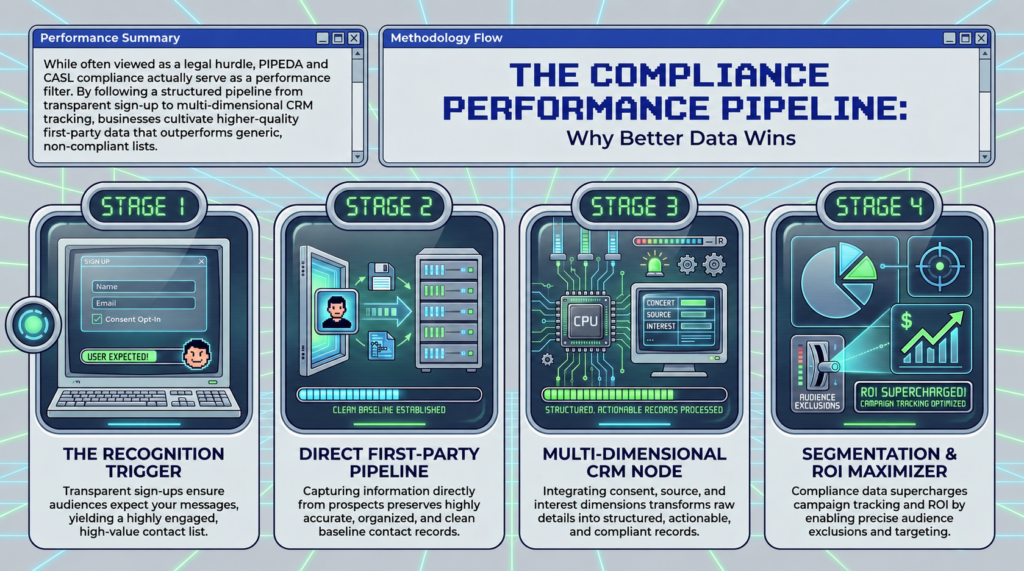
When people understand what they’re signing up for, they’re more likely to recognize your business and expect the messages they receive. A smaller list of engaged contacts is usually more valuable than a larger list with unclear permission or little interest.
First-party data is information your business collects directly from customers and prospects. When it’s kept accurate and organized, it can improve audience segmentation, campaign tracking, and reporting.
For example, a CRM that tracks consent, lead source, service interest, and lifecycle stage can show which campaigns generate qualified leads, which customers return, and which audiences should be excluded from acquisition campaigns.
Make PIPEDA and CASL Work for Your Marketing Strategy
PIPEDA and CASL requirements should guide how consent is collected, recorded, and used in every campaign. Opt-in forms should clearly explain what people are agreeing to, and your records should show when and how consent was given. Any later changes should also be reflected in your email and SMS tools.
To confirm that consent is being handled consistently, review whether those records are transferred accurately to your CRM, campaign tools, and unsubscribe system. This can reveal unclear opt-ins, outdated records, and cases where the messages a person receives no longer match the permission they gave.
When compliance issues do come up, addressing them is often more complex than updating a single platform. TechWyse helps businesses identify and fix gaps between their website, CRM, campaign platforms, and reporting.
Our team combines digital strategy, content marketing, automation, tracking and measurement, paid media, and conversion-focused website development to improve how customer information is collected and used. By connecting the tools behind your campaigns, we can help you build a more reliable email and SMS process that respects each contact’s consent preferences.
Book a 20-minute strategy call, call us at 866-208-3095, or get in touch with the TechWyse team to discuss how your email and SMS systems can manage consent more consistently.
FAQ
What is the difference between PIPEDA and CASL for marketers?
PIPEDA applies to the collection, use, and disclosure of personal information. CASL applies to commercial electronic messages, including many marketing emails and promotional texts. For marketers, PIPEDA affects the data collected through forms, signups, and CRM activity, while CASL affects whether and how that contact can receive a commercial message.
Do I need consent for every email in Canada?
For commercial electronic messages, yes. CASL generally requires express consent or valid implied consent before a business sends marketing emails or texts. Some messages may fall outside CASL’s commercial electronic message rules or fit specific exemptions, so businesses should confirm the context before they send.
What is meaningful consent under PIPEDA?
Meaningful consent means people can reasonably understand what information is being collected, why it’s being collected, how it will be used or shared, and what choices or consequences are involved. In marketing, that information should be clear at the point of signup.
Can I send SMS messages under CASL?
Yes, but promotional SMS messages are commercial electronic messages when they are sent to an electronic address for a commercial purpose. Businesses need proper consent, sender identification, and a clear opt-out method.
What counts as proof of permission?
Useful proof may include the timestamp, source, method, form language, selected channel, and supporting records such as a completed electronic form, signed consent form, or recorded verbal consent. The key is being able to show what the person agreed to and when.
How quickly do unsubscribe requests need to be handled?
CASL guidance says unsubscribe requests must be actioned within 10 business days and at no cost to the recipient. In practice, unsubscribe data should stay synchronized across email, SMS, CRM, and audience tools instead of sitting in one platform.
Should email and SMS opt-ins be collected separately?
Yes. In many marketing systems, separate opt-ins are clearer. A person may agree to marketing emails but not promotional texts, or they may want transactional SMS reminders without agreeing to promotional SMS campaigns. Separate choices make the records easier to manage.
*This blog is intended for general informational purposes only and does not constitute legal advice. Laws and compliance requirements may vary by situation, so consult a qualified legal advisor for guidance specific to your business.