
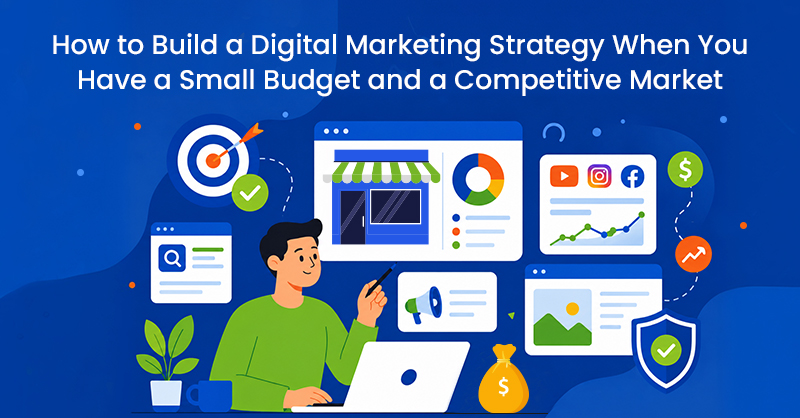
If you run a small business, you already know the market is crowded, and attention costs money. Your customers still start their search online and expect fast answers.
BrightLocal's latest survey found that most consumers (97%) read online reviews when considering local businesses. And many do it regularly. That shift in behaviour means digital marketing stays essential even when cash is tight.
Competing doesn't mean outspending. It means outsmarting. With a clear plan and smart tools, you can compete with bigger players.
This page helps you stay up to date on digital marketing trends in 2026. Learn how to build a cost-effective online strategy that stretches your limited budget in a competitive market. Read on…
1. Understand your market and audience
Conduct market research
Understanding your target market and audience will help you plan your digital marketing strategy. And implement various tactics more efficiently and effectively.
- Start with the basics. Who already serves your customers? What promises are they making? Where are the gaps? A quick way to get there is mixing hands-on observation with free or low-cost tools.

- Google Trends shows search interest patterns and seasonality (see above what’s trending in the U.S. as of the time of writing).
- Find keywords with Keyword Planner and People Also Ask queries.
- Check competitor messages via Facebook Ad Library and their social feeds.
- Layer this with first-hand input. Patterns show up fast when you listen.
- Read your own support emails and reviews.
- Talk to five customers.
- Ask prospects why they didn't buy.
Gregor Emmian, Deputy Chief Digital Growth Officer at Rise, helps brands scale through data-driven digital growth strategies. He says businesses often waste budget when they market based on assumptions instead of actual customer behavior.
Emmian adds, "Strong market research gives you clarity on what your audience actually cares about. Where competitors fall short. What messaging drives action. When you understand those insights early, you can focus your budget on strategies…that are far more likely to convert."
Define your target audience
Personas don't need to be 20-page PDFs. Use the data you have to sketch out who buys and why. Pull customer lists and look for commonalities. Check GA4's insights for locations and devices. Scroll social comments. Then write it down in simple language:
- Who are they? – Job, role, life stage
- What do they need? – Goals, jobs to be done
- What slows them down? – Fears, objections, constraints
- Where do they hang out online? – Channels, groups, communities
- What triggers action? – Events, seasons, problems that make them search
The tighter your audience definition, the less money you waste on messages that miss the mark.
2. Set clear goals
S.M.A.R.T goals
Vague goals burn budgets. Set S.M.A.R.T goals so you know if you're winning. Here’s how, for instance:

Image source: Generated by the author via ChatGPT
- Specific: "Getting 43 demo requests from organic search"
- Measurable: "Increasing newsletter signups by 27%"
- Achievable: "Cut cost per lead to under $18 in 62 days"
- Relevant: "Growing qualified leads from our top three service pages"
- Time-bound: "Within this quarter."
Clear targets keep you honest and help you say no to distractions. They make it easier to ask for more budget later because you can show results.
Prioritize marketing channels
With limited funds, you can't be everywhere.
Pick two or three channels for a unified marketing plan. However, make sure they align with where your audience actually spends time and where you can consistently produce content. Use a simple scorecard: impact potential, cost to execute, your confidence, effort required. Then stack-rank.
Smart channel selection changes the game for small businesses. Deep engagement on fewer channels beats superficial presence everywhere.
For instance, mix email and social:
- Email often gets overlooked but still pulls its weight: Industry research continues to show strong returns for email marketing relative to cost. Especially when you nurture leads with helpful content. Litmus highlights email's consistently high ROI.
- Social remains essential, too: People still spend hours there daily, so choose the platforms that fit your audience and voice. Datareportal's 2024 report estimates that people spend more than 2 hours per day on social media (see below).

3. Craft a cost-effective marketing strategy
Content marketing that compounds
Content is your compounding asset. Start with one anchor piece per month that answers a high-intent question your customers actually ask. Make it practical and specific. Then squeeze every drop of value out of it.
Bryan Henry, President of PeterMD explains, "A single blog post becomes social media updates and email newsletters. This approach multiplies your impact while keeping production costs minimal. When every piece of content works across several touchpoints, small businesses can stay visible and consistent without constantly creating from scratch."
A simple flow:
- Writing a 1,200-word how-to post with the goal of solving one problem
- Recording a short video with the hope of summarizing the steps with your phone
- Breaking the post into five to seven social posts and one newsletter
- Pulling a checklist or template from the post for offer as a free download
SEO on a budget
You don't need a big SEO budget to see traction. You do need consistency and a few fundamentals.
- Find intent-rich keywords with free sources – Google Autocomplete, People Also Ask, Keyword Planner, and AnswerThePublic or AlsoAsked.

- Nail on-page basics: Include one primary topic per page, descriptive title tags, clear H1’s, scannable subheadings, internal links to related content, and helpful meta descriptions
- Make pages fast and accessible. Compress images. Avoid heavy scripts, Run audits with PageSpeed Insights.
- Build local SEO. Claim and optimize your Google Business Profile. Add photos, keep your hours current, as well as earn consistent citations on Yelp for Business and Bing Places. Ask happy customers for reviews after a good experience.
Free SEO tools and consistent optimization practices level the playing field. Focus on crafting descriptive title tags, building local citations, and creating content that answers your customers' questions. These fundamentals often outperform expensive tactics.
But it’s also timely to build a multimodal SEO strategy (for voice, visual, AI search). That’s why you have to level up your tactics.
For example, if you're feeling ambitious, add basic schema markup to key pages so search engines can better understand your content. The Schema Markup Generator can help:

Social media that builds community
Social media marketing remains all the more relevant in 2026. However, think of social as community first, content second. Pick where to show up based on where the right people already are.
What to do:
- Picking one primary platform and one secondary
- Creating two or three content pillars you can sustain
- Engaging daily for 10–15 minutes
- Inviting user-generated content (UGC) with simple prompts and small spotlights
- Testing low-budget boosts only when a post already gets organic traction.
Not every post needs to sell. Most should help, teach, inspire, or prompt action. Sales happen when trust builds.
4. Measures what matters
Track your campaigns
It’s crucial to measure your digital marketing tactics. However, you have to do this consistently by leveraging tools and aligning with trends. Think of how social search, AI content, and user behavior are reshaping your strategy.
Remember: If you can't measure it, you can't improve it. Set up analytics before you launch anything. Even if your plan is simple.

- Install Google Analytics 4 (GA4 as shown above and create key events.
- Connect Google Search Console to monitor search queries and pages.
- Use UTM parameters on every campaign link so you know what worked.
- Set up basic dashboards to see performance at a glance.
Short list of metrics that tie back to your goals:
- Traffic and engagement to your key pages
- Conversion rate and cost per lead or sale
- Lead quality signals (reply rate, booked calls, pipeline value)
- Search queries that actually drive clicks and conversions
Jason Ledbetter, Operator at Jason Ledbetter, works closely with businesses on improving operational efficiency and performance tracking. He recommends consistently reviewing marketing metrics to inform smarter decisions.
Ledbetter shares, "Data reveals where your marketing dollars actually create value. Set up proper tracking from day one and review your metrics weekly. This habit helps you quickly shift resources from underperforming tactics to those driving real growth.
He concludes, “The businesses that grow fastest are usually the ones paying closest attention to what the numbers are telling them."
Test, learn, repeat
Treat your plan like software (not stone). Run small tests. Learn. And do more of what works.
What to do:
- Testing one variable at a time: headlines, offers, formats, etc.
- Revisiting your search queries monthly and creating content around new opportunities
- Shifting budget and attention toward the channels showing the clearest path from click to revenue
- Keeping a simple experiment log so your team remembers what you tried and what you learned
This steady approach builds results without risking your whole budget on a single bet. Of course, you can leverage data analytics for your digital marketing strategy to make the entire process much easier and faster. And more results-oriented!
Small budgets work when you know your audience better than anyone. When you set goals you can measure. And when you build helpful content you can repurpose.
Stick to SEO fundamentals. Show up on social media where it counts. Track everything and keep improving. With that rhythm, even a modest budget can drive real growth month after month.
Final Thoughts
Small budgets don’t limit growth. However, the lack of clarity does. When you set SMART goals and focus on the right channels, every action starts working harder for you.
The real advantage comes from discipline: Measuring what matters. Doubling down on what works. And improving a little every cycle. Over time, those small optimizations compound into sustainable growth.
If you want expert support in building a cost-effective and performance-driven digital marketing strategy, explore TechWyse Internet Marketing. See how a data-backed approach can help you grow faster without wasting budget. Get in touch with them today!