
Content teams are working in a market that no longer rewards volume alone. Automation is integral, but the best way to use it is changing. As more users turn to AI assistants and answer engines for direct responses, the challenge is no longer publishing faster. It is building a system that scales output while protecting clarity and brand control.
In practice, that means moving beyond disconnected tools and lightweight automations. Stronger teams are building operating models that combine machine speed with human direction, editorial standards, and tighter feedback loops.
This article breaks down what that looks like in 2026, where the old model is falling short, and how content teams can design workflows that improve discoverability, governance, personalization, and performance over time.
Why the Old Content Model Is Losing Ground
The older organic model assumed that publishing more pages, ranking for more queries, and driving more clicks would steadily expand visibility. That logic is weaker now. AI-generated answers compress attention, providing summaries that make site visits unnecessary. They also reward material that is structured clearly enough to be extracted and cited.
Source: Gemini
Understanding Zero-Visit Visibility
Visibility now depends less on page position and more on whether a brand is cited inside AI-generated responses. That creates a new layer of influence that happens before a click, and sometimes without a click at all. Content can still shape trust and consideration, but reporting has to account for that earlier moment of exposure instead of treating sessions as the only sign of impact.
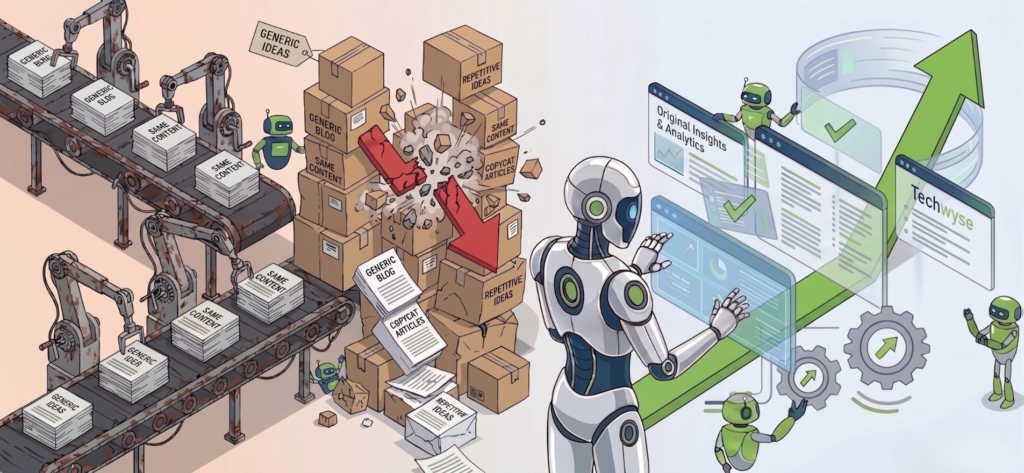
How Generic AI Content Loses Ground
Generic output tends to flatten expertise. It often repeats what is already easy to find, says very little with great confidence, and leaves no memorable perspective behind.
In crowded search and answer environments, that issue is becoming more pronounced as traditional SEO, which relied heavily on clicks and rankings, loses ground. It used to be possible to get passable results with recycled content if it was packaged around the right keywords and search conventions, but answer engines and chatbots work differently.
They interpret meaning with far more depth than traditional search, so when a blog says the same thing as every competing page and adds nothing original, it becomes much less likely to be retrieved or referred to when users ask questions. Teams need sharper editorial standards, stronger positioning, and a consistent point of view if they want automation to support authority rather than dilute it.
Basically, if you want anyone to hear what you're saying, it's time to have an opinion worth listening to.
The Growing Importance of Generative Engine Optimization (GEO) in 2026
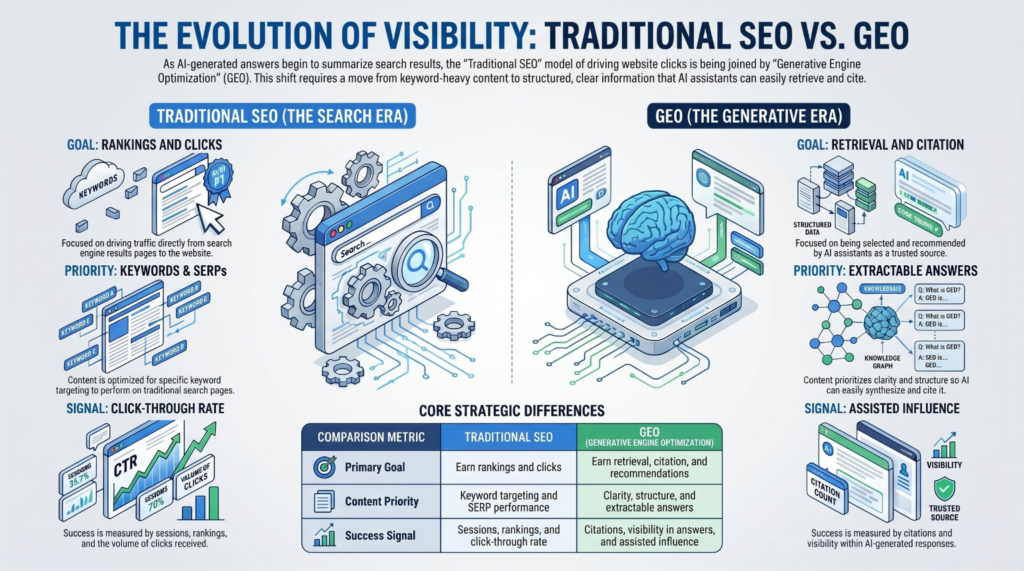
Search still matters, but users are increasingly encountering brands through AI summaries, cited answers, and synthesized recommendations before they ever reach a search results page. While the old adage "write for people, not machines" still holds true, your content still needs to be optimized for AI search platforms.
For GEO, your content should prioritize structure, factual clarity, and topical depth.
Source: Notebook LLM
GEO vs. Traditional SEO
|
Focus |
Traditional SEO |
GEO |
|
Primary goal |
Earn rankings and clicks |
Earn retrieval, citation, and recommendations |
|
Content priority |
Keyword targeting and SERP performance |
Clarity, structure, and extractable answers |
|
Success signal |
Sessions, rankings, click-through rate |
Citations, visibility in answers, assisted influence |
How Semantic Content Clustering Improves Discoverability
Topic clusters help teams cover a subject in a way that reflects how people actually search and how retrieval systems connect related ideas. A strong cluster does more than group keywords. It builds context between the main topic, supporting questions, use cases, and adjacent problems, which improves internal linking and gives each piece a clearer role inside the content system.
What Content Marketing Automation Looks Like in 2026
Many teams have added AI tools, but far fewer have built workflows that actually use them well. That gap helps explain why content operations can feel busy without getting any more efficient. The real opportunity isn't adding more tools. It's building a cleaner, more connected system.
From Basic Automation to Connected Content Workflows
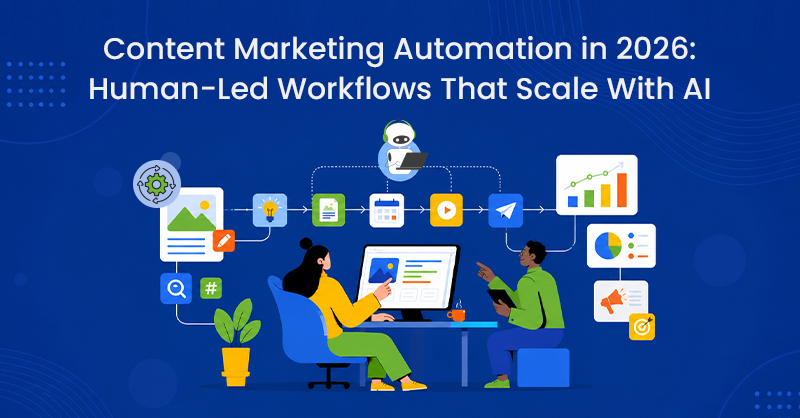
Content marketing automation now involves a lot more than scheduled emails, social media queues, or one-click drafting tools. In mature teams, it acts as a workflow layer that supports planning, briefing, drafting, distribution, and measurement across multiple channels.
The real value comes from coordination. When the system is well designed, each step hands cleaner information to the next one. Older setups handled single tasks in isolation. Newer systems connect multiple actions inside one process, from research and briefs to refresh cycles and performance reviews.
The Ongoing Role of Human Review in AI-Assisted Workflows
The highest-risk decisions still need people. Strategy, source judgement, fact-checking, voice control, and final approval all shape whether a piece of content feels credible or like just another piece of generic AI-slop.
Teams that remove review too early usually get a short burst of speed followed by longer cleanup cycles, weaker authority, and metrics that have their bosses shooting them disappointed looks across the boardroom table during bi-weekly reviews.
Strategy and Intent Mapping
The first step is to map each asset to user intent, funnel stage, and business value. Automation can help here by routing repeatable work, surfacing relevant briefs, and reducing low-value requests. The strategic calls still belong to people, especially when the team is choosing themes, audience priorities, and the commercial role of each piece.
AI-Assisted Production and Content Orchestration
AI is most useful when it supports preparation and coordination. It can speed up source gathering, outline development, brief creation, refresh recommendations, and first-draft assembly. Used this way, it becomes a support layer for editors, strategists, and subject matter experts rather than a replacement for them.
Review, Refinement, and Brand Alignment
Editorial review is where scale becomes quality. This step checks whether the draft is accurate, distinct, on-voice, and aligned with the audience problem it claims to solve. It is also the stage where teams protect originality. Without a formal review layer, fast production tends to drift toward generic language, weak examples, and safe but forgettable framing.
Distribution, Repurposing, and Channel Fit
A useful workflow plans repurposing before the first draft is written. One core asset can become a newsletter section, a sales enablement page, a short-form social series, a webinar talking outline, or a refreshable FAQ. That approach improves efficiency while keeping the messaging tighter, since each version starts from the same central argument.
Measurement and Continuous Improvement
The strongest systems treat reporting as input, not paperwork. Performance should feed directly back into briefs, templates, publishing priorities, and revision rules. Over time, that creates a healthier operating loop in which each release helps improve the next.
Why AI Content Governance Cannot Be an Afterthought
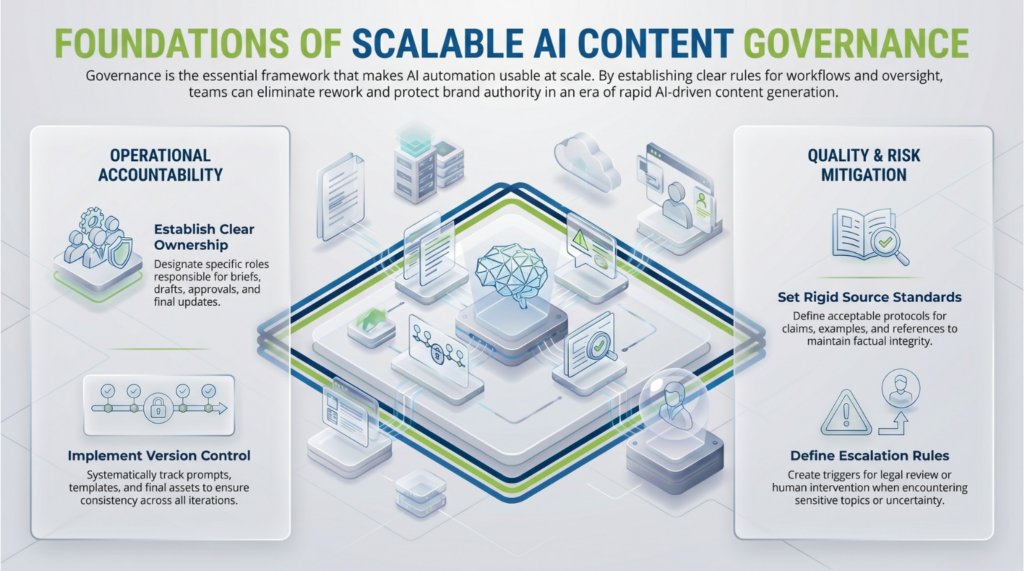
Governance is what keeps automation usable at scale. It sets the rules for who can trigger workflows, which sources are acceptable, how approvals move, what needs human review, and how versions are tracked. Good governance reduces rework because the team isn't stopping halfway through production to debate basic standards.
Core Governance Rules for Hybrid Content Creation Models
Source: Notebook LLM
A practical governance checklist usually includes:
- Clear ownership for briefs, drafts, approvals, and updates
- Source standards for claims, examples, and references
- Version control for prompts, templates, and final assets
- Escalation rules for sensitive topics, legal review, or factual uncertainty
Governance also shapes how well content performs after it goes live. As answer engines place greater weight on clarity, extractability, and trust, teams need quality controls to prevent automation from turning into a volume machine.
Brand Controls Still Matter
As AI-generated content becomes easier to produce, brand controls become more important, not less. Without clear standards for voice, claims, source quality, and review, teams tend to publish material that sounds polished but interchangeable. Strong controls protect against that drift. They help ensure content still reflects the company’s expertise, strategic positioning, and editorial judgement, rather than sounding like a generic summary that could belong to anyone.
What Teams Should Measure Now
Source: Notebook LLM
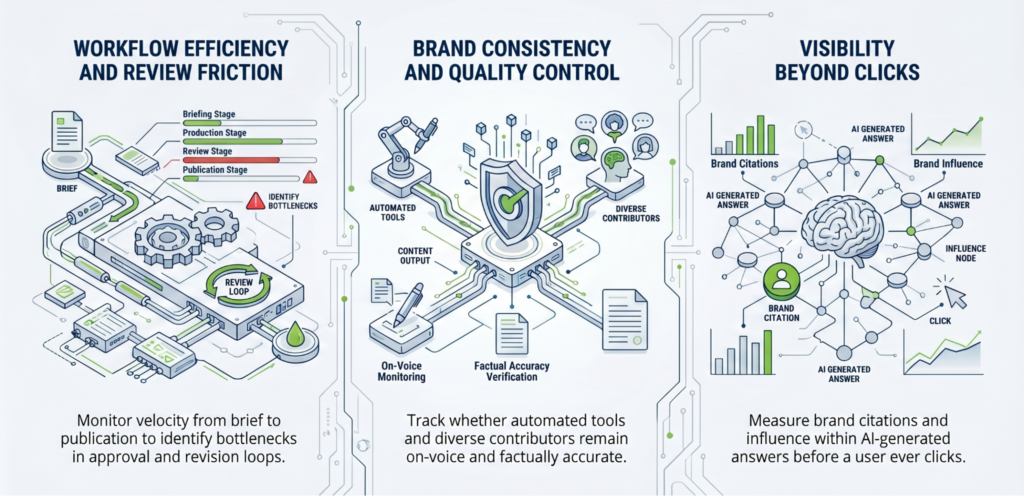
Traffic is still useful, but it is no longer enough on its own. Teams need metrics that show whether the system is getting faster, staying consistent, and earning visibility in AI-assisted discovery.
Workflow Efficiency and Review Friction
Workflow health matters because speed without quality usually creates hidden costs. A velocity metric can show how long it takes to go from brief to publish, where delays occur, and whether throughput is improving. It should also show where review friction is building, whether that happens at approvals, revision loops, or handoffs between teams.
Brand Consistency and Content Quality Control
Consistency matters just as much as speed. Teams need to know whether messaging and tone still hold together as more contributors and tools enter the process. That means tracking whether drafts stay on-voice, whether claims are being checked properly, and whether the finished content still sounds distinct rather than generic.
Visibility Beyond Clicks
Many teams still do not have a reliable way to track how often their content is cited, how visible their brand is across AI platforms, how those citations are framed, or how much traffic arrives from AI-driven discovery. That matters because user influence is starting earlier in the journey.
A brand may shape trust, comparison, and purchase consideration within an answer engine long before a traditional analytics platform records a visit, form fill, or conversion. If teams only measure clicks, they miss part of the picture.
The Future of Human-Led AI Content Marketing
The strongest content systems in 2026 won't be the ones publishing the most or moving the quickest. They'll be the ones that combine machine efficiency with strong editorial judgement, clearer governance, smarter personalization, and better visibility design. Content teams don't need a fully autonomous publishing machine. They need a dependable operating model that can scale without hollowing out expertise.
For teams looking to move in that direction, the next step is usually an operational one: tighten the workflow, set the standards, and connect content planning to discoverability from the start. Reach out to TechWyse today at call 866-208-3095 or contact the team online to discuss how a stronger, human-led content system can support visibility, quality, and long-term performance.