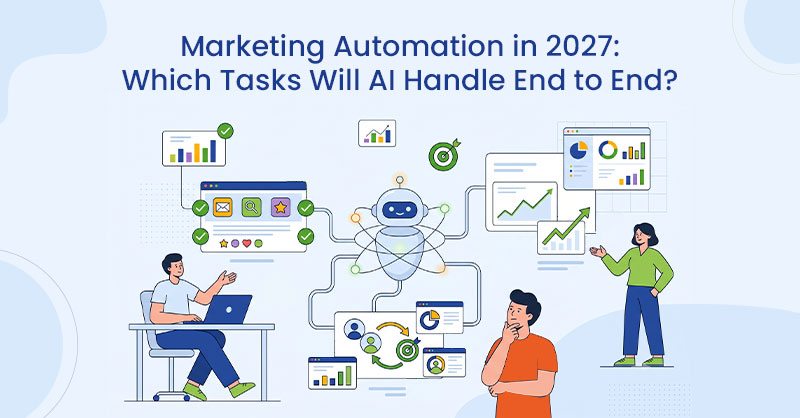
Marketing automation deals with the processes that marketers have to perform on a regular basis, such assending follow-ups, adding new persons to contact lists, and publishing pre-scheduled posts.
AI makes these workflows more flexible.
It can track a prospect's activity, notice that a campaign is starting to slow down, or pick up patterns in the responses a brand is getting on social media.
According to HubSpot's 2026 research, 86.4% of marketing organizations are using artificial intelligence (AI) in their jobs. Gartner found that marketing leaders expect AI-driven automation to increase from 16% of marketing work in 2026 to 36% by 2028.
So what will AI actually handle on its own in 2027?
Which Marketing Tasks Can AI Handle End to End?
Start with tasks that follow the same basic process, happen regularly, and give you a result you can measure.
Lead Qualification
Sales teams are often busy handling enquiries that will unlikely convert into sales.
An AI workflow can handle much of that first layer.
It can review information submitted through a form, look at previous website activity, check company details, ask qualifying questions, and compare the answers with the company's target customer profile.
A high-fit prospect might be sent to a salesperson with a summary of their activity. Someone who is interested but not ready to buy can enter a nurture sequence. An inquiry from outside the company's market can be handled differently without taking up sales time.
Email Follow-Ups
Traditional email automation works well when every subscriber follows roughly the same path.
Real customers rarely do.
Someone might download an introductory guide and disappear for a month. Another person may read the guide, visit the pricing page twice, return to the product section, and then reply to an email.
That makes the workflow less dependent on dozens of manually written rules.
The marketer still decides what the company wants to communicate and which offers are appropriate.
Content Distribution and Social Media
Content distribution is another area where AI can remove a lot of repetitive work.
Take a company publishing a detailed industry report.
This workflow extracts key points from original content, and turns them into social media posts on platforms like LinkedIn, X, and Instagram, and the company newsletter. Then drafts are reviewed by the social media manager, and refines the wording before they're published.
This is already possible with mainstream marketing software. HubSpot's social composer allows marketers to create one draft and adjust it for different networks such as LinkedIn, Facebook and Instagram. It also works with X, Reddit, TikTok, YouTube and other platforms. The AI assistant generates social copy and hashtags too.
The more interesting part comes after publication.
Suppose one LinkedIn post about a specific customer problem gets far more meaningful engagement than the other posts from the same report. The team might turn the topic into a standalone article, a newsletter discussion, or a sales resource. It’s also worth thinking about how people will find that content, especially as more searches become conversational and happen through voice search.
HubSpot's 2026 research of more than 1,100 social media marketers found that 72% said their AI-created social content performs better than content created without AI.

Social Listening
Publishing is only one side of social media. Paying attention to what people say also matters.
A brand gets comments, mentions, questions, complaints, and discussions on many platforms. Reviewing individual conversations is manageable for a human team, but finding a pattern in thousands of conversations is a lot tougher.
AI can group those conversations by topic and highlight changes.
For example, a software company might suddenly see a rise in comments about a confusing onboarding step. No single comment looks especially important. But together, they point to a recurring problem that the marketing, product, or customer support teams should know about. This can also highlight common customer questions, reactions to product launches, and topics that get the most attention.
Advertising Optimization
Paid advertising is already one of the most automated parts of marketing.
AI systems can process a huge number of signals and make decisions on bids, targeting, and placements much faster than a human. They also consider various creative combinations.
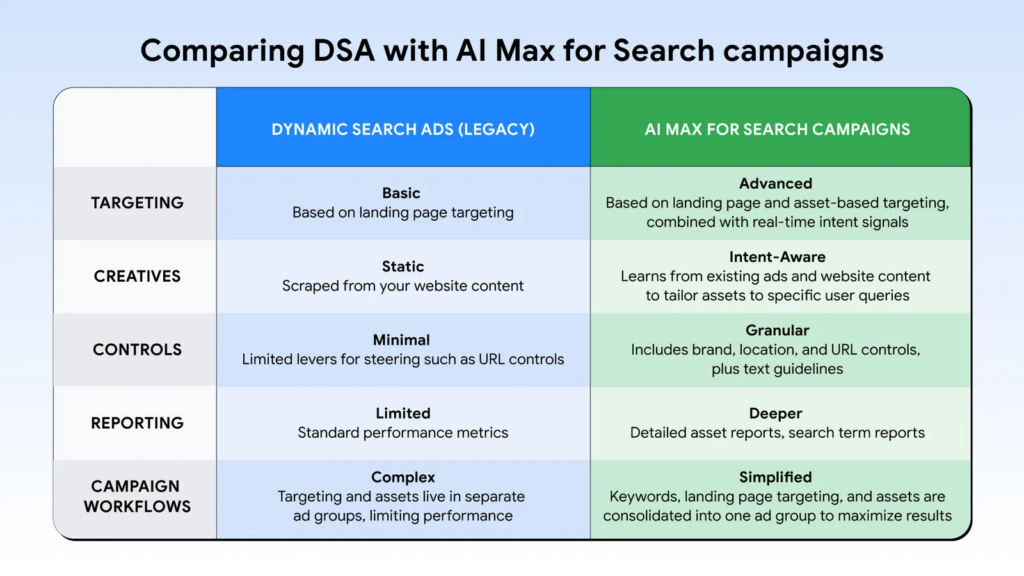
Google's AI Max for Search campaigns is a good example. The system uses AI for search term matching, text customization, and final URL expansion. Google reports an average 7% increase in conversions or conversion value at a similar CPA or ROAS when the full feature set is used, based on Google's internal 2026 data for non-retail advertisers.
Reporting and Re-Engagement
Reporting does not have to be a monthly exercise anymore.
AI agents can monitor campaign and customer data continuously and flag unusual changes as they happen.
A sudden increase in acquisition costs can trigger an alert. A campaign that stops generating qualified leads can be sent for review. A group of customers who have become inactive can enter a re-engagement workflow.
For an ecommerce company, for example, inactive customers could be divided according to purchase history and product interests. Someone who regularly bought one category could receive a different message from someone who made a single purchase six months ago.
Which Decisions Still Need a Human?
Not every marketing decision becomes better when it becomes faster.
Positioning is a good example. AI can compare competitors, analyze customer reviews, identify common phrases, and suggest possible messages. It cannot reliably decide which position a company should own when the business is entering a new market or deliberately trying to differentiate itself from the category.
Major campaign decisions can have the same problem.
Customer conversations require similar judgment.
Questions from customers about shipping, store hours or product availability generally don’t require much attention from the support team. These types of queries can be effectively managed through automation. A billing complaint is different, especially when the same customer has already reached out several times and still has not gotten a useful answer.
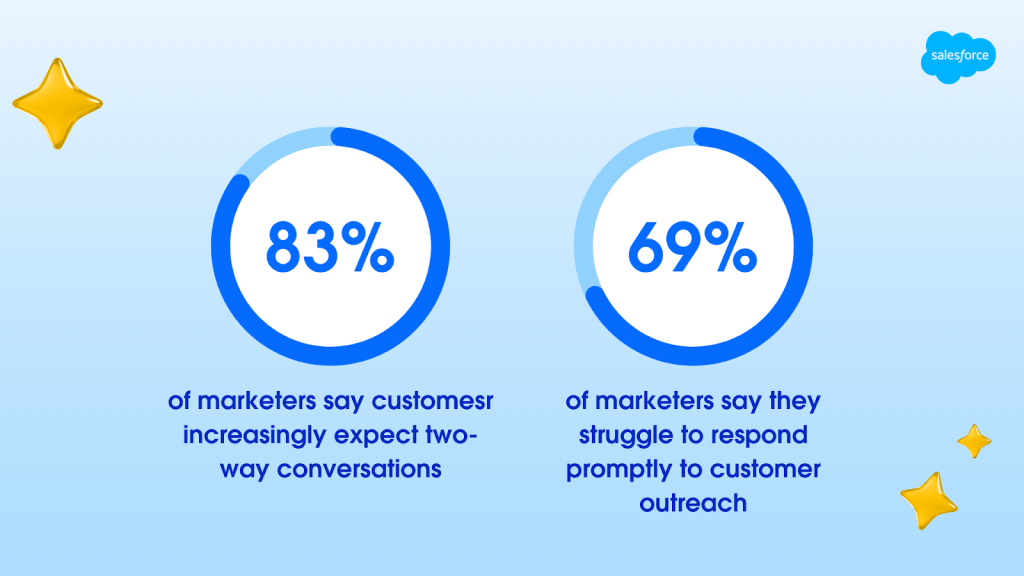
Salesforce's 2026 State of Marketing report found that 83% of marketers say customers expect two-way conversations, while 69% have trouble responding quickly. The report found that 81% of marketers would trust AI to respond to customers but poor or disconnected data can get in the way.
How Do You Decide What to Automate?
Start with the work that repeatedly consumes time without requiring much judgment. Pulling reports, updating records, sorting leads, or checking the same campaign metrics every day are usually easier places to begin than tasks that require a different decision in every case.
Then look at how much the task varies. A process with a predictable input and clear output is usually easier to automate. Risk matters too. Automatically categorizing a contact is relatively easy to reverse if something goes wrong. Automatically changing a large advertising budget is much harder to undo.
Volume should factor into the decision as well. A ten-minute task performed twice a month probably does not justify a complicated automation project. A two-hour process that runs every working day is a different story.
How Should a Team Build Its First Workflow?
Map your existing process before choosing software. To understand a workflow, identify the trigger first. Then break down the process, looking at which systems are involved and what decisions need to be made. Missing information can also impact the workflow.
A lead might look ideal on paper but come from a market the company does not serve. A customer might appear inactive because their contact details changed. A sudden performance drop might come from broken tracking rather than a real campaign problem. Decide what should happen in those situations before you automate the process.
For the first test, choose one workflow and one clear outcome. A company might want to reduce lead-response time or cut the hours spent preparing weekly reports. Run the automated process on a limited group first, then check the results before giving it wider access. That makes problems easier to isolate and gives the team a useful baseline for comparison.
Three Mistakes That Can Make Automation Worse
Automating an unclear process
AI won't resolve disagreements if marketing and sales teams can't agree on which leads are considered sales-ready.
Connecting too many systems
A workflow that depends on six platforms can become difficult to troubleshoot. One broken integration can affect everything afterward.
It's best to start with one or two systems and expand them once the process becomes reliable.
Chasing the easiest metric
AI will optimize toward the objective it receives.
If the goal is more leads, the system can find more leads. If the goal is lower cost per lead, it can find cheaper ones.
Neither objective says anything about whether those people become customers.
The measurement needs to reflect the actual reason the company built the workflow.
How Should Results Be Measured?
The first few weeks can produce misleading numbers.
The right measurement depends on the job.
For lead qualification, sales acceptance and opportunity creation tell you more than the number of records processed. Email automation should be connected to what recipients do after the message. Social media workflows should look beyond impressions considering qualified traffic, useful conversations, or actions from the right audience.
McKinsey found that nearly 90% of CMOs experiment with AI and fewer than 10% see value from it across all their marketing workflows.
What Will Marketing Automation Look Like in 2027?
While companies may have access to more advanced systems simply adding another AI tool won't automatically improve their marketing efforts.
More workflows will connect different parts of the marketing stack. A change in customer behavior could trigger a different email, audience, or follow-up without someone moving that information manually.
The marketing team still sets rules, reviews exceptions, checks results. They need to make sure automation is working.
Ready to Put Marketing Automation to Work?
Explore TechWyse's marketing automation services to discuss your marketing strategy and find a solution that suits your business.