

AI-powered search advertising is giving algorithms more freedom to choose where customers land. Microsoft is now giving advertisers a way to influence those decisions.
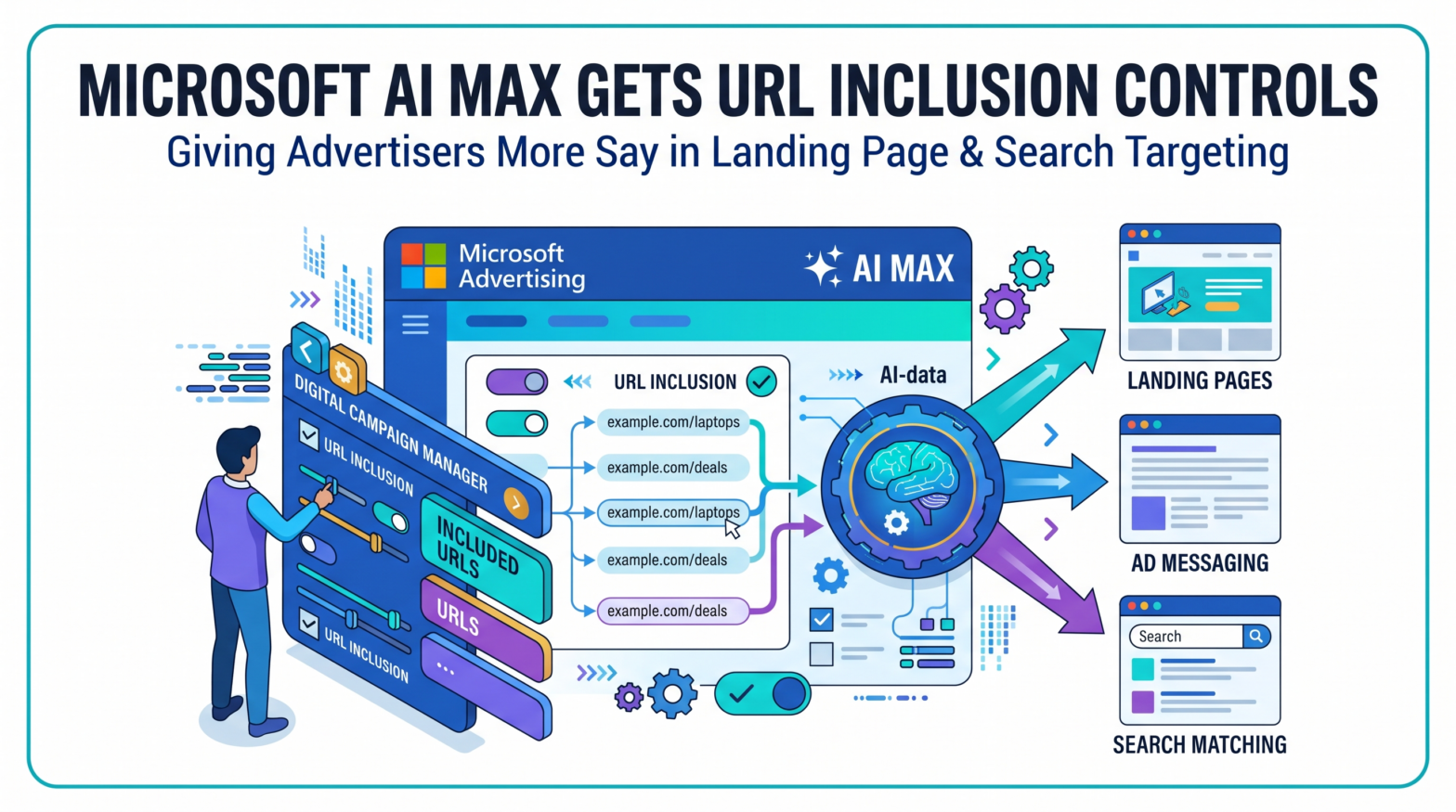
Microsoft Advertising is rolling out URL inclusion controls for AI Max Search campaigns, allowing businesses to identify which sections of their websites should inform automated targeting, ad messaging, and landing page selection.
The feature, confirmed in Microsoft's November 19, 2026, advertising update, addresses a familiar concern with automated campaigns: how much control advertisers retain when AI determines which website content is relevant to a particular search.
URL Inclusions Give Advertisers a Say in Three AI Max Functions
The new URL inclusion controls extend Microsoft's existing final URL expansion functionality.
Under final URL expansion, AI Max can select a landing page based on the user's search intent rather than automatically sending every visitor to a predetermined destination.
Advertisers can now identify website pages they want the system to use when making those decisions.
According to Microsoft Advertising's November product announcement, the selected URLs can inform three connected functions: landing page selection, text customization, and search term matching.
The first determines where an advertiser's traffic is directed. The second allows AI Max to draw information from selected website content when generating ad copy. The third uses that content as an additional signal when identifying relevant searches.
These functions were already part of AI Max. The November update introduces another way for advertisers to guide the information feeding them.
For example, an electronics retailer running a campaign for laptop accessories could identify its relevant product and category pages rather than relying entirely on the system to select content from a much larger website.
Those pages could then help inform the searches AI Max identifies, the messaging it generates, and the destinations it selects.
The update connects three decisions that advertisers have traditionally managed separately: which searches to target, what advertisements should say, and where customers should arrive after clicking.
URL Inclusions Are Not the Same as URL Exclusions
The distinction between influencing automated decisions and restricting them remains important.
Microsoft describes URL inclusions as a way to specify the website sections advertisers want AI Max to use. It has not stated that included URLs become the only destinations eligible to receive traffic.
Advertisers should therefore not interpret the new setting as a guarantee that every click will lead exclusively to a listed page.
That distinction matters for businesses with large websites containing different product categories, outdated promotional pages, or sections that are unsuitable for particular advertising campaigns.
URL inclusions provide direction about preferred content. Explicit exclusions, where supported, serve a different purpose by restricting specified destinations.
Microsoft has not published detailed performance benchmarks showing how URL inclusions affect landing page relevance, conversion rates, or advertising costs.
The announcement also does not establish whether supplying more included URLs produces better results than selecting a smaller group of highly relevant pages.
For now, the confirmed change concerns the advertiser's ability to guide the system's use of website content, not a demonstrated improvement in campaign performance.
Microsoft Is Adding More Controls Without Removing AI Max Automation
URL inclusions are the latest addition to a series of controls introduced alongside Microsoft's expansion of automated Search campaigns.
The company made AI Max broadly available in August 2026 after earlier pilot testing. The feature operates within existing Search campaigns rather than functioning as a separate campaign type.
Its underlying system combines expanded search term matching, automatically generated advertising text, and dynamic landing page selection.
The global rollout of Microsoft Advertising AI Max also introduced reporting and campaign controls intended to give advertisers visibility into automated decisions.
These include brand inclusions and exclusions, term exclusions, and reporting that distinguishes AI-expanded search matches from traditional keyword matching.
In October, Microsoft added another layer through messaging guidelines.
The October advertising update introduced an open pilot allowing advertisers to provide plain-language instructions about the claims, language, themes, and tone permitted in AI-generated advertising copy.
Microsoft said advertisers could supply up to 40 messaging guidelines for eligible campaigns.
Those instructions govern how generated advertisements should communicate. URL inclusions address a different part of the process: which website content AI Max should draw upon.
Together, the controls give advertisers more influence over both the source material and the resulting messaging.
The broader development follows Microsoft's earlier introduction of AI Max for Search campaigns, which expanded automated search matching and creative generation beyond conventional keyword-based advertising.
Microsoft continues to position AI Max as an optional collection of AI-powered Search features, with existing campaign settings and advertiser-defined restrictions remaining part of its operation.
Landing Page Selection Becomes More Important as AI Search Expands
Microsoft's latest change arrives as the company extends advertising into more AI-powered search experiences.
In its November announcement, Microsoft confirmed that advertisements can appear alongside AI Overviews on Bing, using eligible existing campaigns, including AI Max and Performance Max.
The placement does not require advertisers to establish a separate campaign.
Microsoft says advertisements in Bing AI Overviews are available across its supported markets except China.
These placements form part of a wider shift in how search advertising operates. Instead of relying exclusively on the words entered into a search box, automated systems can evaluate additional context when deciding which advertisements and landing pages are relevant.
For advertisers, landing page content already plays a role in communicating what a business sells and which customer needs a particular page addresses.
With AI Max, that content also becomes an input to automated search matching and creative generation.
URL inclusions give businesses an additional way to identify which pages reflect the products, services, or campaign themes they want to emphasize.
The setting may be especially relevant to advertisers managing extensive product catalogues, multiple service categories, or campaigns built around particular offers.
It also separates the question of where an advertisement appears from the question of which website content informs the ad.
Bing AI Overview availability is a placement development. URL inclusions are a campaign-control development. Microsoft announced both in November, but they address different parts of the advertising process.
Advertisers Can Compare Selected Pages With Actual Traffic Destinations
The practical significance of URL inclusions will depend partly on how advertisers assess the landing pages AI Max ultimately selects.
Microsoft already provides a search term landing page reporting template for AI Max.
In its August AI Max product documentation, the company explained that advertisers could use this reporting to examine how search queries correspond with selected landing pages.
That visibility becomes particularly relevant when advertisers begin specifying preferred URLs.
A campaign may include pages associated with a particular product category, but reporting is still needed to establish which pages actually receive traffic and which search terms generated those visits.
For paid media teams, the immediate operational consideration is whether automated query matching, generated ad messaging, and landing page selection remain consistent with the campaign's intended products or services. Search term and landing page reports provide a basis for reviewing that alignment without assuming that the inclusion setting enforces an exclusive destination list.
Microsoft has not announced a separate reporting interface specifically for URL inclusions.
It has also not published results isolating the effect of the new control from the broader performance of AI Max.
The company confirmed that URL inclusions began rolling out in November 2026, but did not provide an account-by-account availability schedule or a fixed date for completing deployment.
The functionality is being introduced within AI Max for Search campaigns, expanding the controls available over the website content used in Microsoft's automated search advertising.