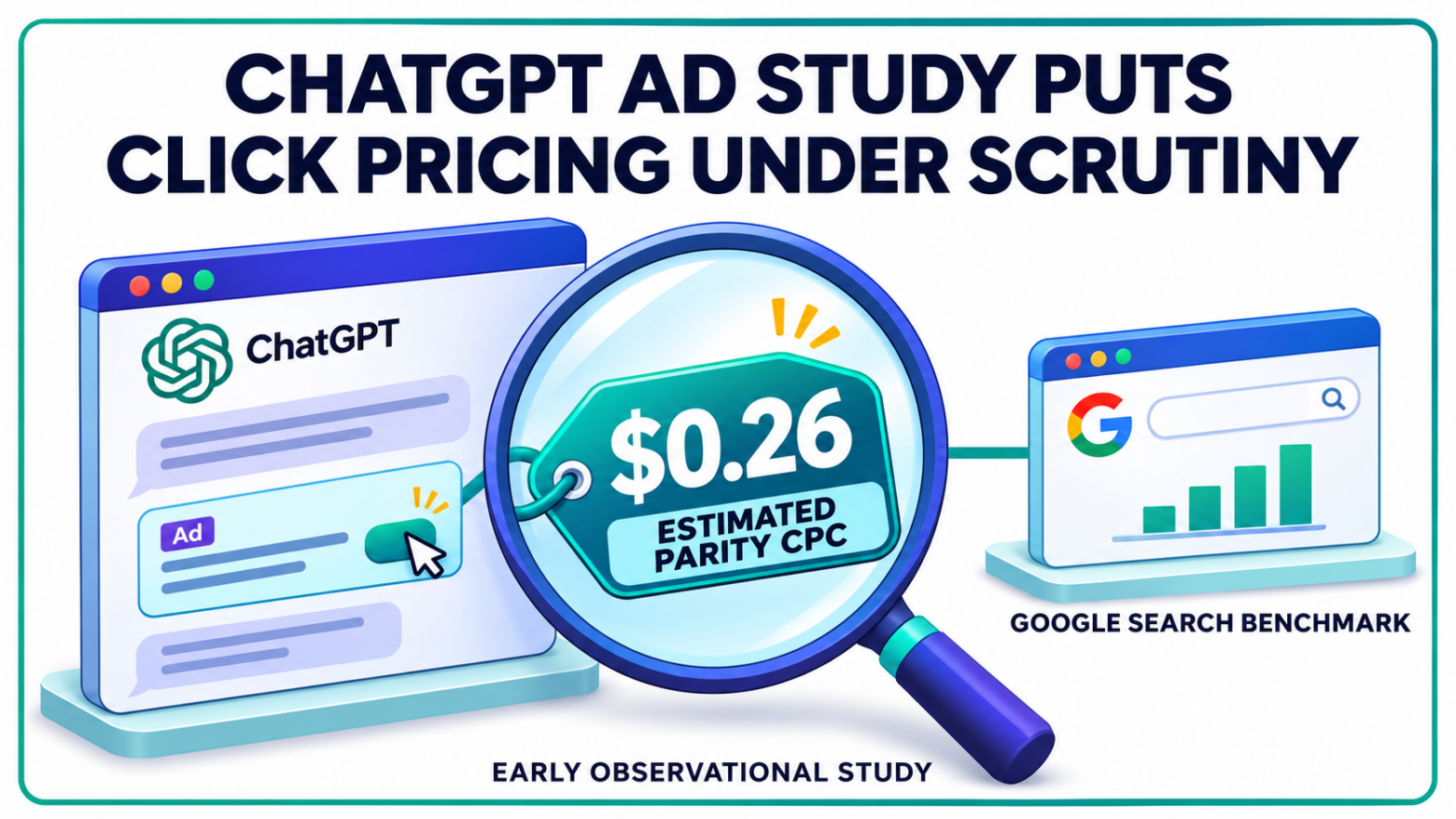
ChatGPT’s early advertising results point to a pricing challenge: researchers estimate a click would need to cost about US$0.26 to match Google Search’s revenue return in their sample.
The October working paper by Maximilian Kaiser of WU Vienna and Christian Schulze of Frankfurt School of Finance & Management remains under review. Its central question for advertisers is practical: how much can a conversational ad click cost before its economics fall behind an established alternative? The findings concern advertiser revenue, not the revenue OpenAI collects from advertising. The researchers’ study provides the underlying analysis.
ChatGPT Ads Face a Click-Price Test
In U.S. traffic, ChatGPT ad visits generated US$0.89 in revenue per session against US$2.45 for Google Search ads, a 64% shortfall. Conversion rates were 0.37% and 1.17%, respectively. The parity estimate uses a US$0.72 median search click price from 16 accounts. The working paper details that calculation.
Lower revenue per visit does not automatically make an advertising channel uneconomic. A sufficiently inexpensive visit can still produce a competitive return. The difficulty arises when the acquisition price does not reflect the revenue that traffic generates.
The comparison also separates two questions often bundled together in discussions of ChatGPT ads: whether conversational context reaches relevant people, and whether reaching them produces enough business to justify the price.
OpenAI’s current advertiser guidance recommends starting CPC campaigns with a maximum bid of US$3 to US$5. That is a bidding recommendation, not a reported average price paid or a guaranteed charge. It should not be treated as directly equivalent to the study’s calculated parity price. OpenAI’s pricing documentation distinguishes maximum bids from auction delivery.
The Paid-Ad Sample Narrows the Finding
The financial analysis covers 102 websites, not the 1,898-site organic-referral panel. Among 87 advertisers buying both channels in U.S. traffic, 84 earned less per ChatGPT visit. The paid comparison is observational, and visit-attributed revenue can miss later purchases. Data ends August 22, 2026. The study’s methodology sets out those boundaries.
Those distinctions limit the verdict. The findings describe observed performance among participating advertisers; they do not establish what every business would earn by moving budget between platforms.
Revenue efficiency is also different from profitability. Two campaigns can generate the same return on ad spend while selling products with different margins. Matching another channel’s revenue return does not necessarily match its contribution to profit.
For marketers, the practical comparison is account-specific: revenue per visit, actual click cost, purchase quality and consistent attribution windows. Later purchases and assisted conversions belong in that assessment, but should remain distinguishable from revenue recorded during the initial visit.
AI Advertising Measurement Changes the Comparison
The measurement environment has continued to develop beyond the study period.
OpenAI’s current reporting documentation allows seven-, 14- or 30-day click attribution windows and an optional one-day view-through window. Relevant reporting endpoints default to 30-day click and one-day view attribution, with conversion totals including eligible click-through and view-through outcomes. Clicks take precedence when both qualify. OpenAI’s reporting documentation explains those settings.
A conversion credited after an ad impression answers a different question from revenue recorded during a referred website visit. Comparing the two without identifying their measurement rules can make performance appear stronger or weaker for reasons unrelated to a campaign change.
Nor does attribution alone establish that advertising caused an additional purchase. It assigns credit under a defined set of rules.
OpenAI acknowledges that its conversion totals can differ from third-party analytics because of attribution methods, reporting dates, consent conditions, deduplication and campaign configuration. Its systems may also include modelled conversions where available. Its conversion measurement guidance describes those differences.
There is a separate traffic-quality consideration. OpenAI warns that ad-review crawlers can visit landing pages with tracking parameters and appear as paid traffic in external analytics, despite generating no billable click. That is a reconciliation issue, not evidence that crawler activity explains this study’s findings. OpenAI’s advertiser guidance identifies the distinction.
Newer Advertiser Examples Use Different Yardsticks
OpenAI has published more favourable advertiser examples, although they do not provide a like-for-like rebuttal to the academic analysis.
In its October 5 announcement, the company cited DV Rockerbox’s finding that WeightWatchers’ attributed acquisition cost was 15.3% below its blended paid-search benchmark. It also described early work with Haus, Measured and WorkMagic on geographic experiments intended to assess incremental business outcomes. OpenAI’s measurement announcement presents those partner-reported findings.
Acquisition cost, incremental purchases and revenue per session measure different outcomes. A selected advertiser’s result cannot establish a platform-wide benchmark, just as an early observational sample cannot settle performance for every campaign.
The expanding scope of AI advertising measurement makes those distinctions more consequential. A wider reporting window can capture additional credited sales without, by itself, demonstrating additional demand.
On October 21, OpenAI said more than 100,000 advertisers had run campaigns since launch and that ChatGPT Ads availability had reached 89 countries. The company said further development would include additional formats, objectives, buying options and measurement capabilities. OpenAI’s expansion announcement was published after the research data window closed.