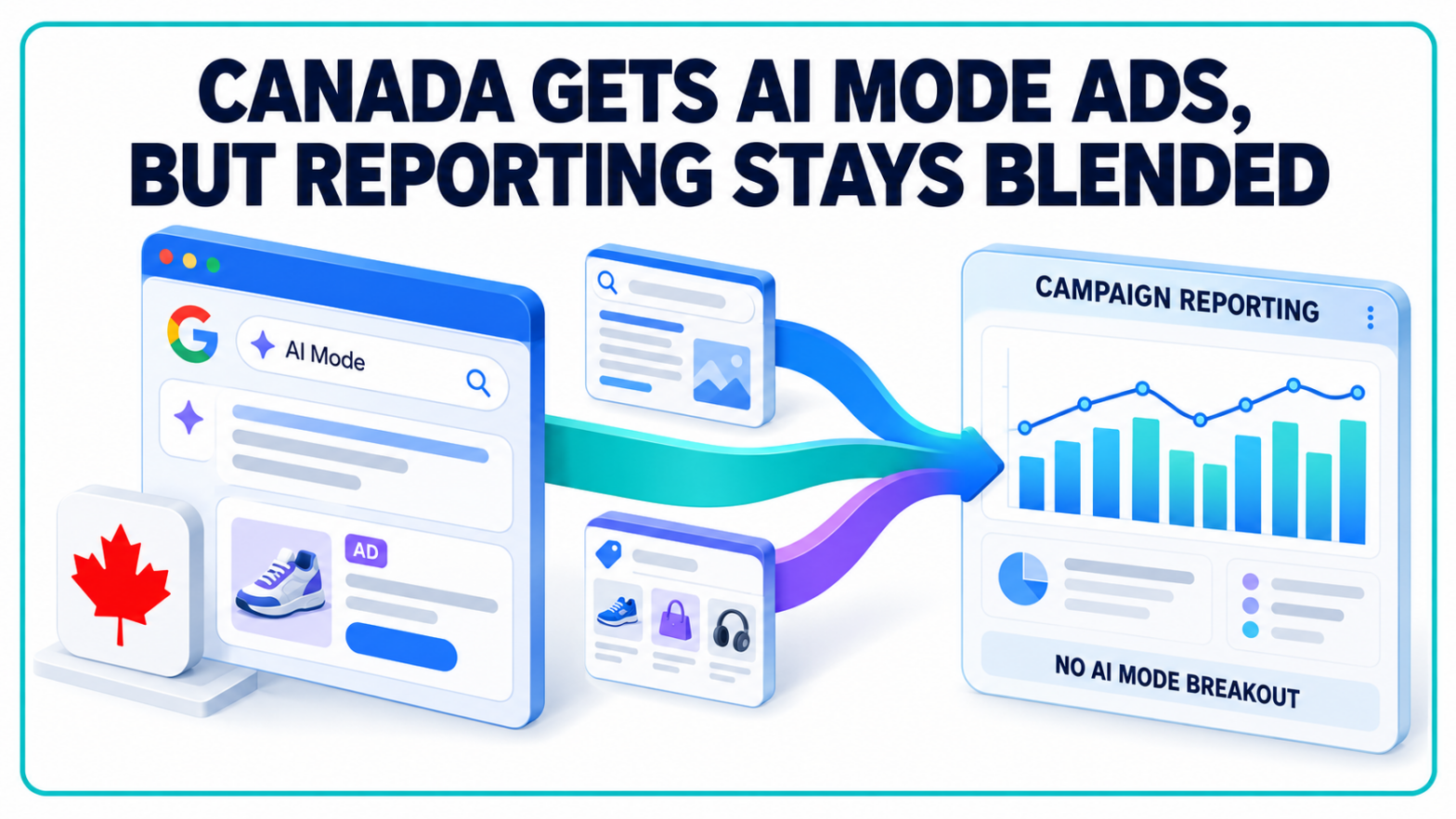
Canadian advertisers are gaining access to another part of Google Search, without a separate view of its results. Google is expanding advertising inside AI Mode to Canada and nine other markets, while performance remains folded into existing campaign reports.
The October 28 announcement extends the commercial reach of Google’s conversational search experience. For businesses, the immediate question is less about opening a new advertising account than understanding where existing campaigns can now appear.
Canada Joins the Rollout, but Language Limits Remain
Google’s international expansion includes Australia, Canada, India, Kenya, Malaysia, New Zealand, Nigeria, Pakistan, the Philippines and Singapore.
Its current advertising documentation lists English as the supported language for placements within AI Mode and AI Overviews. Pakistan is limited to text ads. Canadian availability should therefore not be read as confirmation of French-language advertising inside these experiences.
There is also a separate geographic boundary within the announcement. Google is launching multiturn ads, which allow advertising on follow-up queries, in the United States. It has not announced that same capability for Canada.
A wider country list does not establish identical availability across languages, formats and stages of a conversation.
AI Mode Ads Use Existing Campaigns
According to Google’s campaign eligibility guidance, existing Search, Shopping and Performance Max campaigns can participate automatically when relevant. Advertisers do not need a separate campaign or budget.
Matching rules still matter. Exact and phrase match keywords can serve when a query expresses direct commercial intent. AI Max, broad match, Shopping and Performance Max can also qualify for contextual matching that considers both the query and the AI response.
TechWyse previously covered the testing of AI Mode ads with exact and phrase match keywords. Google’s current documentation describes that route while distinguishing it from broader contextual eligibility.
Advertisers cannot target AI Mode exclusively or exclude it separately from Search. Existing controls, including negative keywords and brand exclusions, remain available.
For campaign managers, participation and placement control are different things. Eligibility opens access to an advertising surface; it does not provide a dedicated buying switch for that surface.
Performance Max Eligibility Is Not a Universal Format Launch
The expansion arrives alongside a broader effort to develop advertising for conversational search. Those developments should not be treated as one undifferentiated rollout.
At Google Marketing Live in May, Google described two experimental AI Mode formats. Conversational Discovery ads use Gemini to create advertising tailored to a person’s question. Highlighted Answers allow relevant ads to appear within recommendation lists generated by AI Mode.
Google also described independent AI explainers accompanying those formats. These provide context about a product or service alongside the advertiser’s creative, rather than relying only on conventional advertising copy.
Its May announcement pointed advertisers towards AI Max for Search, AI Max for Shopping and Performance Max as foundations for accessing the developing formats. TechWyse’s Performance Max coverage examined those announcements within the wider Marketing Live programme.
The October country expansion does not establish that every experimental format is now available to every Canadian account. Access to AI Mode advertising and access to a particular new format remain separate questions.
AI Performance Insights Do Not Measure Paid Ads
Measurement creates another distinction.
Google includes AI Mode advertising metrics in aggregate within standard campaign and search terms reporting. That limits an advertiser’s ability to attribute a change in overall campaign results specifically to the Canadian expansion.
Merchant Center offers a different report, but it does not fill that paid-advertising gap.
Google’s AI performance insights documentation says the report is available for English-language queries for accounts in Canada, Australia, India, New Zealand and the United States. It examines product and brand visibility across AI Mode and AI Overviews.
The report includes share of voice, products appearing and query frequency. It also groups shopping queries into discovery, evaluation and ready-to-buy stages, giving retailers a view of how their products appear during different kinds of research.
Its traffic scope is strictly organic. Paid advertising is excluded.
TechWyse previously examined Canadian access to AI performance insights alongside Google’s commerce infrastructure updates. Those insights can inform an understanding of unpaid visibility, but they cannot establish the return generated by AI Mode ads.
In practice, marketers can assess campaign conversions, acquisition costs and revenue alongside accurate product feeds and landing pages. A change in those campaign totals, however, is not proof that AI Mode caused it. Paid campaign reporting and organic AI visibility answer different questions.
Google’s Click-Through Evidence Comes From the U.S.
Google says sponsored and organic product-list items within AI Mode already have similar click-through rates. The comparison comes from internal U.S. data collected between August 20 and September 3, 2026.
That is a product-list comparison, not evidence that Canadian advertisers will achieve equivalent conversion rates or acquisition costs. The announcement does not provide those Canadian performance measures.
Google plans to expand AI Mode advertising to additional markets, including Brazil, Mexico and the United Kingdom, during the fourth quarter of 2026. Its announcement gives no specific launch dates for those countries.