

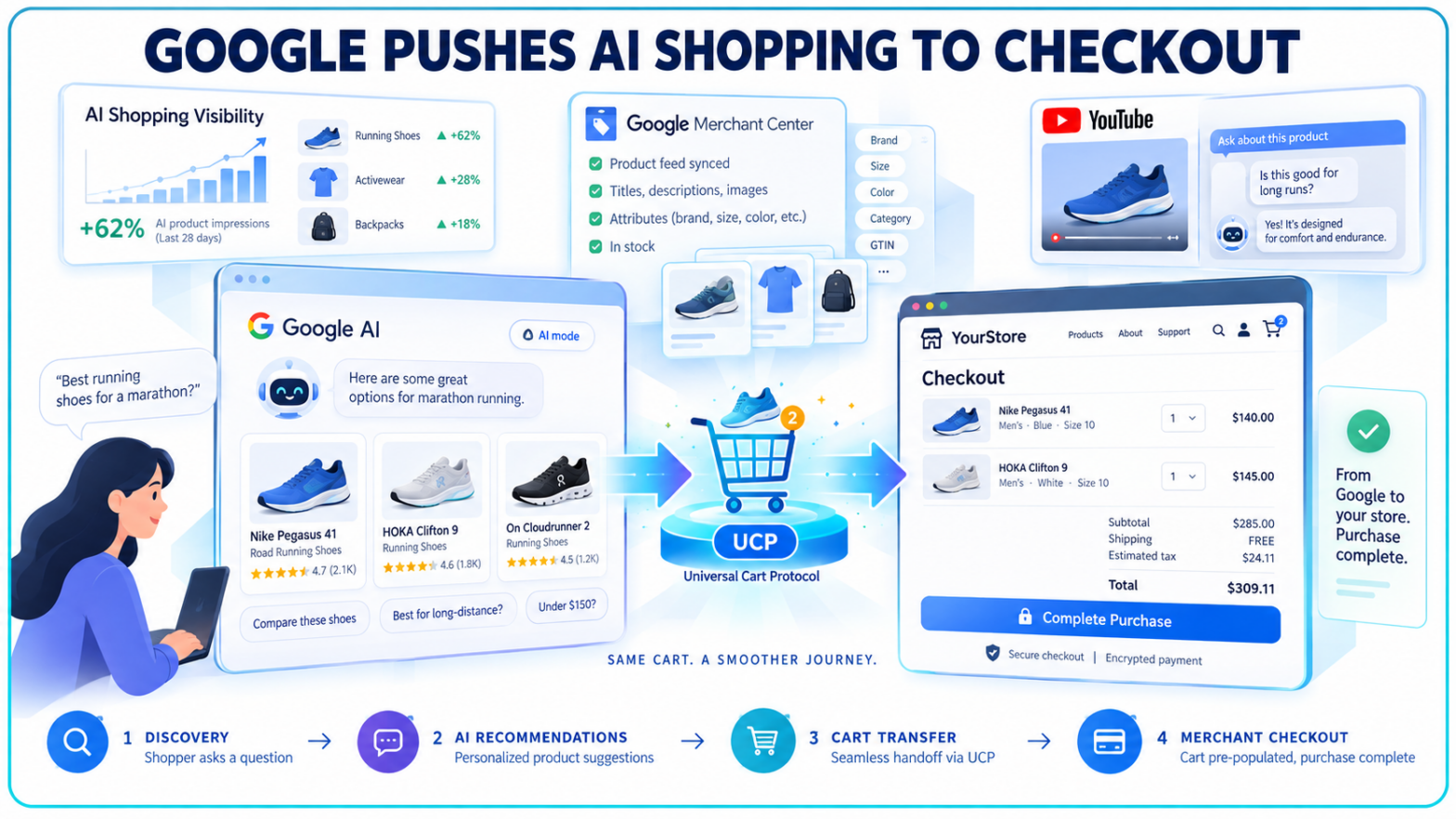
Google wants fewer shopping journeys to break between an AI recommendation and the checkout page.
Its latest holiday commerce rollout expands the Universal Commerce Protocol integration inside Merchant Center, giving participating retailers more control over how shoppers move from Google’s AI-driven shopping experiences into a transaction. Cart transfer to merchant websites is now part of that handoff, alongside expanded checkout testing, while Google pushes conversational product research into YouTube and opens AI performance reporting more broadly.
The larger shift is not simply that Google is adding another shopping feature. It is building infrastructure that connects product discovery, product questions, merchant data and checkout without requiring every shopping journey to follow the traditional search-result-to-product-page path.
UCP Cart Transfer Keeps the Merchant Site in the Transaction
Google’s Universal Commerce Protocol integration hub already gives eligible merchants a route into UCP-powered checkout across AI Mode in Search and Gemini. The September update adds another option: instead of completing the transaction entirely through Google’s native checkout flow, merchants can enable cart transfer and send the shopper to their own site with the selected items ready to purchase.
That distinction matters.
Google’s broader agentic commerce strategy has been moving shopping tasks deeper into its own interfaces. A shopper can research a product conversationally, receive recommendations and, for eligible merchants, reach checkout without repeating the discovery process elsewhere.
Cart transfer gives retailers another configuration within that system. Google can handle more of the discovery and shopping assistance while the merchant site still handles the final purchase experience.
Merchant Center’s UCP integration hub also includes validation tools for a retailer’s UCP profile, cart transfer and native checkout APIs. Google says merchants must complete the technical implementation before beginning onboarding, and participating accounts can use a sandbox environment to test the integration.
Google is also adding enhanced checkout-flow testing. Analytics for these experiences are planned but were not included in the September 16 rollout.
Canada Gets the Measurement Before the Checkout Tools
The rollout has two different geographic timelines.
AI performance insights in Google Merchant Center are now available for English-language queries to eligible accounts in Canada, Australia, India, New Zealand and the United States. The UCP integration hub and its new cart-transfer capabilities, however, are rolling out gradually in the U.S. first. Google says Canada and Australia will follow early next year.
For Canadian retailers, that creates an interim period where measurement arrives before the expanded transaction infrastructure.
The AI performance report shows how a brand or product appears for conversational shopping queries in AI Mode and AI Overviews. It includes share of voice against a Merchant Center-defined competitor set, the number of products appearing, query frequency and visibility across three stages Google labels discovery, evaluation and ready to buy.
There is an important limitation. Google says the report currently covers organic AI traffic, such as free listings. Paid advertising traffic is not included. Historical data is updated daily with a lag of several days.
Retailers therefore gain a new view into AI discovery, but it should not be read as a complete measurement of every paid and organic interaction occurring across Google’s commerce surfaces.
YouTube Business Agent Moves Product Research Inside the Ad
Google is also extending conversational shopping beyond Search.
Eligible U.S. retailers are being invited into a beta that embeds Business Agent directly within YouTube ads. A viewer can ask detailed product questions and receive tailored responses without leaving the YouTube experience.
That compresses another part of the shopping funnel.
Video advertising has traditionally been strong at discovery but dependent on another destination for deeper research. Business Agent gives Google a way to keep questions about specifications, fit and other product details inside the advertising environment before the shopper moves closer to purchase.
Google first introduced Business Agent in Search earlier this year. The YouTube beta extends the same conversational layer into a format where product discovery often starts with demonstrations, reviews and creator content.
The feature is currently a U.S. beta rather than a broad international rollout. Google has not provided a Canadian release date in its September announcement.
Product Feeds Are Becoming the Input Layer for AI Shopping
The agent may look new. The data feeding it is familiar.
Google is tying much of this commerce expansion back to product feeds, asking merchants to keep prices, attributes, product details and other Merchant Center information current. The company says merchants following its core feed best practices see an average 5% increase in conversions in the following month, although that figure describes merchants adopting those practices generally rather than results from UCP specifically.
Google is also encouraging retailers to provide richer conversational attributes. During testing with lululemon, Google says information supplied through those attributes appeared in 50% of relevant AI Mode product recommendations in the test. That finding is specific to the reported test and should not be treated as a universal inclusion rate.
Loyalty information is being pulled into the same data layer. Merchants can connect programme details so Google can surface member pricing, shipping benefits and other eligible perks to signed-in shoppers.
The pattern extends beyond Google. TechWyse recently reported that feed-connected sources were playing a growing role in ChatGPT Shopping recommendations. Different platforms use different retrieval systems, but retailers are increasingly being asked to maintain product data for machines that interpret the catalogue before a shopper ever reaches the product page.
For marketers, the practical work is becoming less separated between feed management, AI visibility and conversion testing. Product titles, attributes, inventory, pricing, loyalty details and checkout behaviour now affect several stages of the same AI-assisted shopping journey. A feed error can therefore become more than an advertising problem; it can also limit what an AI system has available to understand or present.
Holiday Commerce Is Turning Into an Integration Test
Google has already been expanding AI Mode shopping beyond static product listings. UCP pushes that model further by creating a standard way for agents and merchant systems to exchange commerce information and support transactions.
The holiday season gives Google a high-volume environment to test that infrastructure.
Tapestry, the parent company of Coach and Kate Spade, has already implemented UCP-powered checkout so products can be purchased through Google Search, including AI Mode, and the Gemini app. Google says UCP-powered checkout is available across hundreds of thousands of brands and retailers, although access to the newer Merchant Center integration capabilities remains subject to the staged rollout.
For retailers outside the initial U.S. expansion, the immediate change is more measured. AI discovery is becoming visible in Merchant Center now, while deeper UCP integrations arrive market by market.
Google’s commerce stack is moving toward a model where the search result is no longer necessarily the end of Search’s role. Increasingly, it can be the start of a product conversation, a populated cart and, eventually, the transaction itself.