



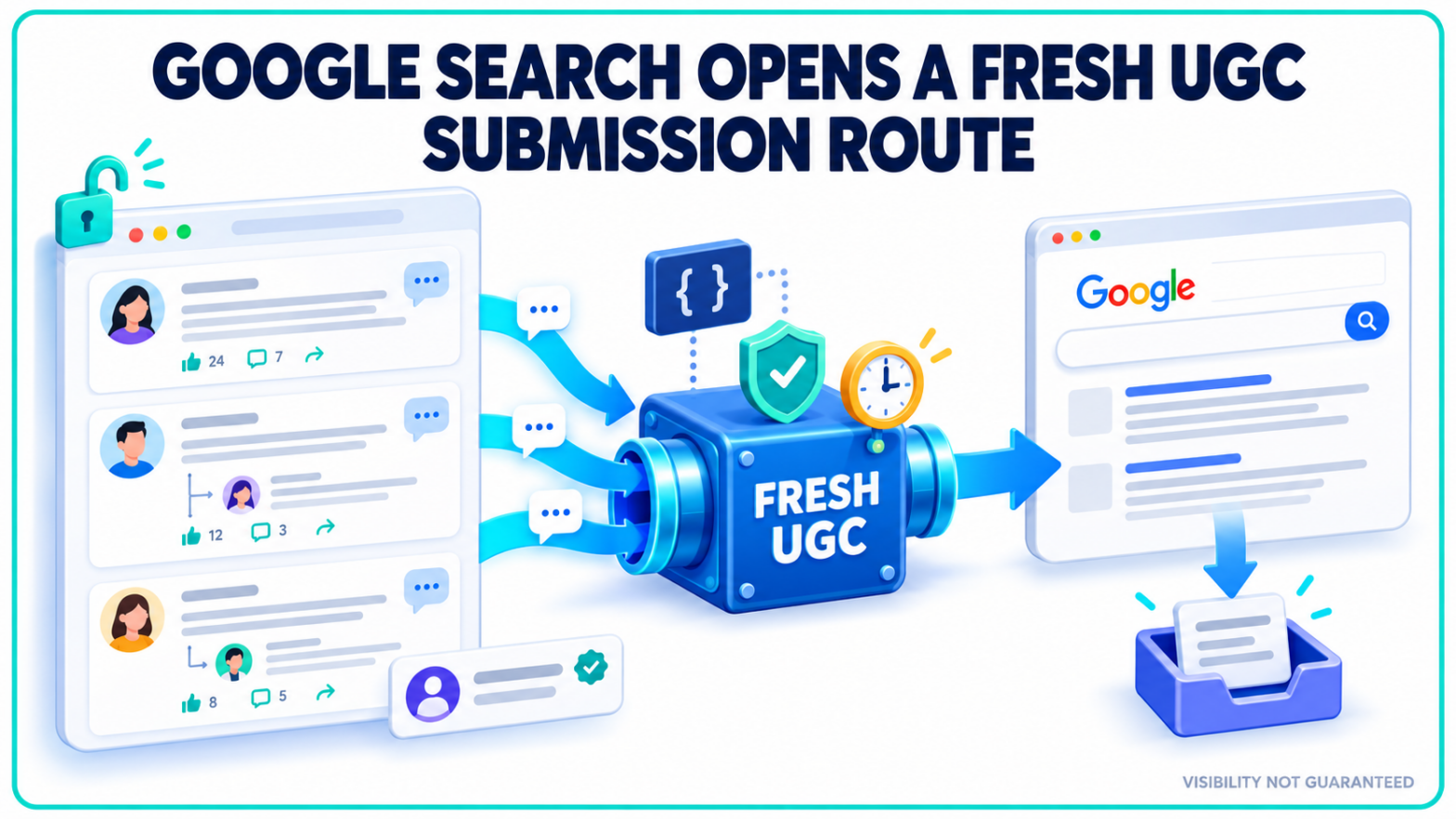
A fast-moving discussion can change before a search engine revisits its page. Google has now published the participation rules for a dedicated route that sends fresh community content and interaction signals directly to Search.
The UGC Fresh Data Program targets trending user-generated content from approved platforms. Google’s October 8 documentation update explains the disclosure as guidance on the program’s purpose, eligibility and application process.
For community operators, the news is a clearer set of entry requirements. Access depends on the platform’s content, public availability and ability to maintain a technical integration.
Fresh User Generated Content Needs a Public Home
Eligible platforms must primarily host UGC, social posts or forum discussions, with substantial content volume and a significant user base. Posts need dedicated, stable URLs. Profile and feed pages are excluded as submission destinations.
Content must be accessible to users and Googlebot without a login or paywall, and attributable to creators with public profiles.
Those conditions distinguish an individual discussion from the changing stream in which users discover it. A feed can contain many posts, while a dedicated URL gives one contribution a persistent location.
The distinction also matters for businesses with customer communities. An active discussion platform and a company website with occasional comments have different content models; publishing comments alone does not establish program eligibility.
User-generated content already appears within the wider search landscape. This disclosure concerns how eligible content reaches Google, rather than announcing a measured change in its ranking.
Structured Data Must Describe the Discussion Accurately
The technical requirements include secure OAuth 2.0 authentication, validated JSON-LD payloads and valid on-page schema.org markup, such as SocialMediaPosting or DiscussionForumPosting with interaction statistics. Platforms should send fresh content within minutes and update engagement counters within 72 hours of creation.
That integration requirement sits alongside Google’s existing discussion forum markup guidance.
The general guide reserves DiscussionForumPosting for genuine user posts. Publisher-written articles, even those with comments, and product reviews are listed as invalid uses of that particular type. SocialMediaPosting can describe more general social-platform content under the same requirements.
The relationships between posts and replies also matter. Google recommends nesting comments beneath the post they address, using a comment tree when the forum itself has a threaded structure.
InteractionCounter associates a number with a specific interaction type. A count without that context does not fully describe what users did.
Recent changes to structured data documentation have also clarified creator and engagement information for video. The applicable requirements remain specific to each content type.
A working ingestion connection and accurate page markup are separate parts of the platform’s implementation.
Creator Attribution and Moderation Sit Beside Speed
Participation also requires active moderation, a user reporting mechanism and no illegal content.
Those conditions put content governance alongside the technical work of sending updates. A platform needs a way to handle what its users publish, as well as a way to distribute it.
Google’s separate profile page documentation explains how ProfilePage markup helps Search understand creators in online communities. Other structured data types can link to those profiles through their author information.
That existing guidance provides context for attribution. It does not make ProfilePage markup an additional published requirement of the fresh-data program.
Google’s broader UGC abuse guidance recommends clear anti-spam policies, reporting by trusted users and manual approval for suspicious interactions. It also describes monitoring signup patterns and automated account creation.
These are general platform safeguards, distinct from the new program’s onboarding instructions. They illustrate why moderation is an operating function rather than a one-time setting.
For marketers and SEOs supporting an eligible community, the practical implication is coordination across publishing, development and moderation. Stable post URLs, accurate creator information and current engagement data need to reflect the same public content.
The Google Indexing API Has Its Own Boundaries
Google describes the UGC pipeline as independent of its Indexing API and ordinary organic crawling.
The distinction is relevant to teams already using submission tools. Google’s Indexing API documentation restricts that API to pages containing JobPosting or BroadcastEvent embedded in VideoObject. It supports notifications about new, updated or removed eligible pages.
That API’s existing permissions do not establish access to the UGC program.
For conventional pages, Google’s recrawl guidance describes URL Inspection for individual URLs and sitemaps for larger groups. It says crawling can take days or weeks, and repeated requests for the same URL do not speed up the process.
Neither a crawl request nor successful discovery establishes that a page will appear in search results.
The same distinction is relevant when reading Google indexing reports: discovery, crawling, indexing and visible search performance answer different questions.
For a business publishing service pages or editorial articles, those conventional processes remain the relevant reference points. The UGC disclosure describes a specialized integration with its own participation criteria.
An Application Comes Before Integration Details
Platforms can express interest through the application linked in Google’s program documentation. Google states a six-to-eight-week response window; acceptance is not guaranteed. Selected platforms receive technical documentation and onboarding instructions.
That sequence places implementation details after selection. The public page gives prospective applicants enough information to assess broad suitability, while the accepted partner receives the integration specifications.
The date of the disclosure also needs a precise reading. Search Central’s changelog records the addition of documentation on October 8, 2026. It describes the purpose as explaining the program and helping prospective applicants understand participation.
That is the confirmed public milestone. It does not establish when the underlying program began operating.
Google explicitly says participation does not guarantee that submitted content will appear in Search.