

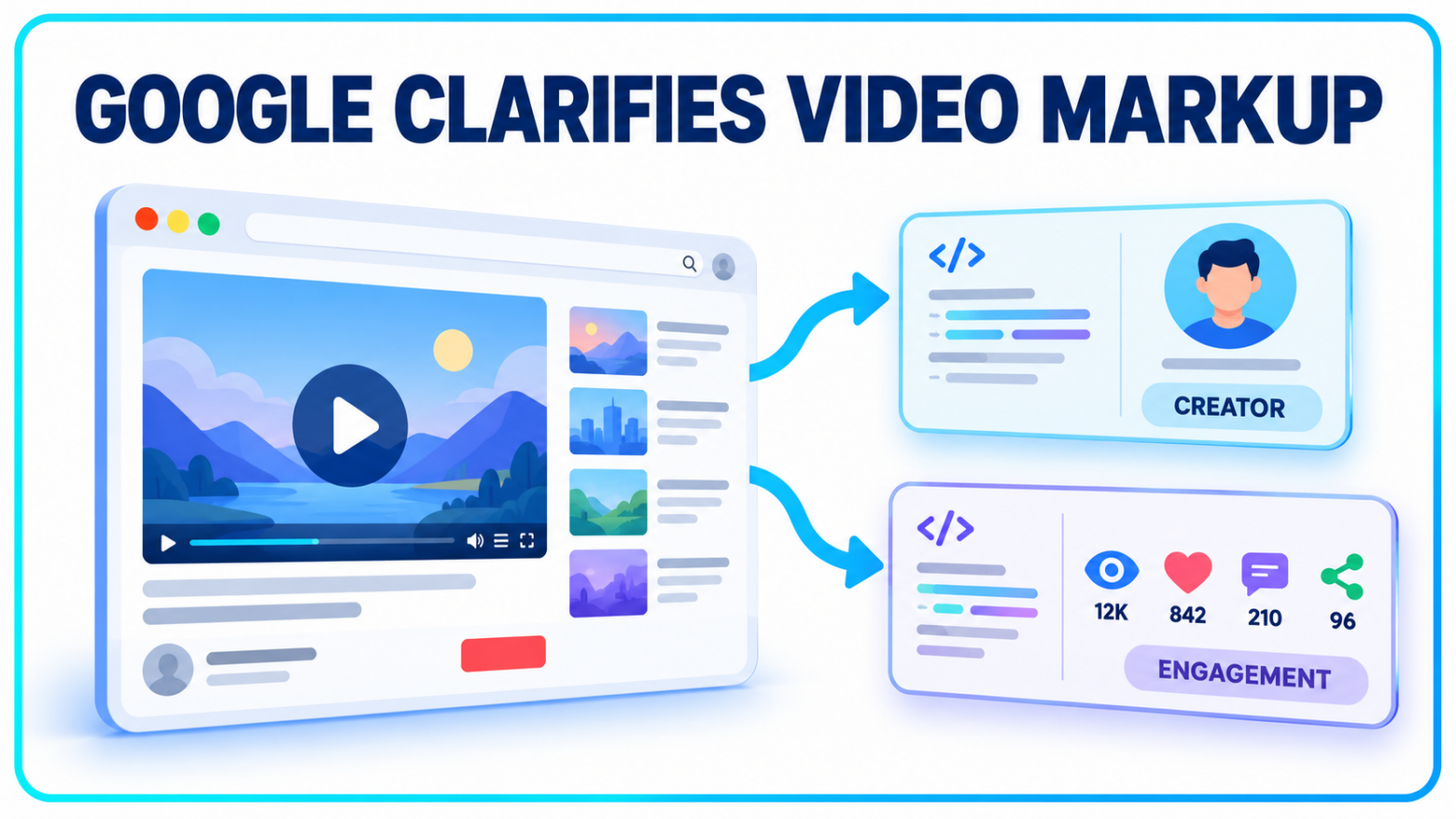
Google’s video documentation now spells out how publishers can identify a video’s creator and describe its audience activity. The September 24 update addresses attribution and engagement metadata without announcing a new ranking benefit.
The change adds creator, confirms support for author, and clarifies the interaction types supported under interactionStatistic. For publishers maintaining video libraries, the immediate question is whether their existing markup accurately describes who made each video and what its engagement numbers represent.
Video Structured Data Gets a More Explicit Attribution Field
Google’s updated VideoObject documentation accepts a Person or Organization under creator, with author supported as an alternative. The field identifies the person or organization that created or published the video.
When that entity is supplied, Google requires either name or alternateName. A creator URL can point to a profile page or homepage that uniquely identifies them. Both creator attribution and interaction statistics sit among the recommended properties. The required fields remain name, thumbnailUrl and uploadDate.
The underlying vocabulary already accommodates these relationships. Schema.org’s VideoObject definition includes creator and author properties inherited from its broader CreativeWork type. Google’s announcement concerns what its own documentation explicitly supports.
That distinction matters when interpreting video structured data updates. A property’s presence in Schema.org and its documented use by Google are separate questions.
Schema.org also distinguishes creators from actors, production companies and copyright holders. Those fields describe different relationships to a video. Someone appearing on screen is not necessarily its creator, just as owning the rights does not describe every contribution to its production.
Engagement Counts Need to Name the Action
The revised Google reference lists four supported interaction types: WatchAction for views, LikeAction for likes or upvotes, CommentAction for comments, and ShareAction for reshares. The associated userInteractionCount records how many times the specified interaction occurred.
Each number needs a clear meaning.
The InteractionCounter definition pairs a count with the action it measures. A video with 8,000 views and 240 likes has two different measurements. Combining them into an undifferentiated engagement total would lose the distinction that the markup is designed to express.
The same principle applies when a publishing system stores several metrics under similar labels. Plays, reactions and comments describe different audience behaviour, even when they appear together in a reporting dashboard. Mapping those fields into structured data requires preserving the action behind each total.
Schema.org’s vocabulary is broader than Google’s documented list. For example, InteractionCounter also describes how to represent dislikes. Its availability in the vocabulary does not establish Google support for that interaction in VideoObject results.
Google’s September 24 changelog entry frames this part of the revision as clarification of supported types. It does not announce an engagement threshold or state that videos with more likes will rank higher.
Video SEO Still Depends on the Page Around the Player
More descriptive markup does not remove the conditions a video must meet to appear in Google’s video features.
Google’s video indexing guidance requires an indexed watch page, a visible embedded video and a valid thumbnail at a stable URL. The watch page must also perform well enough in Search for its video to be considered for indexing. Indexing the page alone does not guarantee that Google will index the video.
A watch page has a specific purpose: watching an individual video is the main reason to visit it. A product page with a supporting demonstration or a blog post containing a related clip serves a different purpose.
For video SEO, that distinction remains relevant regardless of how much metadata accompanies the player.
Third-party hosting does not automatically rule out a publisher’s own page. Google says an embedded video can be indexed on both the publisher’s website and the hosting platform when the respective pages meet its criteria. It still recommends structured data on the publisher’s watch page.
Rich Results Depend on Accurate Page Content
Google’s general structured data policies require markup to represent the page accurately. They prohibit misleading information, impersonation and misrepresentation of ownership or affiliation. Content described in the markup must also be visible to readers.
Those rules provide the context for supplying creator identities and audience statistics. A technically valid field is still a claim about the content it describes.
For marketing and SEO teams, the practical work sits in the publishing process: confirming where creator details come from, matching engagement fields to the correct actions, and checking that automated templates preserve those relationships across individual videos. A shared template can distribute the same mapping error throughout a library.
Eligibility for rich results also remains separate from guaranteed display. Google says correctly implemented structured data may still produce an ordinary text result, depending on the search context and its systems’ assessment of the appropriate presentation.
Validation Checks the Markup, Not Its Search Impact
Google’s video implementation guidance recommends testing markup with the Rich Results Test, deploying it on a small number of pages and checking those pages with URL Inspection. Recrawling and reindexing can take several days.
Automated validation has limits. Google notes that its tools cannot easily test every quality requirement, and some incorrect or misleading implementations can escape technical checks. Passing a test therefore does not establish that the supplied attribution or engagement data is accurate.
The September 24 entry provides no rollout schedule for a new visual treatment in Search. Its stated scope is documenting creator and author support and clarifying the engagement types publishers can supply.