Blocking OpenAI in robots.txt sounds definitive.
It isn't.
OpenAI's crawler documentation now draws a clear line between automated crawling and a page request triggered by someone using ChatGPT. While site owners can use robots.txt to control OpenAI's search and training crawlers, the company says those rules "may not apply" when ChatGPT visits a webpage on behalf of a user.
For enterprise teams treating robots.txt as a universal OpenAI access control, that distinction changes the conversation.
ChatGPT-User Is Not Another Version of GPTBot
OpenAI operates several web agents, and their names matter because they do different jobs.
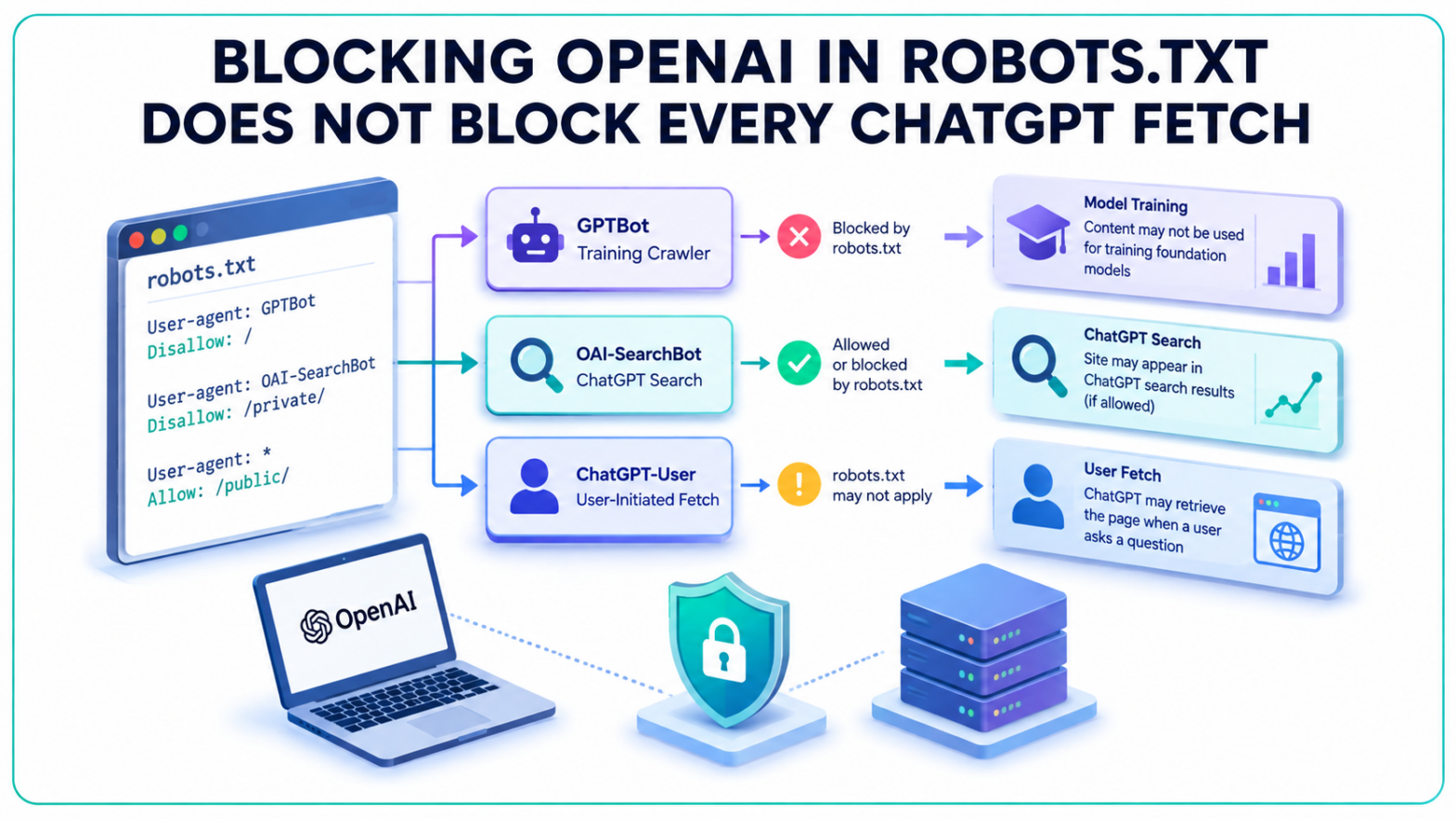
GPTBot is the training crawler. OpenAI says it crawls content that may be used to improve its generative AI foundation models. A site can disallow GPTBot to indicate that its content should not be used for that training purpose.
OAI-SearchBot has a different role. It supports ChatGPT search and is used to surface websites in search results. OpenAI says websites that opt out of OAI-SearchBot will not be shown in ChatGPT search answers, although they can still appear as navigational links.
Then there is ChatGPT-User.
OpenAI describes ChatGPT-User as an agent used for certain actions initiated inside ChatGPT and Custom GPTs. When a person asks ChatGPT a question, the system may visit a webpage using that user agent. OpenAI explicitly says it is not an automated web crawler.
That distinction is easy to miss when all three requests appear as bot traffic in server logs.
TechWyse previously reported that OpenAI crawlers were producing substantially more server activity after GPT-5, with OAI-SearchBot and GPTBot accounting for large volumes of automated requests while ChatGPT-User represented a separate class of user-triggered fetches.
Calling all of them "the OpenAI bot" is no longer precise enough.
robots.txt Controls Automated Crawling, Not Necessarily User Requests
The most consequential sentence in OpenAI's documentation is attached to ChatGPT-User.
"Because these actions are initiated by a user, robots.txt rules may not apply."
That wording does not say ChatGPT-User ignores robots.txt on every request. It says organizations cannot assume the file governs these interactions in the same way it governs OpenAI's automated crawlers.
The reason is architectural.
A traditional crawler independently decides which URLs to visit at scale. robots.txt was designed to communicate crawl preferences to systems operating in that mode.
ChatGPT-User represents something else: a user has asked an AI system to retrieve or interact with information, and ChatGPT may make a request to the relevant website in response.
OpenAI reinforces the separation elsewhere on the same page. ChatGPT-User is not used to decide whether a webpage may appear in ChatGPT Search. For search opt-outs and automated crawling controls, OpenAI directs site owners to OAI-SearchBot instead.
That creates three separate questions for technical teams:
Is OpenAI allowed to crawl the site for model training?
Is the site eligible to be surfaced through ChatGPT search?
Can ChatGPT retrieve a page when a user explicitly asks it to?
A single wildcard disallow rule should not be treated as proof that the answer to all three is no.
An OpenAI Search Opt-Out Is Not a ChatGPT Access Firewall
This is where enterprise governance can go wrong.
A security, legal or publishing team may review robots.txt, see GPTBot and OAI-SearchBot blocked, and conclude that OpenAI cannot retrieve website content.
OpenAI's documentation does not support that conclusion.
Blocking GPTBot communicates a training preference. Blocking OAI-SearchBot controls participation in ChatGPT's search crawling and search-answer visibility. ChatGPT-User sits outside that automated crawling framework because it can operate when an individual initiates a request.
The difference also matters for companies deliberately balancing visibility against content reuse.
Earlier analysis covered by TechWyse found that businesses were increasingly blocking AI training crawlers while remaining more receptive to search and assistant-oriented systems. That strategy depends on treating each user agent independently rather than using one blanket assumption about "AI access."
OpenAI itself says its robots.txt settings are independent. A webmaster can allow OAI-SearchBot while disallowing GPTBot, permitting potential visibility in ChatGPT search without signalling permission for content to be included in foundation-model training crawls.
ChatGPT-User adds another layer to that matrix.
It is not a search-indexing permission. It is not a training permission. And robots.txt alone may not be sufficient to prevent it from making a user-triggered request.
The Real Enforcement Point May Sit Below robots.txt
robots.txt has always been a protocol for communicating crawler rules, not a network security boundary.
That difference becomes much more important with AI agents.
If an organization has content that genuinely must not be retrievable by unauthorized parties, access should depend on controls designed to enforce authorization rather than on crawler directives alone. Authentication, session controls, application permissions, network restrictions and other server-side protections operate at a different layer from robots.txt.
OpenAI publishes IP ranges for its different agents, including ChatGPT-User, OAI-SearchBot and GPTBot, giving infrastructure teams another signal they can inspect when evaluating incoming traffic.
The same distinction already matters elsewhere in OpenAI's crawler ecosystem. TechWyse recently reported on OAI-AdsBot, another separate OpenAI agent used specifically to review landing pages submitted for ChatGPT advertising.
The crawler list is becoming more specialized, not less.
For infrastructure teams, that makes server logs more useful than aggregate analytics. A request from GPTBot indicates something different from OAI-SearchBot, and a ChatGPT-User request points to another type of interaction entirely.
AI Visibility and AI Access Are Becoming Separate Decisions
For marketers and SEOs, the practical implication is straightforward: review OpenAI bot policy by user agent and by business objective.
A company that wants ChatGPT search visibility but does not want its pages included in training crawls can configure OAI-SearchBot and GPTBot differently. A company trying to restrict access to confidential or authenticated material should not depend on robots.txt as the security mechanism. And teams reviewing logs should classify ChatGPT-User separately from automated AI search crawlers because the request can originate from a user's action rather than a background indexing process.
None of that makes robots.txt irrelevant.
OpenAI still uses it as the documented control for OAI-SearchBot and GPTBot, and the company says changes to search-related robots.txt settings can take about 24 hours to propagate through its systems.
But the file now answers a narrower question than some enterprise teams may have assumed.
A disallow directive can tell an automated crawler to stay out. It should not be mistaken for an access-control layer that guarantees ChatGPT can never request the same public URL when a person specifically asks for it.