

Programmatic scale has always rewarded speed. Google is now making that speed carry more governance.
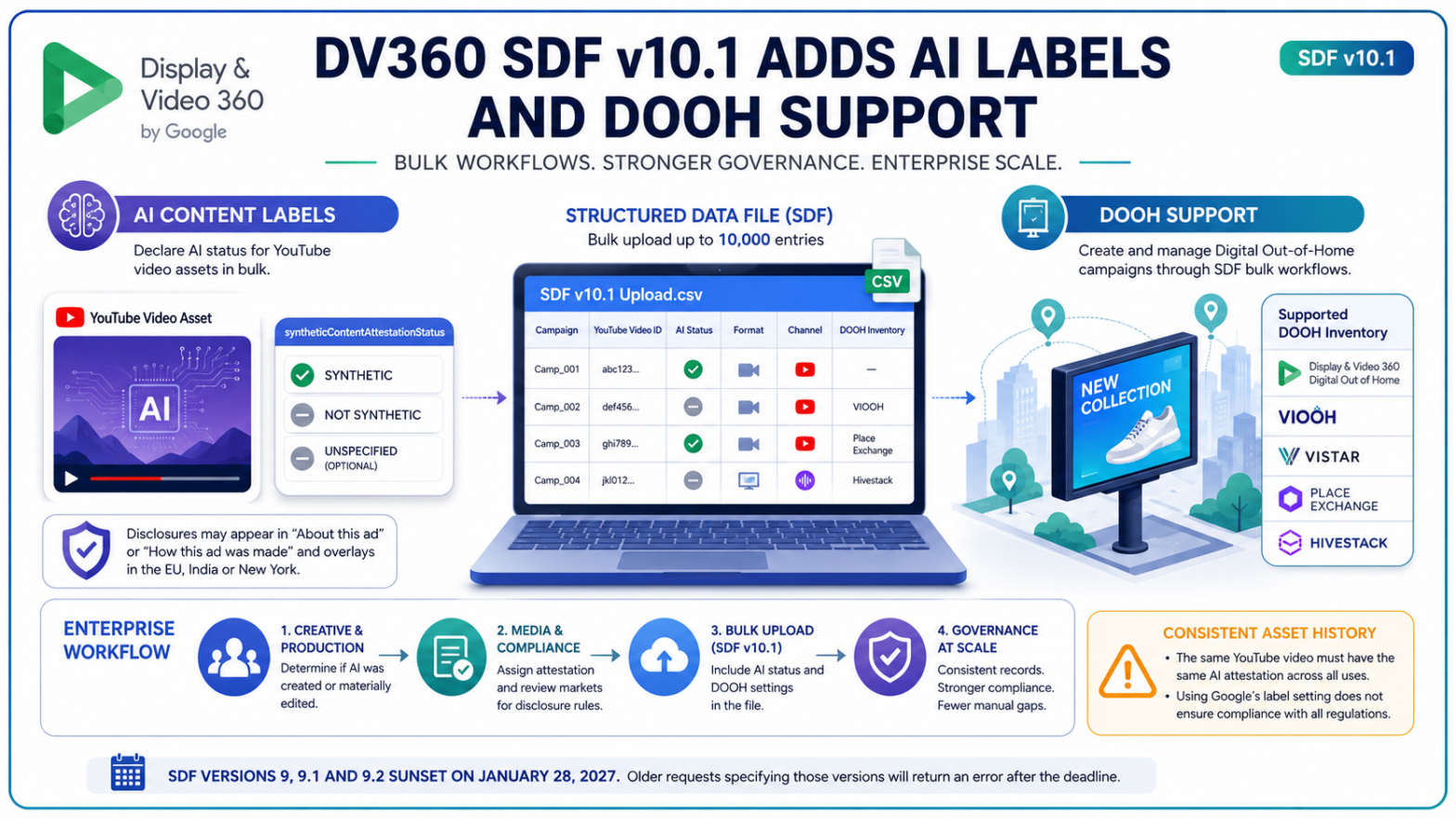
Structured Data Files v10.1 brings AI-content declarations for YouTube video assets and Digital Out-of-Home campaign support into Display & Video 360’s bulk-editing system. For enterprise advertisers, the release connects two jobs that have usually lived in different departments: campaign production and compliance control.
The update is technical. Its consequences are operational.
Bulk Editing Is Becoming a Compliance Layer
Structured Data Files are CSV files used to retrieve and manage Display & Video 360 resources in bulk. Large advertisers and agencies use them to build, audit and update thousands of campaign components without opening each item in the platform.
SDF uploads can contain as many as 10,000 entries, making them central to the way enterprise programmatic advertising teams manage campaigns across markets, product lines and media formats. Google also offers read-only QA versions that replace numeric identifiers with recognizable display names, helping teams review configurations before changes go live.
Until now, some of the newest governance settings could not be fully handled through the same upload process.
Google’s SDF v10.1 announcement closes part of that gap. Teams can include the AI status of YouTube video assets within an SDF upload rather than adding the declaration separately after campaign creation.
That is more than a convenience for accounts with thousands of localized videos.
A compliance field that sits outside the campaign-building file can easily be missed during a rushed launch, an agency handoff or a creative revision. Moving the declaration into the upload structure lets the asset status travel with the campaign data.
AI Content Labels Move Down to the Asset Row
Google’s advertising systems now let advertisers identify whether a creative or asset was created or meaningfully edited with artificial intelligence.
Within the Display & Video 360 API, the setting is represented by the syntheticContentAttestationStatus field. An asset can be marked as synthetic, marked as not synthetic or left without an attestation. Once an attestation has been set, it cannot return to an unspecified state. It can only be changed between the synthetic and non-synthetic values.
SDF v10.1 extends that control to YouTube video assets managed through bulk uploads.
The release should not be read as a universal rule that every video must carry a visible AI warning. Google describes the attestation field as optional, while disclosure obligations depend on the asset and the regions where the ad is served.
Ads containing assets marked as AI-created or edited can receive disclosure information in the “About this ad” experience or the “How this ad was made” section of My Ad Center. Visible overlays may also appear when campaigns target the European Union, India or New York, where Google says local rules require disclosures for certain AI-generated or edited advertising materials.
The practical burden is still substantial. Enterprise teams need to know how each video was produced before the campaign file is assembled.
Google’s broader rollout of AI content labels has already pushed creative provenance into paid media operations. SDF v10.1 makes that provenance usable at bulk scale.
One Video Can No Longer Have Conflicting Histories
Asset reuse creates a less obvious challenge.
Google’s API documentation states that assets tied to the same YouTube video must carry the same synthetic-content attestation when a status has been assigned. A team cannot classify one use of a video as AI-created and another use of the identical video as non-synthetic.
That rule matters for multinational brands.
A single master video may be attached to different campaigns, advertisers, markets or business units. Without a shared asset record, separate teams could make different decisions about whether AI was involved. An SDF validator may catch the technical conflict, but it cannot determine which classification is factually correct.
The file therefore needs information that originates upstream.
Creative teams must distinguish between routine edits and material generative changes. Media teams need access to that decision. Legal or compliance teams may need to review the intended markets. The final attestation then has to remain consistent when the asset appears in another campaign.
Google also cautions that using its label setting does not guarantee compliance with every applicable regulation. The platform can apply a disclosure, but the advertiser remains responsible for deciding whether the asset and campaign require additional action.
DOOH Joins the Enterprise Campaign File
The second part of SDF v10.1 expands support for Digital Out-of-Home inventory.
DOOH campaigns place digital creative on screens outside personal devices, including inventory reached through participating out-of-home exchanges. Google’s exchange reference lists several relevant sources, including Display & Video 360 Digital Out of Home, VIOOH, Vistar, Place Exchange and Hivestack.
Bringing DOOH settings into Structured Data Files gives large advertisers another way to build and edit those line items through standardized bulk workflows.
That is important because Display & Video 360 automation has been expanding across campaign types. Demand Gen resources recently moved deeper into the DV360 API, while SDF v10 added connected TV targeting and new audio inventory options. SDF v10.1 continues that pattern by pulling another channel into the platform’s bulk-management layer.
DOOH does not behave like a browser impression or a mobile video view. Screens can be public, audiences may be estimated rather than individually identified and creative requirements vary by venue and inventory provider.
The value of bulk support is not that it makes those differences disappear. It gives teams a common file structure in which the relevant campaign settings can be created, reviewed and transferred between internal systems.
For enterprise media departments, digital out-of-home advertising no longer needs to remain isolated from the workflows used for YouTube, display, audio and connected TV planning.
Old Templates Will Create New Errors
SDF version changes rarely affect only the spreadsheet itself.
An enterprise deployment may include upload templates, naming scripts, validation rules, data warehouses, campaign-building software and approval tools that expect a fixed set of columns. Adding AI declarations and DOOH support can break those assumptions even when the visible change appears small.
Teams using SDF v10.1 will need their internal systems to preserve the new fields rather than dropping them during exports, transformations or reuploads. Video asset inventories also need enough metadata to assign a defensible AI status before the file reaches DV360.
Older integrations are already facing a separate deadline. Google has deprecated SDF versions 9, 9.1 and 9.2, with all three scheduled to sunset on January 28, 2027. Requests that continue specifying those versions after the deadline will return an error, while affected partner and advertiser defaults will move to v10.
For marketers, the immediate implication is procedural. Campaign uploads should be checked for whether AI status is captured at the YouTube asset level, whether repeated video IDs carry consistent classifications and whether DOOH fields survive every stage of the bulk-editing workflow.
Google has placed those controls inside the same files enterprises already depend on to launch media at scale. The remaining question is whether the records feeding those files are accurate before the upload begins.