AMP is losing one of its most familiar Google-era wrinkles.
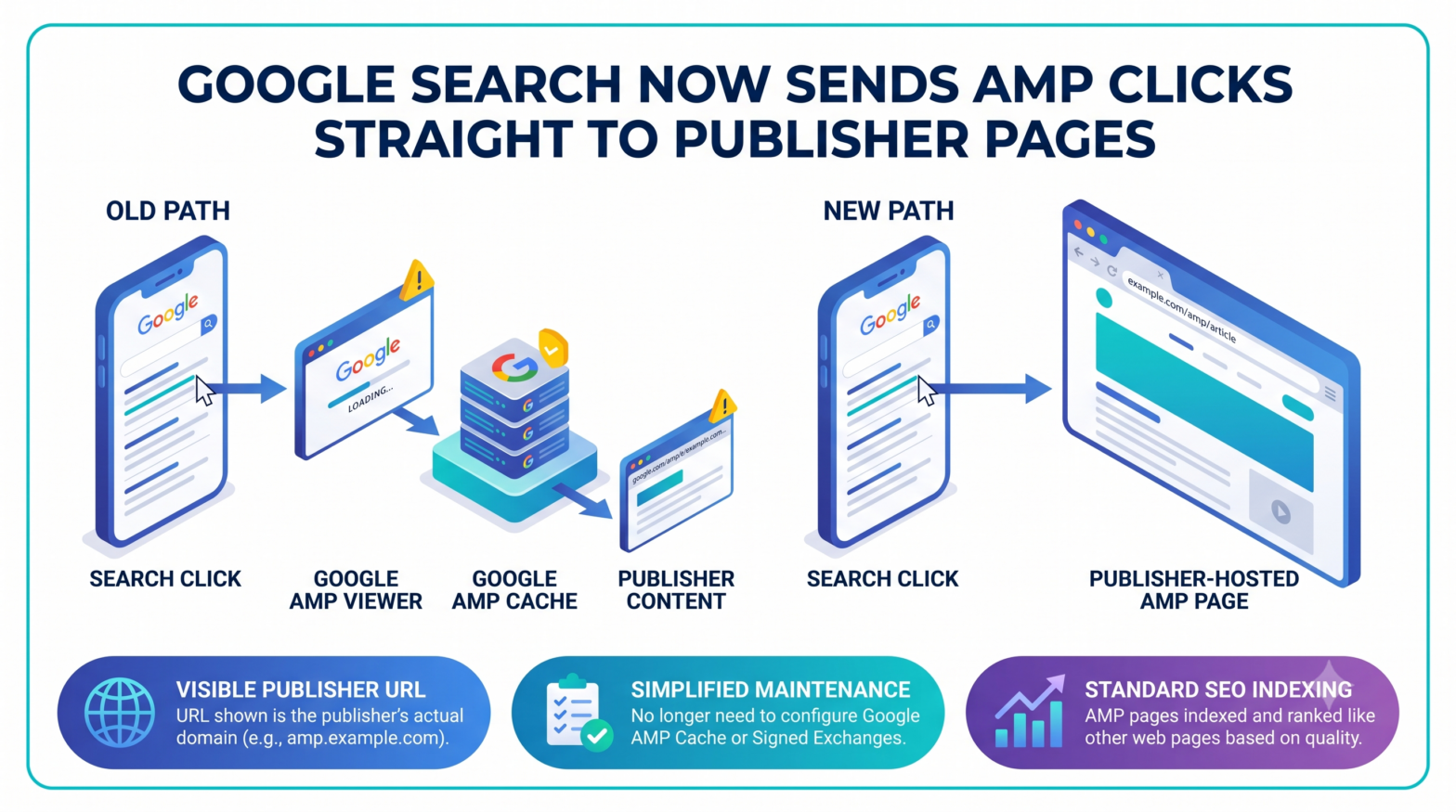
Google Search is no longer routing searchers through its older AMP viewing infrastructure when they click AMP results. Instead, users are being sent directly to publisher-hosted AMP pages, a change Google framed as a simplification for publishers still maintaining AMP content.
The AMP URL Is Now The Publisher’s URL
Google updated its Search Central documentation on July 1, 2026, saying it has “simplified” its AMP documentation by removing outdated references to the AMP Viewer, AMP Cache, and signed exchange. The reason is more important than the cleanup: Google Search now connects users directly to a publisher’s AMP host pages.
That changes the user path.
For years, AMP in Google Search was tied to a layer of Google-hosted delivery and cache-related implementation details. Publishers maintaining AMP pages often had to think about how those pages appeared through Google’s AMP systems, not just how they functioned on their own domain.
The new guidance narrows the operational focus. If a publisher has AMP pages, Google says Search will take users to the AMP page hosted by that publisher. Google also says AMP content will continue to rank like any other web page.
That last point matters for SEO teams watching whether this is a ranking change.
Google is not presenting it as one.
The update is about how Search sends users to AMP pages, not a new advantage or penalty for using AMP. Google’s current AMP documentation says Search indexes AMP pages like other web pages and applies the same standard to all pages, regardless of the technology used to build them.
Google Removes The Old AMP Maintenance Burden
The practical change is maintenance.
Google says publishers creating AMP content no longer need to update the AMP cache or configure signed exchanges. That reduces some of the technical overhead attached to legacy AMP setups, especially for publishers that kept AMP templates live after the format lost much of its earlier prominence in mobile search.
AMP is still supported in Search. It is just being treated more plainly.
Google’s refreshed AMP documentation now focuses on the basics: AMP pages can appear in Google Search as rich results, structured data can help Google understand the page, and AMP pages must still follow AMP HTML requirements.
The page also keeps several familiar standards in place. Users should be able to experience the same content and complete the same actions on AMP pages as they can on the corresponding canonical pages, where possible. AMP URLs should make sense to users. Pages must be valid. Structured data, when used, must follow Google’s policies.
That is the new centre of gravity.
Less Google-specific AMP plumbing. More focus on whether the AMP page works as a proper web page.
Publisher Control Becomes More Visible
The most visible change for users is the URL.
Google’s AMP guidance now tells publishers to use an AMP URL scheme that makes sense because, when users click an AMP result from Google Search, the AMP URL is visible in the browser “like any web page.” Google gives examples such as hosting AMP at an amp.example.com subdomain or in an /amp/ directory instead of using an unrelated domain that could confuse users.
That is a small wording change with a larger product signal.
Search clicks are being framed as direct visits to publisher-hosted pages, not as an experience mediated through Google’s AMP Viewer. For publishers, that makes domain clarity, canonical alignment, analytics configuration, and mobile page quality easier to reason about.
It also fits a wider pattern in Google Search.
Google has been adjusting how publishers appear across Search surfaces, from publisher identity features to AI-driven visibility reporting. TechWyse recently covered how Google Search profiles give publishers a new front door in Search, and how Google Search Console AI reports are expanding. Both moves point to the same pressure point: publishers need cleaner ways to understand where their content is seen and how users reach it.
AMP now sits inside that same conversation.
AMP Still Has To Compete On Normal Search Quality
Google’s documentation does not position AMP as a special ranking lane.
The refreshed page says AMP pages are indexed like other web pages and are held to the same standards. It also says AMP pages can appear as rich results, but structured data does not guarantee rich result eligibility.
For SEO teams, that keeps the decision fairly blunt.
AMP should exist because it serves a site’s publishing, performance, or template strategy. It should not exist because a team expects a separate Google ranking benefit from the format itself.
That distinction has become more important as Google Search has moved deeper into AI Overviews, AI Mode, Discover, and other surfaces where visibility is no longer only about a blue link. TechWyse previously reported that Google says AI Search still runs on SEO, with crawlability, useful content, site experience, and structured data still sitting underneath newer search experiences.
AMP does not escape those basics.
If an AMP page is thin, broken, inconsistent with its canonical version, or poorly structured, the format will not solve the quality problem. If it is fast, valid, crawlable, and useful, Google says it is handled under the same Search standards as other pages.
What Marketers And SEOs Should Check Now
For marketers and SEOs, the immediate work is not to remove AMP. It is to audit it.
Publishers that still maintain AMP templates should confirm that AMP URLs resolve cleanly on their own host, match the user intent of the canonical page, carry the same primary content and actions where possible, and report accurately in analytics. Technical teams should also check AMP validation, structured data consistency, canonical tags, internal links, ad delivery, consent banners, and paywall handling.
Analytics deserves special attention.
A direct publisher-hosted AMP visit may be easier to attribute than older Google-mediated experiences, but only if tracking is configured properly across the AMP and canonical versions. Referral patterns, session stitching, consent mode behaviour, and ad measurement should be reviewed before teams assume reporting will clean itself up.
This is not a broad SEO reset.
It is a cleanup of a legacy AMP pathway that had become heavier than the modern use case required. Google’s updated documentation leaves AMP in Search, removes older infrastructure references, and puts responsibility back where most publishers already wanted it: on the page they host, maintain, measure, and show to readers.