
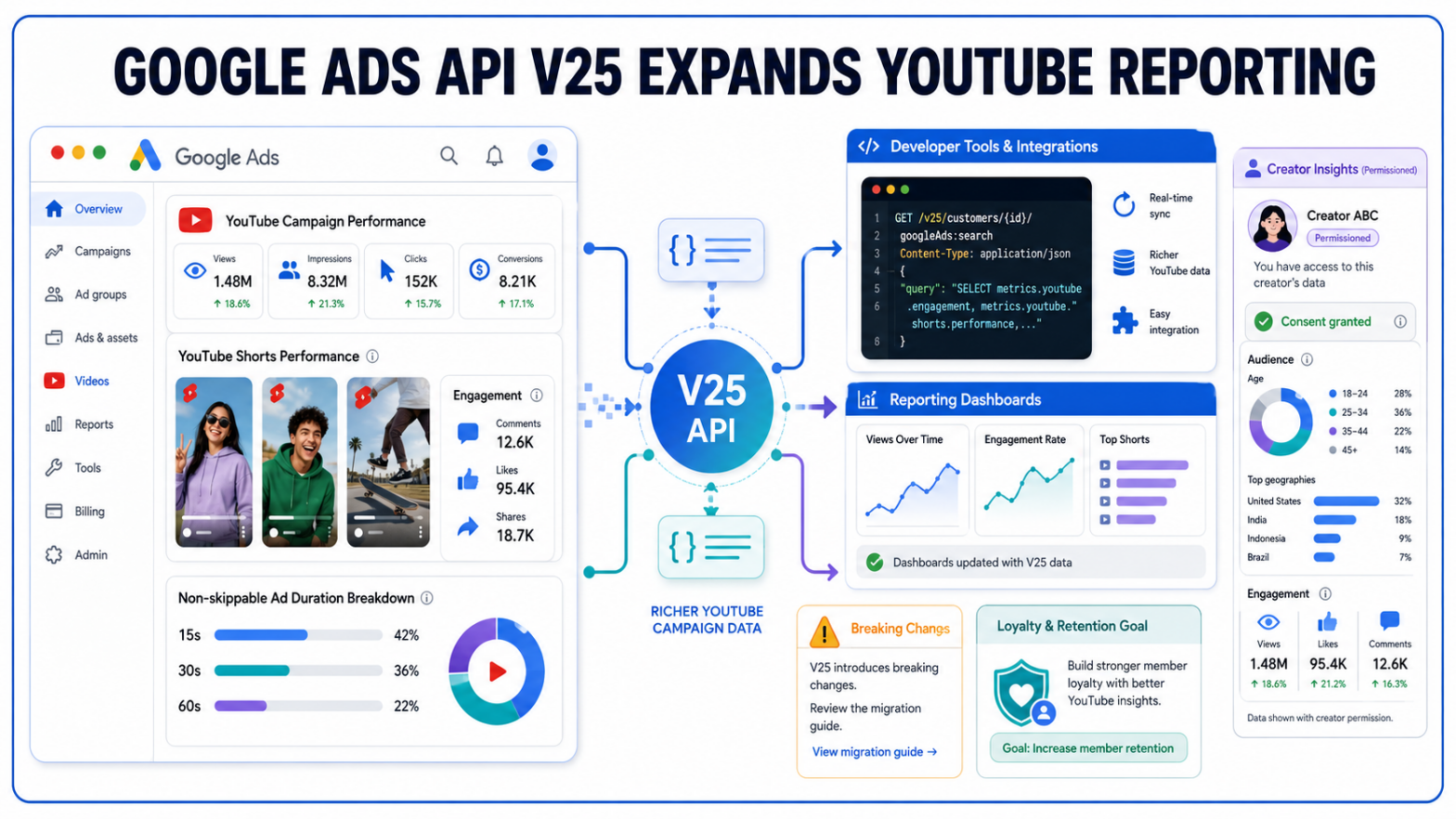
Google Ads API v25 is pushing more campaign intelligence into automated advertising systems. The July 22 release adds deeper YouTube reporting, new lifecycle goals and several breaking changes that advertisers may only feel once their reporting tools or campaign integrations stop behaving as expected.
Google confirmed the release in its Google Ads Developer Blog, with detailed changes published in the official Google Ads API release notes.
YouTube Shorts Metrics Move Deeper Into Google Ads Reporting
The most visible change for marketers is better reporting for YouTube Shorts ads.
Google Ads API v25 adds video-specific social engagement metrics for Shorts campaigns, including YouTube comments, likes and shares. These metrics are available across several reporting resources, including ad group, ad group ad, asset, campaign, customer and video reports.
That gives advertisers and reporting platforms a clearer view of how short-form video creative is being received, not just whether it delivered impressions or clicks.
Shorts has become a major placement inside Google’s video and Demand Gen ecosystem, but reporting has often lagged the way marketers evaluate creative performance on social platforms. Engagement metrics will not replace conversion data. They do, however, give teams a cleaner way to compare creative signals across Shorts assets, especially when campaigns are designed for attention, product discovery or upper-funnel reach.
For agencies and platforms already building YouTube dashboards, the change adds another layer to YouTube ads reporting. Social actions can now sit closer to paid media performance data instead of being treated as a separate platform signal.
Non-Skippable Video Ads Get Duration Breakdowns
Google also added a new ad_sub_format_type segment for YouTube instream non-skippable ads.
The segment breaks down non-skippable ads by duration, including standard, max 30-second and max 60-second categories. Google says the segment must be selected with the ad_format_type field and is available across resources including AdGroup, AdGroupAd, Campaign, Customer, Video and VideoEnhancement.
That is a technical reporting change with practical consequences.
Advertisers running multiple non-skippable formats can now separate performance by duration more cleanly through the API. A 15-second non-skippable unit and a longer non-skippable asset do not carry the same creative burden, viewer experience or media planning logic. Grouping them together can flatten the story inside a report.
The new field should help reporting tools show whether longer non-skippable formats are carrying their weight or simply absorbing spend inside broader video campaigns.
Lifecycle Goals Become More Structured
Google Ads API v25 also updates campaign goal management, with two lifecycle changes standing out.
First, the release adds support for a loyalty retention goal. Google says the goal lets advertisers optimize campaigns for retaining loyalty program members, with account-level and campaign-specific settings available through the API. Campaign-specific settings can include bid adjustments and showing member benefits in Product Listing Ad format.
That points to a continued shift in Google Ads from simple acquisition objectives toward customer-value modelling.
Retailers and subscription businesses have been under pressure to separate valuable existing customers from low-margin or one-time buyers. A loyalty retention goal gives API-connected systems another way to reflect those distinctions inside campaign setup, rather than only after the fact in CRM or analytics reporting.
Second, Google revamped the new customer acquisition goal to fit its unified goals schema. The old CustomerLifecycleGoal and CampaignLifecycleGoal resources and their related services have been removed in v25. Developers now need to configure these goals through the Goal and CampaignGoalConfig resources.
For marketers, the visible impact depends on how their accounts are managed. Teams working entirely inside the Google Ads interface may not notice the schema change. Teams using internal tools, agency platforms or third-party bid management systems may need those systems updated before new customer acquisition settings work cleanly.
Consent-Based Creator Insights Expand
The release also adds more YouTube creator insight fields when creators have consented to share non-public data.
Google’s release notes say the YouTubeChannelInsights.data_sharing_consent_given field shows whether a creator has provided that consent. When consent is present, API users can access fields such as average views per video, average likes per video, average comments per video, engagement rate and channel audience attributes.
That matters for creator-led advertising and partnership planning.
Brands often evaluate creator fit using public signals: subscribers, recent views, visible engagement and audience assumptions. Consent-based fields can add more structured data to that process, especially for advertisers comparing creators at scale or feeding creator insights into planning workflows.
The consent requirement is important. Google is not opening private creator data by default. The additional fields depend on creators agreeing to share non-public information, which keeps the feature tied to permissioned data access rather than broad scraping or inferred audience modelling.
Breaking Changes Put Pressure On API Integrations
Google Ads API v25 is a major version, so the release is not limited to additive features.
The official release notes list breaking changes across campaigns, general services, planning and reports. Legacy customer lifecycle goal resources are removed. Some incentive service fields have been renamed or made required. The consumer email address field in the LocalServicesLead resource is no longer supported. Planning fields such as search_brand have also been removed in favour of newer alternatives.
Reporting integrations also need attention. Google changed the customer_metrics field in certain benchmark reporting responses from a generic metrics type to a CustomerMetrics type that only contains metrics representing the customer’s ad performance.
Practical implications for marketers are straightforward: the release is less about a button inside Google Ads and more about the systems around Google Ads. Agencies, in-house teams and software providers using the Google Ads API should confirm that client libraries, report queries, dashboards and campaign-management workflows are updated for v25 before relying on the new YouTube and lifecycle goal features.
Google says updated client libraries and code examples have been published. The company is also directing developers to its API support channels and release documentation for implementation details.
The timing lands during a busy stretch for Google Ads API changes. TechWyse recently covered Google’s move to block new Smart Campaign creation through the Google Ads API, another sign that legacy campaign paths and older integration patterns are being narrowed while newer goal and automation systems take priority.
For now, v25 gives advertisers more granular data around YouTube Shorts, non-skippable video formats and loyalty-focused campaign goals. The tradeoff is technical: those gains only show up cleanly after developers update the integrations that turn Google Ads API data into everyday campaign decisions.