

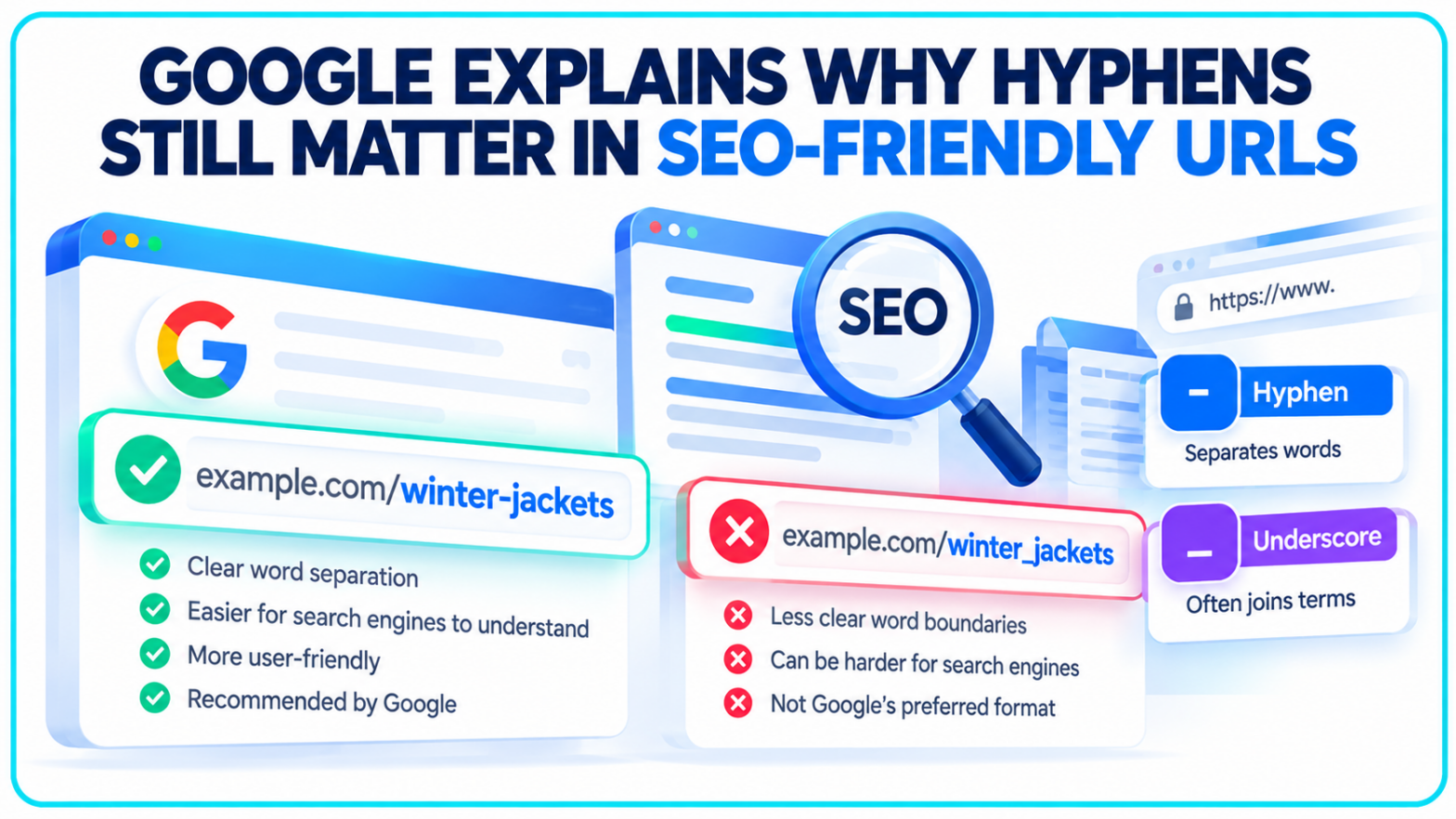
A hyphen and an underscore might look like minor differences in a web address. To Google, they don't serve quite the same purpose.
Google has updated its URL structure guidelines to explain why hyphens remain the preferred way to separate words in website addresses, while underscores are discouraged.
The clarification, published on October 23, 2026, reinforces existing technical SEO recommendations rather than introducing a new ranking rule. It also explains a distinction that has occasionally caused confusion among website owners: a URL can be technically valid without following Google's preferred formatting conventions.
For businesses managing large websites, ecommerce catalogues or frequently updated content, the update offers clearer guidance on how URLs should be constructed. It does not establish a reason to rename every existing page.
Google Wants Hyphens to Mark Clear Word Boundaries
The updated Google Search Central documentation recommends separating words in URLs wherever possible.
Its preference is specific: use a hyphen (-) rather than an underscore (_).
Consider two URLs pointing to similarly named pages:
- Preferred: example.com/winter-jackets
- Not preferred: example.com/winter_jackets
Both formats can function as valid web addresses. The difference is how clearly they communicate separate words.
Google explains that hyphens signal word boundaries, helping search engines and users distinguish concepts within a URL.
Underscores have a different history.
In programming languages, underscores frequently connect words that belong to one identifier. A function named format_date, for example, represents one named concept rather than two separate elements.
Google's revised documentation makes that distinction more explicit. Hyphens indicate separation, while underscores are commonly associated with terms intended to remain together.
The guidance also discourages joining words without separators. An address such as example.com/greendress is less clearly segmented than example.com/green-dress.
None of these examples suggests that underscores prevent Google from crawling a page. They concern how clearly the URL communicates its content.
The change appears in the best-practices section of Google's technical documentation, not in a new list of indexing requirements.
The Clarification Is Not a New Google Ranking Update
Google's Search documentation changelog identifies October 23 as the date of the revision.
The reason is unusually specific.
Google says the revised wording brings its documentation into alignment with episodes of The Non-Canonical Cabinet, a Search Central video series addressing technical questions about how Google processes websites.
The series covers subjects including URL characters, domain names, word separators and other details that rarely receive attention outside technical SEO discussions.
The documentation update should not be mistaken for an algorithm change.
Google has not announced a new ranking penalty for underscores, a preference affecting only newly published pages, or a requirement to migrate existing URLs.
The company already recommended hyphens in its URL guidance. The October revision expands the explanation for that preference.
That distinction matters because URL formatting is only one element of how a search engine understands a webpage.
A descriptive address may provide useful context, but it does not replace the page's content, internal linking structure or other information Google uses to interpret relevance.
The same principle applies to keywords.
Putting an exact search phrase into a URL does not automatically make the page more relevant than another page with stronger content. The revised guidance focuses on readability and identifiable concepts, not on increasing keyword density.
Google's recommendation is to make addresses understandable, not to turn them into strings of search terms.
Existing URLs Do Not Need an Automatic Rewrite
There is an important difference between choosing a URL format for a new page and changing one that already exists.
A website publishing new content can adopt hyphen-separated URLs without disrupting established addresses.
An existing site has more to consider.
Changing example.com/office_furniture to example.com/office-furniture creates a different URL. Even if both addresses display identical content, Google must discover and process the relationship between them.
That process involves more than editing a page slug.
Google's site migration documentation recommends permanent redirects when URLs change, alongside updates to internal links, canonical tags and XML sitemaps.
The company also warns that rankings can fluctuate temporarily while its systems crawl and process moved pages.
For a website with thousands of established product or service URLs, replacing underscores solely to meet a formatting preference could create considerable migration work without evidence of a corresponding ranking benefit.
URL stability remains relevant to crawling and indexing.
TechWyse previously covered Google's warning that changing sitemap URLs to force additional crawling is not a reliable way to accelerate discovery.
The broader technical issue is similar. Changing an address creates another URL for Google's systems to process, regardless of whether the underlying content has changed.
Google's latest clarification does not establish a need for widespread URL replacement.
Complex URL Parameters Remain a Bigger Crawling Concern
The updated word-separation guidance is one part of Google's broader documentation on crawlable URL structures.
Elsewhere in that guidance, Google continues to warn about unnecessarily complicated addresses, particularly those containing large numbers of parameters.
An ecommerce website illustrates the problem.
One product category may generate separate URLs for every combination of colour, size, brand, price and sorting preference. Some combinations display nearly identical content.
When those variations multiply, Google's crawler can encounter substantially more addresses than the website has meaningful pages.
Google warns that excessive URL combinations can consume bandwidth and make it harder to crawl a website efficiently.
The company recommends limiting unnecessary parameters and avoiding URL patterns that generate effectively endless combinations.
Session identifiers, repeated filtering options and dynamically generated calendar addresses are among the examples identified in its documentation.
TechWyse has also reported on Google's crawl budget guidance for larger websites, where reducing unnecessary crawler activity can help preserve server resources.
Other established URL recommendations remain unchanged.
Google advises using descriptive words, keeping addresses readable, avoiding fragments to represent distinct page content and handling URL capitalization consistently when the server treats uppercase and lowercase paths as equivalent.
These considerations address different technical problems.
Hyphens improve word separation. Consistent URL handling helps prevent duplicate addresses. Controlling unnecessary parameters can reduce the number of URLs a crawler must process.
Google's October update specifically clarifies the first issue. It does not introduce new rules for all the others.
SEO Teams Can Apply the Guidance Without Rebuilding Their Sites
For marketers and developers, the most straightforward application is in the rules that generate new URLs.
Content management systems, ecommerce platforms and custom website frameworks frequently produce slugs automatically from page titles, product names or category labels.
Where those systems allow formatting preferences to be configured, hyphen-separated words align with Google's current recommendation.
Technical SEO reviews can also identify inconsistent patterns across newly created pages, especially when several publishing systems contribute content to the same website.
A migration deserves separate consideration.
Before changing established URLs, teams need to account for redirects, canonical references, internal links and sitemap entries. A formatting preference alone does not demonstrate that a migration will improve organic search performance.
Google Search Console can help assess whether pages are being discovered and indexed as expected. TechWyse previously covered how delayed Search Console indexing reports can complicate the diagnosis of technical SEO problems.
The October clarification provides no new evidence that underscore-separated URLs are excluded from Search or that converting them will increase traffic.
Google's position remains a preference for clear word separation when constructing URLs, with hyphens recommended over underscores.
The revised explanation is now part of Google's official URL structure best practices, following the October 23 documentation update.