
Hotels and online travel platforms now have a published technical specification for integrating directly with Google's AI Mode booking feature. The Universal Commerce Protocol (UCP) project announced on September 25, 2026, that a draft of its Lodging Booking capability had been merged into its public GitHub repository, and Google's developer FAQ, updated September 24, 2026, states that the company will adopt the standard to power hotel booking in AI Mode.
Google's Plan and Current Booking Rollout
Google added hotel checkout through Google Pay with ten booking partners in the United States to AI Mode in Search on August 27, 2026. The announcement came from James Byers, Group Product Manager for Search, through the company's official blog. Launch partners include Booking.com, Expedia, Hilton, Marriott, IHG, Choice, Wyndham, Priceline, Hotels.com, and Trip.com.
At the time of that launch, the hotel booking feature was not yet fully reliant on UCP. Byers said the initial rollout used "a mix of integration paths, where we've been piloting different ways to bring these hotels online," adding: "As we scale, we will rely on UCP as the sort of common platform and protocol for scaling this up."
The September 25 specification release is the formal standard that will underpin that scaling. According to Google's developer FAQ for UCP for Lodging, the protocol "is our new open standard designed to unify digital commerce, now expanding to support the travel industry," built "to enable direct, instant bookings across Google Surfaces."
What the Draft Specification Covers
The pull request introducing the capability was submitted on behalf of the Lodging Domain Tech Council and introduces both the `dev.ucp.lodging.booking` capability and a Cancellation Policy Extension.
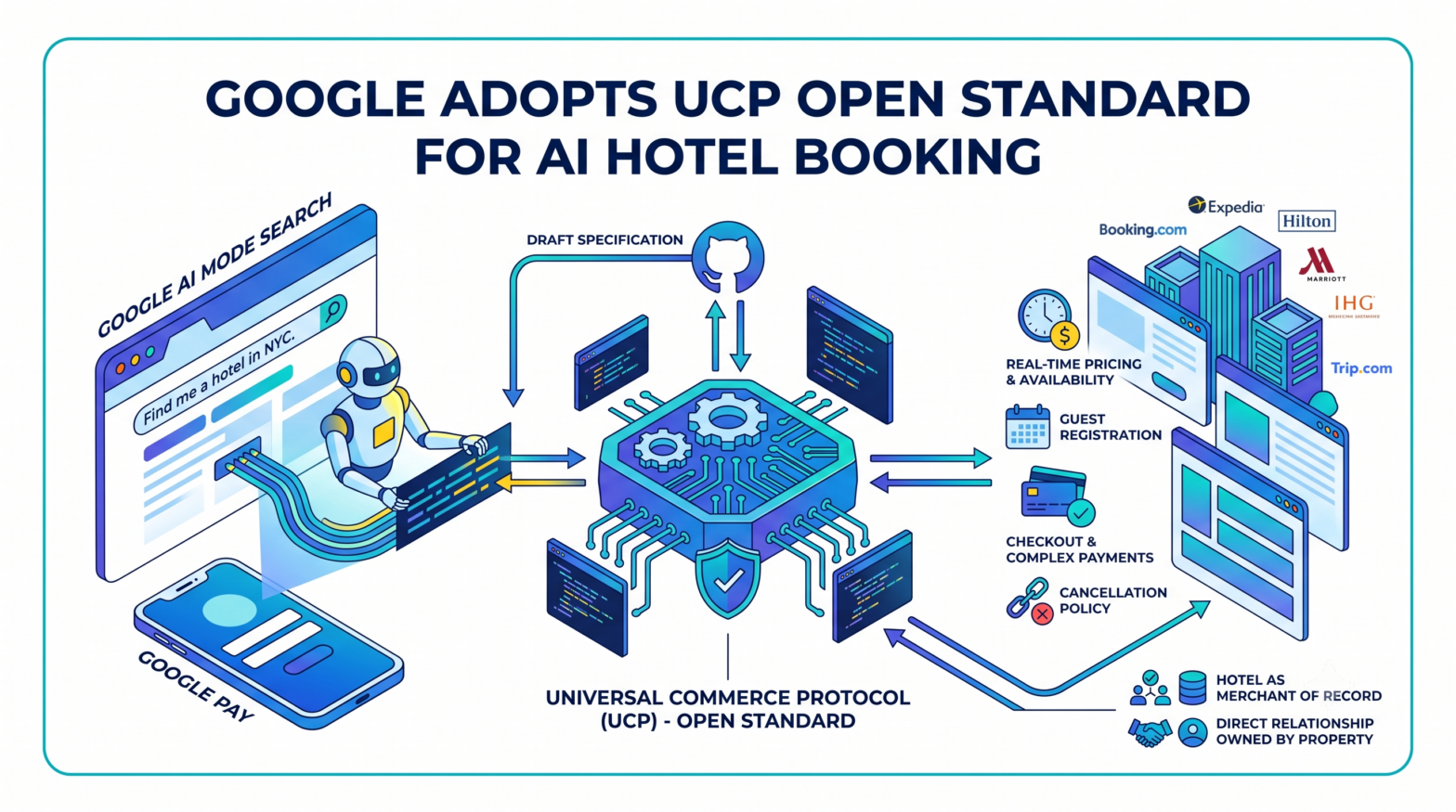
The GitHub announcement lists four capability highlights for the draft: real-time pricing and availability checks for rooms inside AI surfaces; guest registration covering guest details, occupancy counts, check-in and check-out dates, and custom accommodation requirements; checkout with complex payment schedules including deposits, deferred balances, split payments, and cancellation and refund policies tied to the booking lifecycle; and interoperability with core UCP primitives such as identity linking and payment handlers.
The spec states that PCI DSS compliance is not necessary for card payments. Bookings must be finalized by a person through a trusted interface, except when using UCP's AP2 Mandates extension for agent-led payments.
Data models and bindings may evolve, with breaking changes possible, the draft banner warns.
Google's FAQ states that the first milestone covers one room, with multiple rooms described as "potentially as a future extension."
Ranking, Merchant Control, and Payment Requirements
Google's documentation addresses three commercial questions directly. The FAQ clarifies that choosing the booking integration "does not influence how we rank your properties or rates in listings," though entries with UCP integration receive the direct booking option.
Hotels remain the Merchant of Record, "maintaining full control over your customer relationships and the post-booking experience." Properties retain full ownership of their customer relationships, data, and the post-booking experience, and Google's standard security and privacy practices apply to the interaction while the business owns the transaction.
On payments, businesses do not need to support the Google Pay API on their site, but their payment provider must support processing Google's tokens. The FAQ mentions that AP2 can act as a payment layer within UCP for future agent-led transactions, though it stops short of calling it required.
The protocol is interoperable with major industry standards including AP2, A2A, and MCP, and is built to handle the full end-to-end travel journey.
The Council Behind the Specification
The nomination process for the Lodging Technical Council officially closed earlier this year, welcoming inaugural members Amadeus, Booking.com, Expedia, Google, Hilton, Marriott, and Trip.com. On August 11, nominations were finalized, members were appointed and written into UCP's maintainers file, and the vertical received a standing body with the authority to define the lodging spec.
The seven members cover the width of the lodging supply chain: global distribution and online travel agencies (Amadeus, Booking.com, Expedia, Trip.com), hotel groups (Hilton and Marriott), and Google as the consumer surface convening the effort.
Timeline and Access
No switch-over date has been published. Google's UCP for Lodging page currently directs interested businesses to join a waitlist, with detailed onboarding instructions and specifications described as "coming soon."
On September 25, 2026, a maintainer of the Universal Commerce Protocol project announced in GitHub Discussion #864 that the initial draft of the Lodging Booking capability had been merged into the UCP repository and was open for public feedback and contributions.
Implications for Hotel and Travel Marketers
For hotel operators and online travel platforms evaluating the integration, Google's documentation establishes several baseline conditions: the hotel stays merchant of record, property ranking in listings is unaffected by participation, and UCP-generated traffic can be distinguished from direct bookings through lifecycle events shared via the API. Properties whose payment service providers already process tokenized payments will face fewer integration barriers. The current milestone supports single-room bookings only, with multi-room capability listed as a possible future extension. Until Google opens onboarding beyond the waitlist, no self-serve path to integration exists.
In terms of visibility, Google's Group Product Manager James Byers stated that results in AI Mode are not influenced by advertising and are ranked in the same way Google's traditional search results have been ranked.