
Google Search has spent years helping travellers decide where to stay. Now it wants to handle the reservation too.
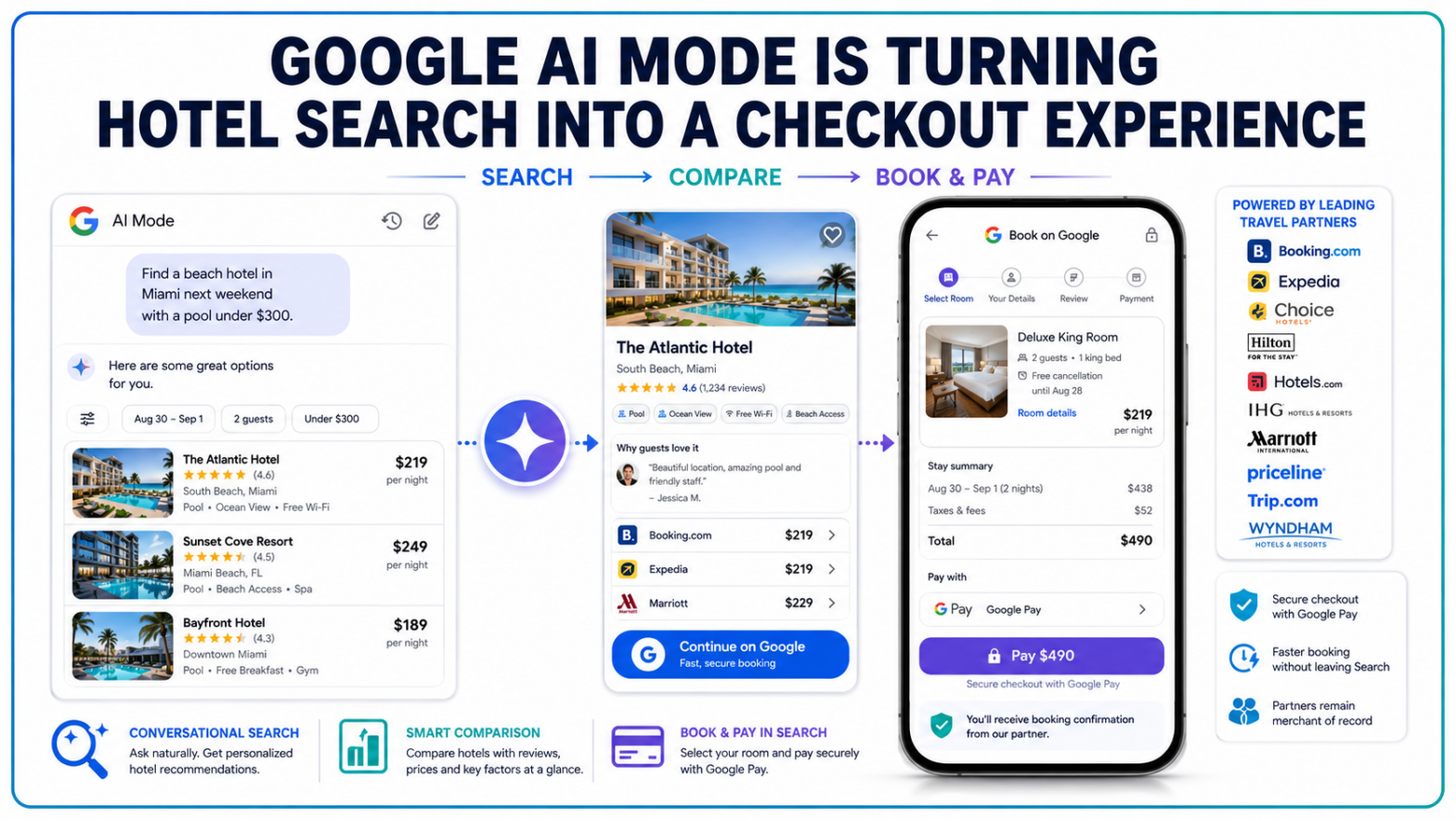
Google has begun rolling out hotel booking directly inside AI Mode, allowing users to move from a conversational travel query to selecting a room and paying through Google Pay without being pushed through the traditional hotel-search-to-website journey. The feature launched August 27 in the U.S. for English-language searches and is rolling out over the coming weeks.
The change is bigger than another travel widget. It puts one of Search's most commercially valuable verticals inside the same AI interface that produced the recommendation in the first place.
The Hotel Website Is No Longer a Required Stop
A traveller can tell AI Mode where they are going, when they are travelling and what they want from a hotel. Google then produces a visual list of properties with guest reviews and factors designed to help compare the options.
From there, the journey changes.
After choosing a property, users can ask AI Mode to complete the booking. Integrated listings display a "Continue on Google" option, which opens a Google-hosted process for selecting a room, checking details such as cancellation policies and completing payment through Google Pay.
That puts the new feature a step beyond the recommendation and app integrations Google has been building into Google AI Mode.
Search can now participate directly in discovery, comparison and conversion.
Google is not becoming the hotel operator or travel seller, however. The hotel chain or booking platform remains the merchant of record and is responsible for customer service after the reservation is made.
That distinction matters. Google owns much more of the interface, but the commercial relationship behind the booking still belongs to its travel partners.
Booking.com, Expedia and Hotel Chains Are Already Inside the Flow
Google is not building the booking inventory alone.
The initial launch includes Booking.com, Choice Hotels International, Expedia, Hilton, Hotels.com, IHG Hotels & Resorts, Marriott International, Priceline, Trip.com and Wyndham Hotels & Resorts. Google says the capability will become available with those partners over the coming weeks.
The mix is notable because it includes both large online travel agencies and hotel groups selling their own inventory.
For travellers, that means the interface can surface multiple routes to the same broader transaction without requiring the user to leave Search first.
For travel marketers, it creates another possible conversion layer between a search impression and an owned website session. Google was already moving travel advertising deeper into its automated Search infrastructure through AI Max and Search Campaigns for Travel. Native hotel booking pushes the consumer side of that transition further.
The booking partner still closes the sale financially. Google increasingly controls the environment where the decision is made.
Flights Show Where Google Has Not Gone Yet
Google announced two other travel features alongside hotel booking, but neither goes quite as far.
AI Mode can now track flight prices while users remain inside a conversation. Travellers can describe their route and dates, review current fares sourced from more than 300 airline and travel partners, and ask Google to monitor the selected trip.
If fares change, Google can send an email alert. Flight price tracking through AI Mode is available in more than 180 countries and territories.
But when someone is ready to purchase a flight, Google still sends them to the airline website or their preferred booking platform.
AI Mode can also display flight and hotel prices in loyalty points or miles. Initial support covers Alaska Airlines/Hawaiian Airlines, American Airlines, Choice Hotels International, Hilton and Wyndham Hotels & Resorts, with Accor, Flying Blue, Hyatt, LATAM Airlines and Lufthansa Group due to follow.
Those rewards results are available globally, but redemption is also completed on the partner's site.
Hotels are therefore the clearest example in this rollout of Google collapsing the transactional journey into AI search itself.
Search Is Moving Past Referrals
For much of Google's history, a commercial search worked through referral economics.
Someone searched. Google ranked or advertised a set of destinations. The user clicked. A merchant, publisher, marketplace or booking platform took over.
AI Mode has steadily weakened that clean handoff.
Google can already assemble answers, generate interactive interfaces and pass tasks into connected applications. Earlier this year, the company also introduced commerce infrastructure that lets purchases happen within its AI-powered surfaces while retailers remain the seller of record.
Hotel booking applies the same architecture to travel.
It also makes Google's broader direction toward agentic search considerably more tangible. A system that finds a hotel, weighs the options and helps execute the reservation is doing more than retrieving information. It is completing part of the user's task.
That changes the value of visibility inside Search. Being discoverable may increasingly depend not only on earning a conventional organic ranking or paid click, but also on supplying the structured information and inventory Google needs to represent a business inside an AI-mediated transaction.
Travel Marketers May See Fewer Traditional Website Journeys
For hotel marketers and SEOs, the immediate practical change is straightforward: some high-intent users may complete more of their decision-making before reaching a hotel or OTA website.
That can make conventional session-based measurement less representative of the entire customer journey. Hotel descriptions, pricing, availability, reviews, cancellation conditions and booking integrations displayed within Google's interface can influence conversion before an owned-site visit occurs — and, in the new booking flow, that visit may never happen.
The shift does not make hotel websites irrelevant. Partners still fulfil reservations, maintain inventory and handle customer relationships. Direct channels also continue to matter outside Google's integrated booking flow.
But the point at which Google stops being a discovery layer is moving.
Google has not announced when direct hotel booking in AI Mode will expand beyond English-language users in the United States. Flight price tracking is already available across more than 180 countries and territories, while points-and-miles results are globally available.
For now, native hotel checkout is the geographically narrowest part of Google's latest travel update.
It is also the part that most clearly shows where Search is heading: not just toward answering a travel question, but toward finishing the reservation.