
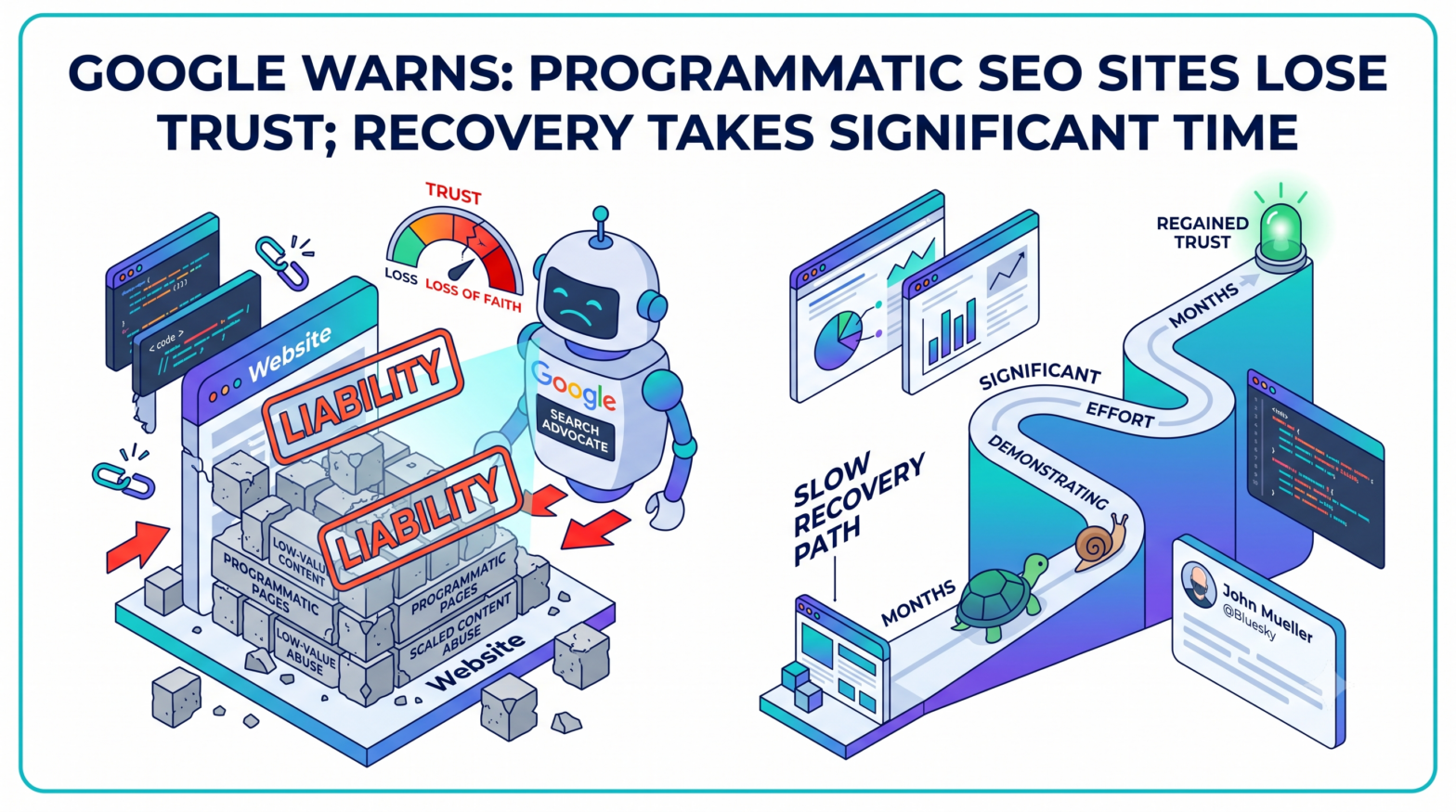
Sites built on low-value programmatic content may carry that history as an ongoing liability in Google Search, even after the pages are changed or removed. Google Search Advocate John Mueller stated on September 7, 2026, in a Bluesky post that Google's systems may have already lost confidence in a site's ability to deliver value to users, and that restoring that confidence is neither quick nor simple.
Mueller's Bluesky Comments
Mueller said that programmatic SEO "often leads to a site that's either spam, borderline spam, or low quality," and that in such cases Google's systems may have "lost faith in your site providing good value to users based on the old pages."
His remarks came in a Bluesky reply to someone describing a site that appeared to generate pages from combinations of domain names, technologies, and attributes. Mueller did not say all programmatic SEO is spam. His comments addressed "programmatic SEO like this," meaning the specific setup that person had described.
The concern Mueller expressed was not about any individual page, but about the site as a whole. He said, "Our systems have possibly lost faith in your site providing good value to users based on the old pages," with the subject of that sentence being the site, not the page set.
Mueller used the word "possibly" and named no specific ranking system, threshold, signal, or penalty. The thread does not describe a stored site-level score, nor does it indicate the effect is permanent.
Why Automated Page Generation Creates Risk
The mechanism Mueller described is a common programmatic pattern: a site iterates through lists of domain names, technologies, and attributes, generating a page for each combination, and ends up with a large number of URLs where each individual page carries minimal value of its own.
In his view, adding more generated content to each page does not address the underlying problem. Mueller added, "It's easy to spin something up with many pages, it's hard to provide real value to users." He treated a page explaining what a PHP term means as the kind of filler that does not improve usefulness for visitors.
Recovery Is Slow
Mueller stated that resolving this type of problem "tends to take time and significant effort to show the value," and framed the recovery timeline alongside how sites work through spam issues and core update impacts.
He pointed to how sites recover from spam and core updates as a reference for scale and effort, while explicitly noting the comparison was about timing and work involved, not a declaration that the site in question was spam.
That framing places mass-generated pages in a category many teams do not plan for: the pages can be deleted quickly, yet the site can still carry the consequence long after they are gone.
Mueller did not describe recovery as something that happens automatically once pages are removed or rewritten, and he provided no specific timeline in the thread.
How This Relates to Google's Existing Policies
Mueller's comments are consistent with Google's published spam policies on scaled content abuse, which have been in effect since March 2024. Google's Search Central documentation defines scaled content abuse as occurring when many pages are generated "for the primary purpose of manipulating Search rankings and not helping users," with the policy applying to content produced through automation, human effort, or a combination of the two.
Google's guidance on generative AI content states that using AI tools to generate many pages without adding value for users may violate its spam policy on scaled content abuse.
The policy is method-neutral: it does not matter whether AI, automation, human writers, or a mix produced the pages. What matters is the scale and the intent. Mueller's Bluesky post does not alter any of these published policies.
What This Means for Site Owners
Cleaning up a set of low-value programmatic pages and demonstrating to Google's systems that a site provides genuine value are two distinct tasks. Mueller's comments indicate the second task carries more weight and takes longer to accomplish. There is no fixed timeline; algorithmic recovery can take months.
Site owners assessing their exposure should note that Mueller's comments were addressed to a specific site configuration, and the word "possibly" in his statement leaves room for variation across different situations. Google's spam policies remain the authoritative reference point: they focus on purpose and user value, not on whether automation was used.
As Google's own policy documentation notes, programmatic SEO is not inherently a violation; volume alone is not the issue. Mueller's concern in this exchange was directed at a configuration where additional pages offered no meaningful benefit to the users who arrived at them.