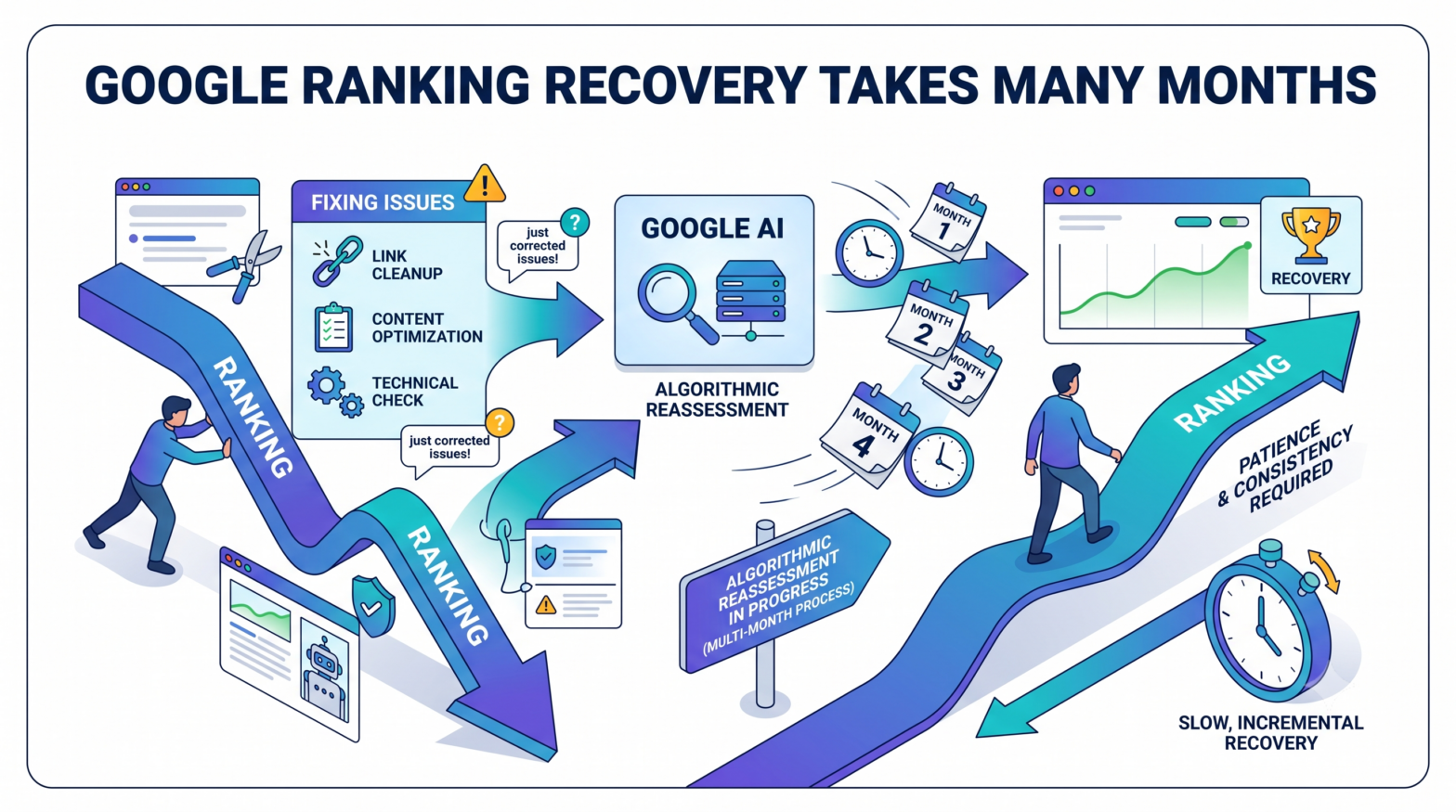
Sites that have lost organic rankings following a major algorithmic change should expect a lengthy wait for recovery, even after underlying problems are corrected. Google's John Mueller stated this directly in a Reddit thread that circulated on September 2, 2026, responding to a site owner who had filed a link disavow and subsequently experienced a collapse in search rankings.
What Mueller Said About Algorithmic Recovery
Mueller's Reddit response addressed a site owner who had disavowed over 800 links flagged as "toxic" by a third-party SEO tool, only to see their organic rankings fall sharply within two weeks of filing the disavow. Mueller opened by pushing back on criticism of the disavow tool in the thread, writing that it "has its place & time" and that "disavowing a handful of links is not going to make your site drop out of search." He advised the site owner to revise the disavow file to reflect what they actually intended, and to look for other causes of the drop.
Mueller noted there had been a broader spam update around the time of the reported drop, and stated that "fixing issues around bigger algorithmic changes can take quite some time — sometimes many months — until you see the effects."
He named two possible causes: the broader spam update, where recovery can take many months, and technical failures on the scale of blocking an entire site. The distinction matters because large technical errors, such as accidentally blocking Googlebot, can be corrected quickly and produce rapid results, whereas algorithmic reassessments do not work on that timeline.
Why the Disavow Is Unlikely to Explain a Sudden Drop
Mueller has previously addressed the question of disavow timing in detail. In a prior statement, Mueller explained:
"With regards to this particular case, where you're saying you submitted a disavow file and then the ranking dropped or the visibility dropped, especially a few days later, I would assume that that is not related. So in particular with the disavow file, what happens is we take that file into account when we reprocess the links kind of pointing to your website. And this is a process that happens incrementally over a period of time where I would expect it would have an effect over the course of… I don't know… maybe three, four, five, six months... So if you're saying that you saw an effect within a couple of days and it was a really strong effect then I would assume that this effect is completely unrelated to the disavow file."
That processing mechanism explains the delay. Mueller has also clarified on Bluesky that Google does not process the disavow file as an immediate filter of the index. Instead, the data is integrated into Google's crawling system, and the neutralization of a disavowed link only occurs when Google naturally recrawls the pages where those links reside.
The August 2025 Spam Update as a Possible Factor
Mueller's Reddit comment referenced a spam update that may have coincided with the site owner's ranking drop. Google's August 2025 spam update ran from August 26 to September 22 and applied globally in all languages. Google classified it as a general and broad spam update and did not announce anything specific about its targeting.
The update produced immediate effects for some sites within approximately 24 hours, then intensified again around September 9, with a number of sites noticing ranking fluctuations and indexing issues. While many impacted sites saw steep declines in organic visibility, some sites previously hit by spam updates saw significant recoveries.
Google Search Central's documentation on spam updates states that sites which see a change should review Google's spam policies for compliance. Making changes may help a site improve if Google's automated systems learn over a period of months that the site complies with those policies. In the case of a link spam update specifically, making changes might not generate an improvement.
What the Site Owner's Link History May Indicate
The Reddit user disclosed that their disavow file included links from guest posts they had purchased through Fiverr, from domains in unrelated niches. Google's published guidance, reinforced by Mueller, is that the disavow tool is relevant where a site's backlink history includes deliberate participation in link schemes, buying links, running private blog network injections, or participating in reciprocal link exchanges at scale. Sites with that history may use the disavow tool proactively as part of a cleanup, but the critical qualifier is that this applies to links the site owner built or paid for, not links that appeared without their involvement.
Mueller has previously stated that "the concept of toxic links is made up by SEO tools so that you pay them regularly," a position that cautions against using third-party toxicity scores as the basis for disavow decisions. A 2026 survey by Editorial.link found that only 39% of SEO professionals still actively use the disavow tool, and a substantial portion of that group are arguably misusing it based on toxicity-score heuristics rather than the situations Google describes. For a site without a manual action, without confirmed self-built manipulative links, and without a measurable negative SEO attack, Google's guidance effectively points to not using the disavow tool at all.
Practical Implications for SEO Practitioners
For site owners and SEO teams managing a post-algorithmic ranking decline, Mueller's statements establish a few working principles. A ranking drop that appears within days of filing a disavow is almost certainly unrelated to that disavow, given the multi-month processing timeline. Sites suspected of being caught in an algorithmic spam update should review Google's spam policies for compliance rather than expecting a rapid reversal. The disavow tool is intended for links a site owner is directly responsible for, not for bulk removal of links identified as toxic by third-party tooling. And where the actual cause is a large-scale algorithmic reassessment, compliance changes should be treated as a long-term correction, not a short-term fix.
Mueller did not confirm that the Reddit user's ranking drop was caused by the disavow file, and he did not suggest the tool was without purpose. He said the file should be corrected to reflect what the owner actually intends, and that the real cause of the drop was likely elsewhere.