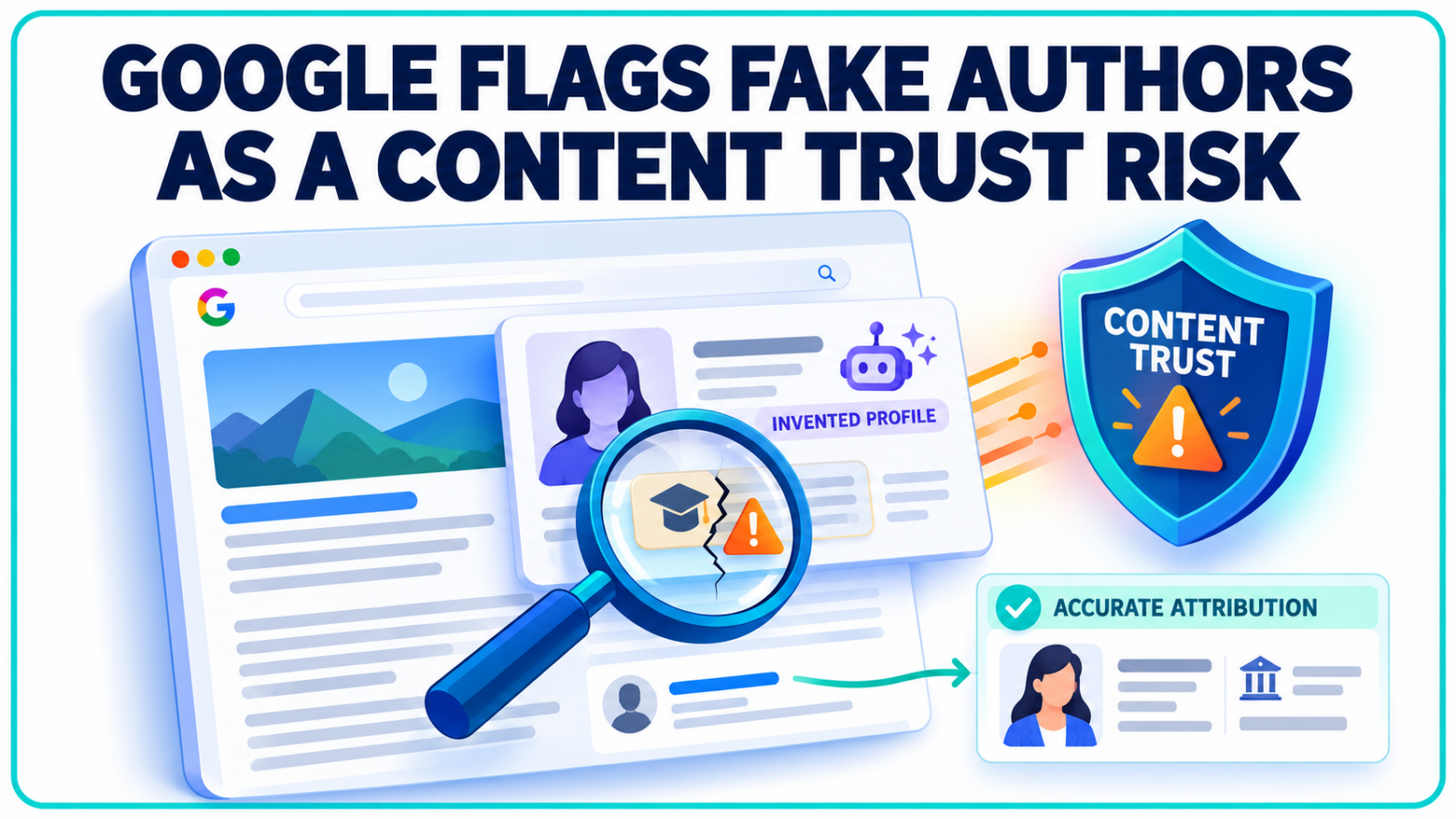
An author box can make a page look credible. Google’s updated content guidance now explicitly warns that inventing the person behind it can make the page untrustworthy to readers and automated quality systems.
The warning names fabricated profiles built with AI-generated headshots, made-up names or false credentials to create the appearance of human expertise. For publishers and businesses, the issue extends beyond whether the article itself contains accurate information: the identity presented alongside it is also a claim.
Fake Author Profiles Become an Explicit Quality Warning
The language appears in Google’s people-first content guidance, in the section discussing who created a page. The document carries an October 5, 2026 update date.
Google continues to encourage accurate authorship information where readers would expect it. The added warning addresses the use of invented identities to make content appear to have been written by human experts.
Its wording is direct:
“Any form of deception makes a page untrustworthy to both users and our automated quality systems”.
The passage identifies deception as a signal of low page quality. It does not announce a separate author-verification product, a universal headshot requirement or a timetable for a new enforcement rollout.
For a site using an invented expert biography, the problem is the representation being made. A polished profile does not establish that the named person exists, contributed to the article or holds the qualifications listed.
The Rater Guidelines Already Describe Invented Experts
The warning has a clear counterpart in Google’s Search Quality Evaluator Guidelines.
Section 4.5.3 covers deceptive page purposes, website information and design. Its examples include AI-generated content paired with made-up author profiles, as well as inaccurate claims about a creator’s expertise. A profile falsely identifying someone as a medical professional is one example.
The guidelines tell evaluators to assign the lowest quality rating to pages using deception. They also recognize that some contexts permit anonymity and that an alias or username can be sufficient for personal contributions on forums or social platforms.
Those distinctions matter. A username identifies how someone participates in a discussion; an invented professional biography asserts qualifications that readers may rely on.
Quality raters assess search results to help Google evaluate its systems. They do not directly set a page’s ranking. The existence of a lowest-quality rating instruction therefore should not be presented as proof that every affected page receives an immediate manual penalty.
The public warning gives site operators a clearer description of the practice Google regards as deceptive.
AI-Generated Content Still Needs an Honest Publishing Record
The warning does not turn all AI-generated content into prohibited content.
Google’s established AI content position focuses on quality and usefulness rather than the production method alone. Automation can support useful material, while using it primarily to manipulate rankings violates the company’s spam policies.
Authorship introduces a separate question: what does the publisher tell readers about the people and processes involved?
An article assisted by automation and reviewed by an actual editor has a different publishing record from one attributed to a fictional specialist. That distinction concerns the accuracy of the attribution, rather than the fluency of the prose.
Google’s current generative AI guide calls for manual fact-checking and review before publication. It extends that review to titles, meta descriptions, structured data and image alt text.
The guide also encourages useful context about how automation contributed to content. It does not describe a disclosure as a substitute for accurate information.
A real reviewer’s role needs equally precise treatment. Reviewing an article, supplying an expert comment and writing it are different contributions. Describing the actual contribution gives readers information they can assess without creating an unsupported impression of authorship.
Structured Data Repeats the Authorship Claim
The author displayed on the page can also appear in machine-readable markup.
Google’s Article documentation supports authors represented as people or organizations. It recommends identifying authors with the appropriate type and a URL or equivalent identity link, and including the authors shown on the page.
An organization can therefore be identified when it is the author. The documentation does not require every article to be attributed to an individual person.
The technical fields also have defined purposes. An author’s name belongs in the name property; job titles and honorifics have separate fields. Multiple authors should be represented separately.
These are attribution rules, not a mechanism for validating credentials.
Google’s general markup policies prohibit misleading information, impersonation and misrepresentation of affiliation. They require marked-up content to reflect what readers can see.
That makes structured data part of the same factual record as the visible biography. Repeating an invented identity in technically valid markup does not establish its truth.
Google also notes that technical testing cannot catch every quality problem. A successful validation result confirms neither that the named expert exists nor that the stated professional relationship is accurate.
Content Teams Have More Than the Article to Check
For marketers and SEOs, the practical implication is a review of attribution alongside the copy: matching bylines, biographies, reviewer credits and author markup to the people or organizations actually involved. Shared author templates deserve attention because one incorrect profile can be repeated across many pages.
This sits within the broader work of SEO, where presentation and metadata describe the content being published. A biography is not merely a design element when it asserts experience or qualifications.
Google’s October 1 generative AI documentation update separately brought its accuracy guidance into line with material used at developer events. The company’s documentation changelog records that change as incorporating information from the quality rater guidelines.
The author warning now appears in the people-first content guide. Google identifies fabricated expertise as deception, while its Article documentation continues to support accurate attribution to either people or organizations.