
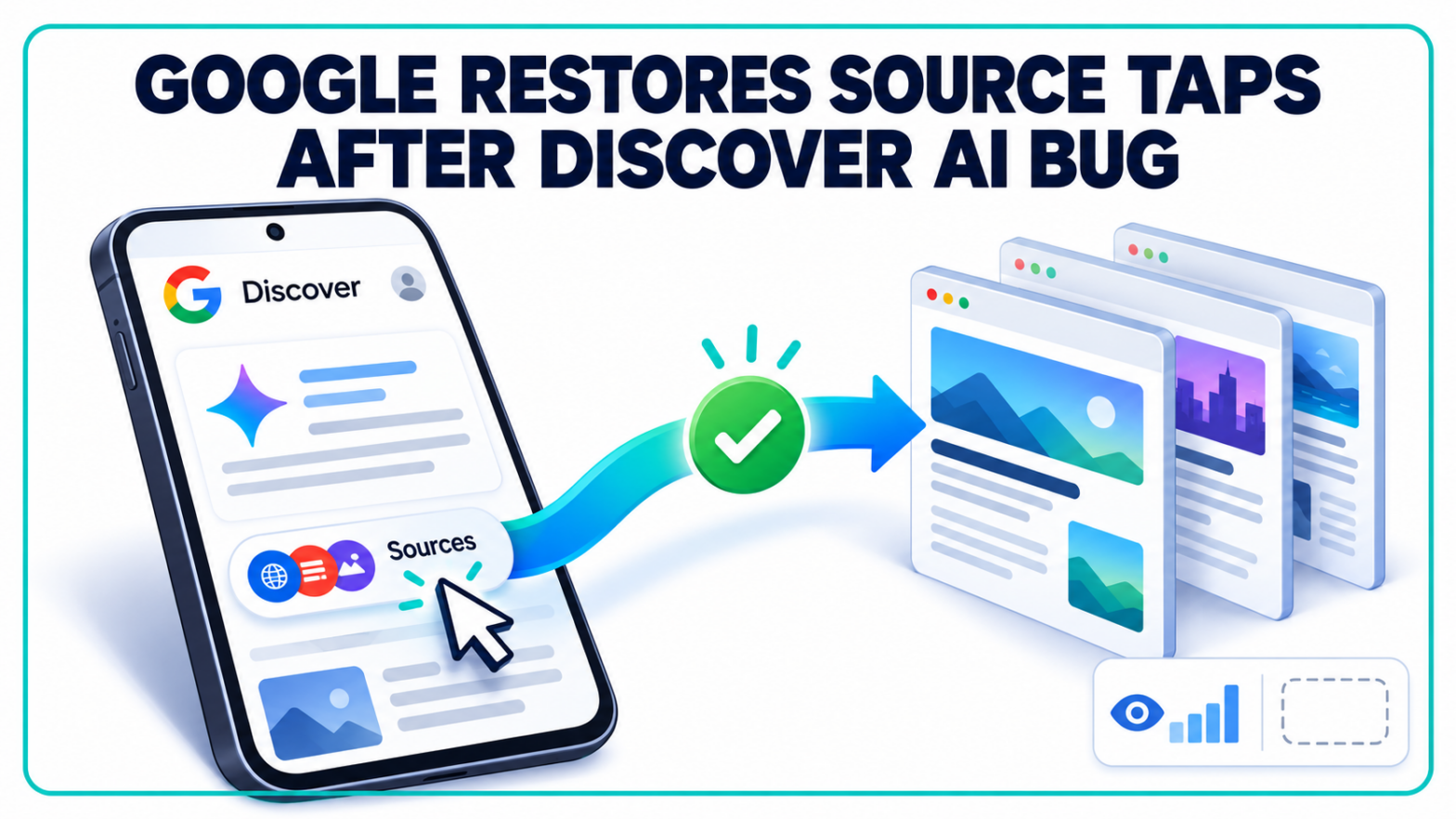
A tap that should have led readers from a Google Discover AI summary to its sources stopped working. Google says the blocked route was a bug inside an experiment, not a permanent removal of publisher links, and the test has now been switched off.
A Broken Exit From AI Summaries, Not a Ranking Change
Rajan Patel, Google’s vice-president of engineering for Search, confirmed on October 27 that the behaviour came from a bug in a Discover experiment. Google disabled the experiment and said the experience was working as intended again.
The issue was first documented on October 23 by Discover researcher Damien Andell. He reported finding an experimental flag named “disable_aio_sources_button_tap,” which prevented the sources control beneath an AI summary from opening its usual article feed.
Under the normal design, tapping the sources area gives a user another view containing articles associated with the generated summary. The affected experiment left those source indicators visible but made the control unresponsive, removing one path from the Google-hosted summary to the underlying content.
Google has not disclosed the purpose of the experiment, how long the faulty configuration was active, which countries were included or how many users encountered it. There is also no indication that the bug changed indexing, content eligibility or the systems deciding which pages appeared in Discover.
The problem was in the interface.
That distinction matters for publishers investigating an unexpected traffic change. A page could still be selected as a source and shown to users while one of the routes to visit it was temporarily unavailable.
Discover Source Links Carry More Weight in an Answer-First Feed
Google introduced an upgraded AI-powered Discover experience in October 2025, initially making it available in the United States, South Korea and India. The company described brief previews that users could expand for more information, along with links for exploring content across the web.
Since then, Google Discover AI summaries have become part of a broader shift from a feed of individual recommendations toward Google-hosted topic exploration. Users may receive enough context to understand a story before deciding whether to visit any publisher.
That makes the placement and operation of source controls consequential. A citation can establish where information came from, but only a functioning link can turn that visibility into a reader visit.
The bug also appeared against a contrasting backdrop. On October 15, Google announced that AI Mode and AI Overviews in Search would show inline links higher in responses more frequently while giving some related articles a more prominent visual treatment. TechWyse has examined how those Discover source links fit into Google’s attempts to give publishers and creators more visible positions within AI-generated experiences.
Those Search changes do not establish how Discover’s separate experiment was designed. They do show why an interface that displayed sources without allowing users to open them attracted immediate attention.
Search Console Cannot Show Who Tried to Tap
Publishers have limited data for determining the practical effect of the bug.
Google’s dedicated generative AI performance report for Discover records impressions. An impression is counted when a user sees a link to a site within a generative AI feature in Discover, provided that the link is scrolled into view. The report can group those impressions by page, country and date.
Google completed the worldwide rollout of those insights on August 31, 2026. The documentation does not describe a source-tap or click metric for the report.
That creates a measurement gap. A publisher might see that its URL appeared inside an AI-powered Discover experience without being able to determine how many people attempted to open the source area, how many reached the article feed or whether the faulty experiment interrupted those interactions.
Conventional Discover reporting is broader. Google’s standard performance report includes impressions, clicks and click-through rate for eligible Discover content when a site meets the required data threshold. Those aggregate figures do not isolate a specific control inside an AI summary.
TechWyse previously covered the launch of Search Console AI reporting and its lack of click data. The source-tap bug shows the practical consequence of that omission: visibility can be measured more precisely than the journey from an AI citation to a publisher’s page.
The Bug Is Fixed, but the Experiment Remains Unexplained
Google’s response closes the immediate issue. It does not explain what the underlying experiment was intended to test.
After Patel’s confirmation, Andell reported on October 27 that the original experiment had been removed and replaced by another configuration named “aio tap falls through to hero.” He did not describe how the replacement behaves, and Google has not published details about its purpose, availability or relationship to the disabled source control.
The internal label alone is not enough to establish how the interface works. It would be premature to conclude that the replacement sends taps to a main video, image or article without documented behaviour or a Google explanation.
What is established is narrower. Some users encountered an experiment in which the source control did not work. Google identified that behaviour as a bug, disabled the experiment and restored the intended interaction.
Google Discover Traffic Still Needs More Than One Measurement
For marketers, SEOs and publishers, the practical response is to treat AI visibility and referral activity as separate measurements. Teams can compare page-level generative AI impressions with standard Discover clicks, click-through rate and analytics referral data, while annotating the October 23 to 27 period so that a short-lived movement is not automatically attributed to content quality or ranking changes.
That comparison still cannot calculate how many visits the bug prevented. A decline in Google Discover traffic can have several causes, including changing audience interests, content mix and updates to Google’s systems. Google itself describes Discover traffic as less predictable than keyword-driven search traffic and recommends treating it as supplemental.
No corrective SEO work has been prescribed because Google did not identify a publisher-side problem. There is no verified evidence that changing structured data, headlines or page content would have affected the disabled control.
The affected source taps are working again, according to Google. The replacement experiment remains active only as an observed configuration name, with no public explanation of what it changes or where users may encounter it.