

Google Discover has traditionally worked like a recommendation engine with an exit door. See an interesting story, tap it, land on the publisher’s site.
Google is now testing what happens when that middle step gets much bigger.
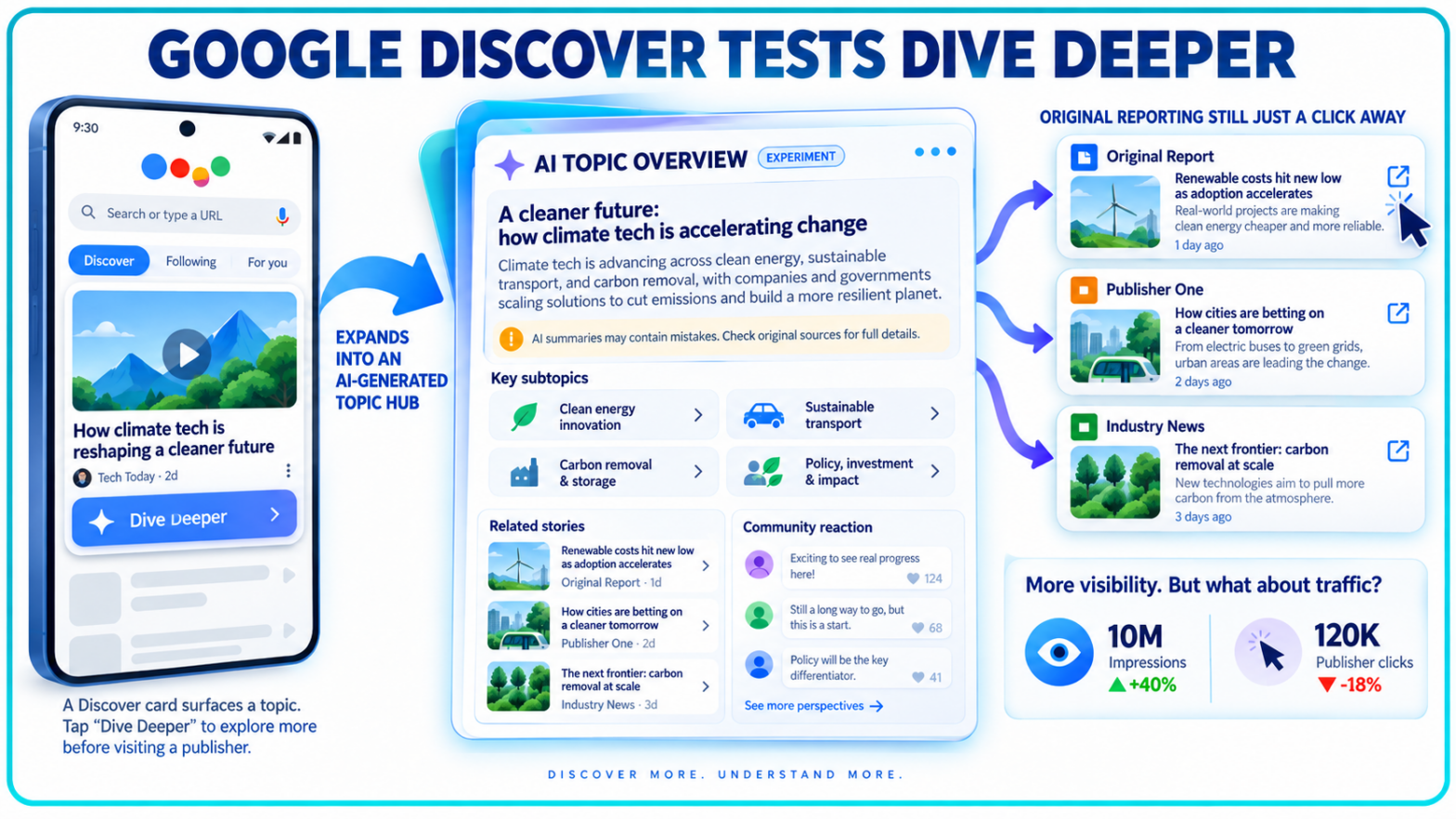
A new “Dive Deeper” experiment lets users open an AI-generated topic overview directly from a Discover card, where Google can summarize the subject, surface related reporting, show community reactions and offer additional links without immediately sending the user to another website. The test starts with video content and could reshape where the actual discovery experience takes place.
Dive Deeper Adds Another Layer Before the Publisher Click
Google Search Vice President Robby Stein described the experiment on September 18 as “a new way to make exploring a topic and discovering related web content easier in Discover.”
The feature appears as a Dive Deeper button beneath participating Discover content. Once tapped, the user moves into a Google-hosted overview rather than directly to the publisher or creator responsible for the original item.
Stein said the experience provides “a short topic overview with prominent links to related stories, community reactions & original reporting.” Google will initially test the feature with videos and experiment with multiple designs in the weeks ahead.
That distinction matters.
Google Discover already recommends articles and videos based on a user’s interests and activity. According to Google’s Discover documentation, eligible content can appear automatically if it is indexed and complies with Discover policies.
Dive Deeper moves beyond recommending the next piece of content. Google is testing whether it can assemble the broader topic experience itself.
AI-Generated Topic Overviews Change the Shape of Discover
The example shared with the experiment shows the shift clearly.
A video appears in Discover with an AI-generated summary and a notice warning that the generated information can contain mistakes. The Dive Deeper view then expands the subject, presents source cards and groups additional reporting into related subtopics.
Publisher links remain present.
But they now compete with an information layer that may answer some of the reader’s immediate questions before a visit occurs.
That puts the test in the same broader direction already visible across Google Search. TechWyse previously reported that 68% of U.S. Google searches ended without a click during the first four months of 2026, based on SparkToro analysis of Similarweb clickstream data. Search behaviour and Discover behaviour are not interchangeable, so that figure cannot be used to predict what will happen inside Discover. It does show why publishers are paying close attention whenever Google adds another answer layer between exposure and an external website.
Google has taken the opposite position on the larger AI search debate, arguing that its AI experiences can expose users to a wider range of websites and help them find original content. The company has also been expanding direct source links across generative Search experiences, giving publishers more visible citation opportunities inside AI-generated results.
Dive Deeper will test whether those links translate into visits when the surrounding context is already available inside Google.
Discover Visibility and Discover Traffic Could Split Apart
This creates an increasingly important distinction for publishers: appearing in Google is not necessarily the same thing as receiving Google traffic.
That gap is already visible elsewhere in AI Search. TechWyse examined the same issue when Google began testing publisher payments for content contributing to AI-generated answers. A page can help generate an answer, appear as a cited source or receive an impression without producing a traditional referral visit.
Google now provides dedicated Search Console reporting for generative AI features in Discover. The report tracks impressions, pages, countries and dates, allowing site owners to see which URLs are being surfaced inside AI-powered Discover experiences. Google completed the worldwide rollout of those insights on August 31.
There is a measurement limitation, though.
The dedicated Discover AI report currently describes impressions rather than clicks for individual generative AI features. It also does not provide a Dive Deeper-specific breakdown. If Google counts the experiment within the generative AI report, publishers may be able to see that their content was exposed without being able to isolate exactly which AI interface produced the impression.
That makes the relationship between visibility and traffic harder to diagnose.
TechWyse has previously covered the expansion of Google Search Console AI visibility reporting as publishers try to separate AI exposure from conventional organic performance.
Google Discover Is Becoming More Than a Feed
Discover has always been different from keyword-based Search.
There is no typed query. Google predicts what a user may want to read based on interests, activity and other signals, then builds a personalized feed around those assumptions. That recommendation model has historically made Discover traffic unusually volatile.
Google itself says Discover traffic can be less predictable than keyword-driven Search traffic and recommends treating it as supplemental to search referrals rather than a dependable baseline.
TechWyse has also examined how recommender-system logic may shape Google Discover visibility, particularly as Google tries to predict interest before a user searches.
Dive Deeper adds a second role.
Google is no longer only deciding which article, video or publisher should appear next. The system can also decide which facts deserve emphasis, which related stories belong together and which sources should be surfaced inside the expanded topic.
That gives publishers another visibility opportunity, but it also moves more of the editorial discovery journey onto Google-owned surfaces.
Publishers Will Need to Watch Clicks, Not Just AI Impressions
For SEOs, publishers and content teams, the practical issue is measurement.
An increase in AI-generated Discover impressions could look positive in isolation. If standard Discover clicks remain flat or decline at the same time, the underlying audience behaviour tells a different story. Publishers should compare conventional Discover clicks and CTR against generative AI impressions rather than treating additional AI visibility as equivalent traffic.
Content format also matters because Google is starting this experiment with video. Search Console now supports platform properties for YouTube, TikTok, Instagram and X, allowing publishers and creators to monitor how social and video content appears across Search and Discover.
Google has not announced when Dive Deeper will expand beyond video, how large the current experiment is, which markets are included or whether the format will become a permanent Discover feature.
For now, it remains a test.
But the interface shows where Google is experimenting: not simply with which story deserves the next Discover card, but with whether the topic itself can be explored without leaving Google first.