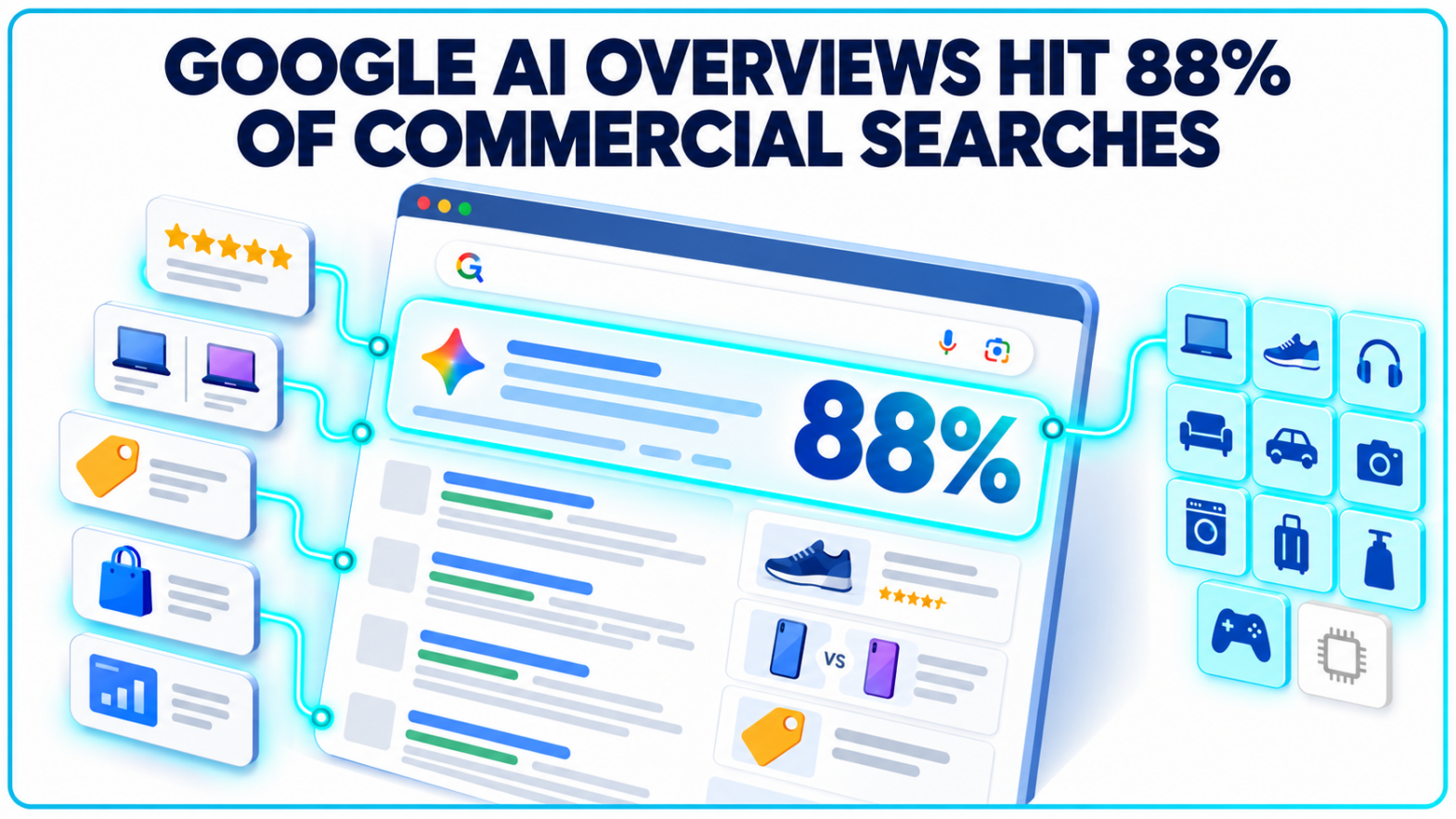
Google’s AI layer is no longer confined to early research. In a year-long Semrush panel, AI Overviews appeared on 88% of tracked commercial keywords, placing generated answers directly inside more product comparisons, reviews and pricing searches.
Commercial Keywords Are Now AI Overview Territory
The Semrush commercial-search study tracked a fixed panel of 400 U.S. desktop keywords from September 2025 through August 2026. The queries covered banking, e-commerce and software, with five modifiers associated with shoppers approaching a decision: alternatives, brand comparisons, “best X for Y,” pricing or cost, and reviews.
AI Overview coverage across the panel climbed from 45.75% in September 2025 to 88% in August 2026.
The increase matters because these searches sit closer to a purchase than broad informational questions. Someone comparing two software platforms, reading a bank account review or checking the price of a product is not simply gathering background knowledge. That person may be narrowing a shortlist.
Google AI Overviews can now mediate that decision before the user reaches a conventional organic result. A generated response may summarize product differences, identify alternatives or consolidate reviews while displaying its own selection of supporting sources.
The study does not represent every commercial search. Its findings are limited to the 400 keywords, three industries, U.S. desktop data and five query groups that Semrush monitored. Within that panel, however, the direction was consistent: every commercial modifier finished the study with substantially more AI Overview coverage than it had at the beginning.
Review Searches Recorded the Sharpest Increase
Reviews began as the least-covered query type in the dataset. AI Overviews appeared for 30.14% of tracked review keywords in September 2025.
By August 2026, that figure was close to 90%, an increase of roughly 59 percentage points and the largest gain among the five modifiers. Reviews moved from the bottom of the group to its second-highest coverage level in 12 months.
“Best X for Y” queries finished even higher at 96.12%. These searches gained 53.4 percentage points during the study and became the modifier most likely to produce an AI Overview.
Brand-versus-brand searches changed less dramatically because they started from a higher base. Coverage rose by 23.18 percentage points from 63.41%, placing more than 86% of those tracked comparisons behind an AI-generated answer by August.
Alternative searches also crossed 82%. By the end of the study, each of the five commercial query groups had AI Overview coverage between 82.05% and 96.12%.
That narrow range is significant. The data suggests Google’s generated summaries are no longer appearing selectively within one corner of commercial research. Across this sample, they became a common feature throughout the consideration stage.
E-Commerce Closed a 35-Point Industry Gap
E-commerce experienced the largest industry-level increase. Coverage rose from 32.62% in September 2025 to 85.11% in August 2026.
Software had started the period at 68%, more than 35 percentage points ahead of e-commerce. By the final month, banking, e-commerce and software were all between 85% and 91%. The difference between the most-covered and least-covered industry had fallen below six percentage points.
Three of the 15 industry-and-modifier combinations reached 100% coverage within the fixed keyword panel: “best X for Y” searches in banking, alternative searches in software and “best X for Y” searches in software.
A few areas remained less saturated. Banking alternatives finished at 65%, e-commerce price and cost searches reached 71.43%, and software reviews reached 75%. Even those combinations recorded substantial growth. E-commerce price and cost queries, for example, climbed from 4.76% to 71.43%.
The study also examined estimated search demand rather than treating every keyword equally. When Semrush weighted the results by monthly search volume, AI Overview coverage reached 97.08% in August. The 12% of keywords that did not produce an Overview accounted for less than 3% of the panel’s estimated search volume.
AI Search Visibility Is Becoming a Separate Performance Layer
Traditional rankings still determine whether a page is discoverable, but they no longer describe the entire search result. A brand can rank organically, appear as a cited source inside an AI Overview, receive an uncited mention or remain absent from the generated response.
That makes AI search visibility a separate measurement problem. Rankings, AI citations, brand mentions, impressions, clicks and conversions may move independently.
Google’s guidance for site owners says no special schema or AI-specific file is required to appear in AI Overviews or AI Mode. A supporting page must be indexed and eligible to display a Search snippet, while established practices such as crawlable content, accurate structured data, internal linking and a strong page experience remain relevant.
For marketers, the practical adjustment is to monitor commercially important results as complete interfaces. Comparison pages, product details, pricing information and review content should be checked for both conventional rankings and inclusion in the generated response. Third-party sources also matter because an Overview may cite review platforms, videos, community discussions or independent comparisons alongside a brand’s own website.
The underlying SEO strategy remains grounded in accessible, useful and current information. What changes is the number of surfaces that can influence a buyer before the click.
Coverage Does Not Prove a Loss of Traffic or Sales
The Semrush study measured whether an AI Overview appeared. It did not measure click-through rates, conversions, revenue or how users interacted with the generated answers.
The findings therefore cannot establish that the expansion caused organic traffic to fall or changed purchasing behaviour. They show that AI Overviews occupied more of the commercial results pages in the panel, including queries with high estimated search demand.
Google is still changing how those answers connect users with publishers and brands. Its October 2026 AI Search update added more prominent inline links, expanded source context and introduced new treatments intended to make supporting pages easier to explore.
Those interface changes arrived after the Semrush tracking period ended. The study’s final August snapshot captured three industries clustered above 85% coverage, while leaving the effect on clicks and conversions unanswered.