
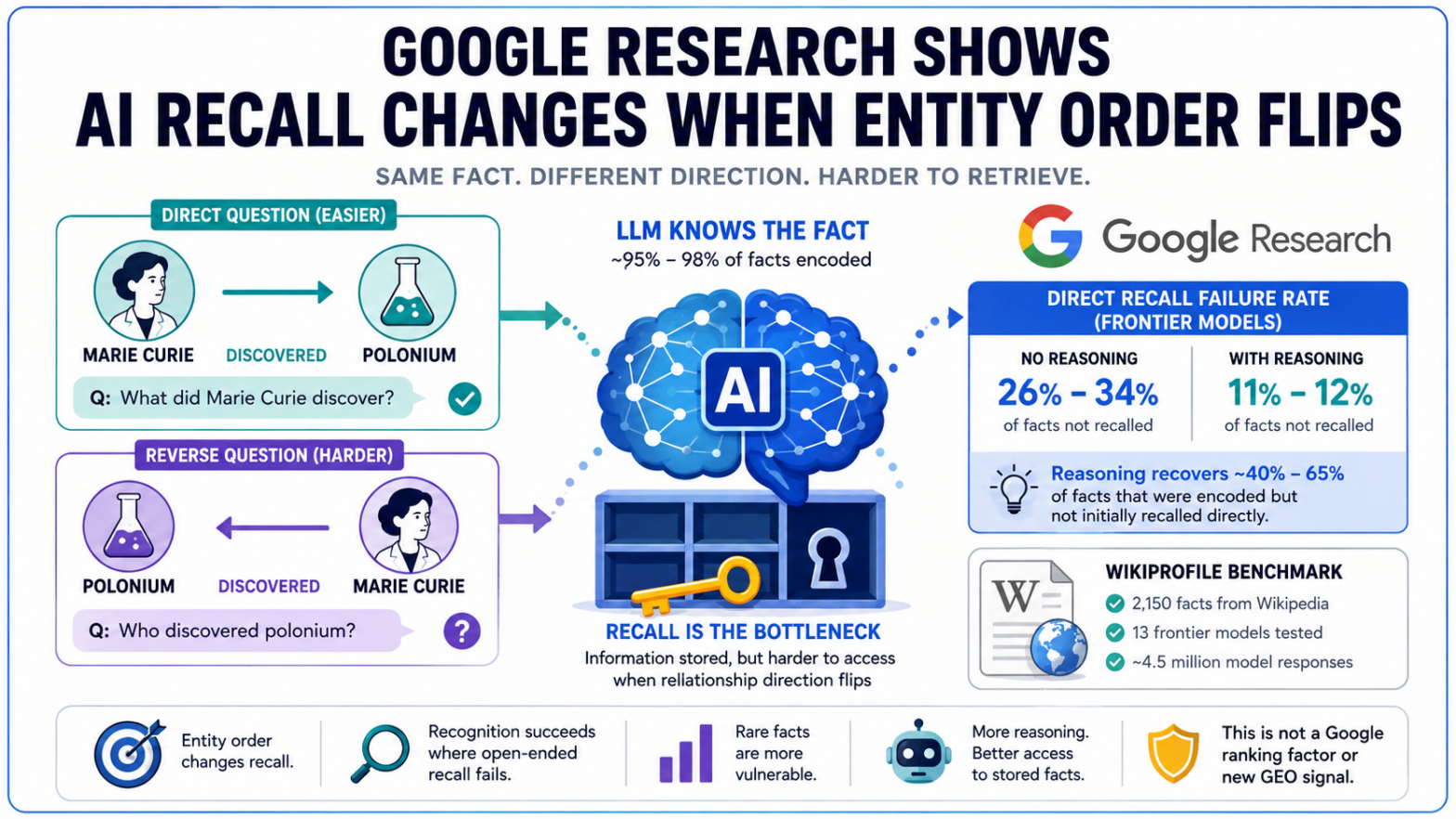
AI models can know a fact and still fail to give it back.
New Google Research shows that some of the strongest large language models struggle to recall information when a question reverses the relationship between two entities from the way that relationship appeared in training data. The finding puts new evidence behind a long-running problem in generative AI: factual knowledge is not necessarily equally accessible from every direction.
For publishers and SEOs, the research is significant. But it does not establish a new Google Search ranking factor or prove that websites need to rewrite every fact twice.
The issue is narrower, and more interesting.
AI Models Are Storing More Facts Than They Can Reliably Retrieve
Google Research published its findings on August 12 in a study titled Empty Shelves or Lost Keys? Recall Is the Bottleneck for Parametric Factuality.
The researchers wanted to separate two problems that conventional AI accuracy tests often combine.
One is an encoding failure: the model never successfully learned a fact.
The other is a recall failure: the model appears to have encoded the information but cannot retrieve it when asked.
Google evaluated 13 large language models using WikiProfile, a benchmark containing 2,150 facts derived from Wikipedia. Each fact was tested through multiple tasks designed to measure whether it had been encoded, could be recalled directly or could be recognized when the answer appeared among alternatives. The experiments produced roughly 4.5 million model responses.
The gap was substantial.
For frontier models including Gemini 3 Pro and GPT-5, Google found that roughly 95% to 98% of tested facts were encoded. Yet those models still failed to directly recall 26% to 34% of them. With reasoning or "thinking" enabled, the failure rate dropped to roughly 11% to 12%.
The model often had the information.
Getting it out was the problem.
That distinction adds another layer to how marketers should think about generative AI systems. More training data and larger models do not automatically guarantee consistent factual retrieval.
Reverse the Relationship and Recall Gets Harder
One part of Google's findings is especially relevant to content structure.
WikiProfile represents facts as ordered relationships between a subject and an object. Researchers then asked questions in both the original direction and the reverse direction.
Consider a simplified relationship:
Marie Curie → discovered → polonium
A direct question follows that relationship: "What did Marie Curie discover?"
A reverse question starts from the other entity: "Who discovered polonium?"
The underlying fact has not changed.
The retrieval path has.
Google found that models consistently had more difficulty generating answers to reverse questions than direct ones. Yet when the same reverse relationships were tested through recognition tasks, where models could choose the correct answer from several options, much of that disadvantage disappeared.
That matters because it suggests the information was not simply missing.
Google's researchers concluded that the fact could be encoded and recognizable while remaining difficult to retrieve when the question approached the relationship from a direction different from how it was originally encountered.
This is closely related to what researchers call the "reversal curse." Google's latest work reframes at least part of that phenomenon as a recall problem rather than evidence that the model completely lacks bidirectional knowledge.
Training Context Appears to Leave a Retrieval Fingerprint
Entity order is not the only variable Google identified.
The researchers found that recall becomes more difficult when a query moves away from the wording, context or relational direction in which information was originally learned. Rare or long-tail facts were particularly vulnerable.
Models encoded uncommon facts at rates much closer to popular facts than their eventual answer accuracy might suggest. The larger discrepancy appeared during recall.
That provides useful context for the growing AI search conversation.
Traditional search retrieval can locate a document containing a fact even when a user's wording differs from the page. Parametric recall asks a language model to retrieve information stored within its learned weights. Google's research shows that access to that stored information can remain sensitive to how the question is framed.
Reasoning helped.
Among models optimized for thinking, Google found that the extra reasoning process recovered approximately 40% to 65% of facts that had been encoded but could not initially be recalled directly. For facts that did not appear to be encoded, the recovery rate was only about 5% to 15%.
That supports the researchers' broader conclusion: increasingly capable models may have less of a storage problem than an access problem.
This Is Not a New GEO Ranking Signal
The obvious SEO temptation is to turn the research into a formatting rule.
Write every entity relationship both ways. Repeat important facts in multiple syntactic structures. Build pages around every conceivable prompt.
Google has not said that.
The study tests parametric factual knowledge in LLMs using Wikipedia-derived facts. It does not test rankings, citation selection, AI Mode source retrieval or the eligibility of webpages for AI Overviews.
That distinction is important because Google's current Search guidance points in a different direction. As TechWyse previously reported in its coverage of generative engine optimization, Google says publishers do not need special AI-oriented text formats, artificial content chunking or a separate optimization framework to appear in its generative Search experiences.
Google Search also uses retrieval systems that can bring external web content into generated responses. That is not the same process as asking a model to answer strictly from information encoded in its parameters.
So the study should not be read as evidence that subject-object order is now a Google ranking factor.
It does show something more fundamental: machines may form and retrieve relationships asymmetrically, even when they appear to understand both entities.
Clear Entity Relationships Now Have a Stronger Technical Case
For content teams, the practical implication is measured rather than radical.
Important factual relationships should be stated clearly, explicitly and in natural language. Pages describing people, products, organizations, locations or technical concepts benefit when the relationship between entities is unambiguous rather than buried in vague pronouns or assumed context. Where users genuinely approach the same information from different directions, covering those perspectives naturally may also make the content more complete.
There is no evidence in Google's paper that mechanically duplicating sentences or reversing every subject-object pair will improve visibility in AI Overviews. Google has separately warned publishers against manufacturing content around large numbers of query variations simply to influence Search or generative responses.
The research instead gives marketers a clearer picture of what happens inside the models themselves.
Frontier LLMs can encode almost all of the facts in Google's benchmark while still losing access to a meaningful share of them during open-ended questioning. Rare facts make the problem worse. Reversing an entity relationship makes it worse again. Giving the model time to reason recovers some of what was apparently already there.
Google's paper was first submitted in February 2026 and revised in June before the company published its research summary on August 12. The work focuses on factuality inside language models, not Search ranking systems.
The distinction may prevent the industry's next GEO shortcut before it starts.