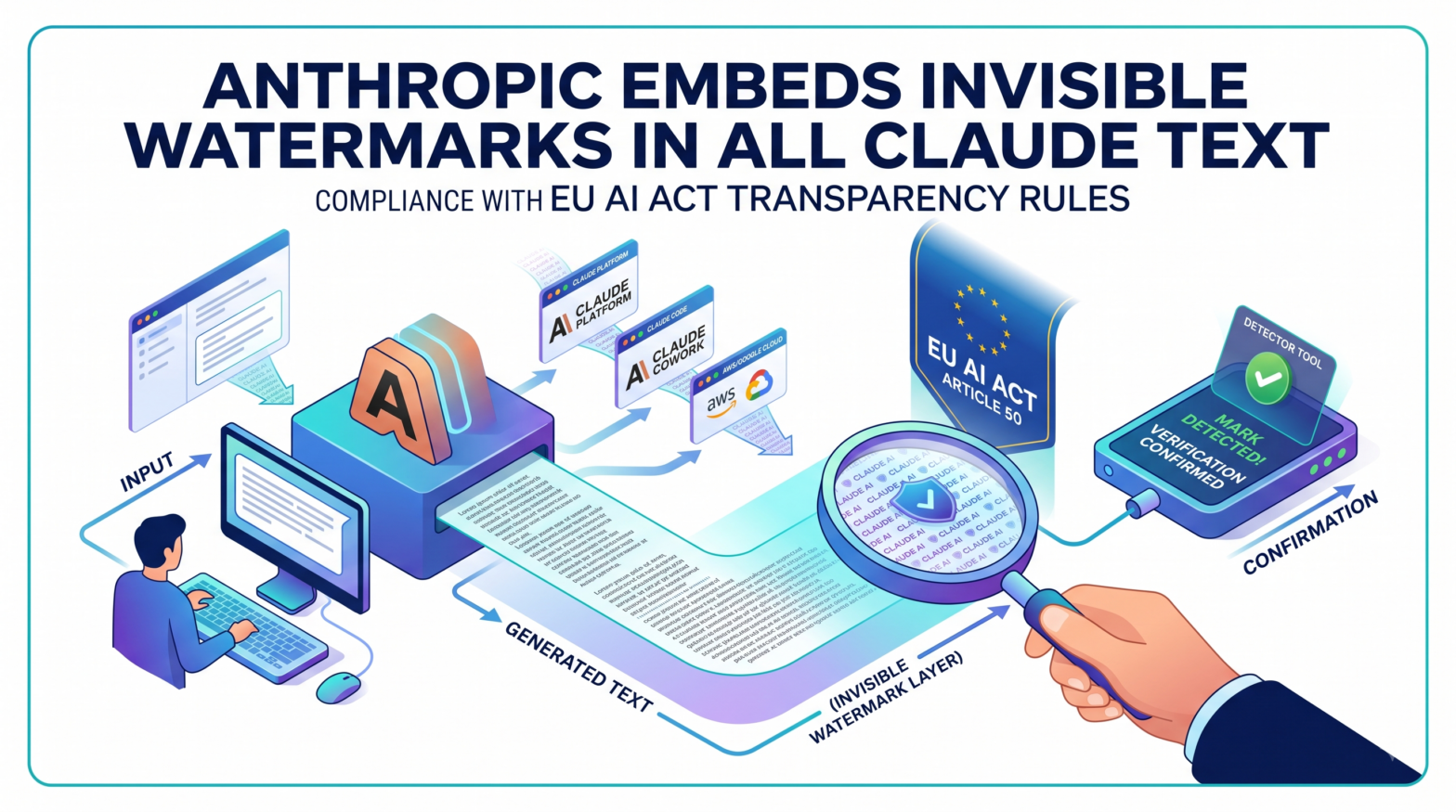
Anthropic has begun embedding invisible watermarks in text generated by its Claude AI models, with the marking system applied worldwide rather than exclusively within the European Union. The company confirmed the change in an updated Help Center support article published August 11, 2026, citing its obligations under the EU AI Act's Article 50(2) Code of Practice on Transparency of AI-Generated Content.
Anthropic announced it will embed invisible watermarks in text generated by Claude models and attach signed provenance metadata to files. The company updated its support documentation to confirm that all Claude models launched on or after August 2, 2026, the date the EU AI Act's Article 50(2) obligations took effect, will carry machine-readable marks from launch.
What Anthropic Committed To Under EU Law
The transparency obligations under Article 50 took effect on August 2, 2026. Non-compliance can trigger fines of up to €15 million or 3% of total global annual turnover, whichever is higher.
Anthropic signed the EU AI Act's Article 50(2) Code of Practice on Transparency of AI-Generated Content as a provider of both generative AI models and generative AI systems, a dual classification that carries distinct obligations under the code.
On July 8 and 9, 2026, the European Commission and the AI Board respectively concluded that the Code of Practice is adequate to facilitate the practical implementation of Articles 50(2), 50(4), and 50(5) of the AI Act. Providers and deployers that adhere to the code can rely on it as the only current EU-wide practical compliance tool assessed as adequate for demonstrating compliance with these transparency obligations, regardless of their place of establishment.
By the end of July 2026, approximately 190 companies and organizations had signed the code. Section 1 signatories, those covering machine-readable marking and detection, include Aleph Alpha, Anthropic, Black Forest Labs, Cohere, Google, Meta, Microsoft, Mistral, OpenAI, and Synthesia.
How the Marking System Works
Anthropic's implementation uses two separate technical mechanisms, one for text and one for supported file types.
Claude models released on or after August 2, 2026, embed an imperceptible, machine-readable watermark directly into all generated text, invisible to human readers but detectable by the right tools. The watermark leaves the meaning and readability of the text completely intact. Because the mark is embedded within the text, it stays intact when copying and pasting and, as Anthropic notes, "may persist through some editing." This watermarking is implemented at the model level, so it appears in any Claude product the text comes from.
The second method involves digitally signed provenance metadata for supported files. Anthropic plans to attach this metadata to files such as .svg, .png, and .jpg images when Claude generates or processes them. The metadata uses the Coalition for Content Provenance and Authenticity (C2PA) open standard, an industry-backed framework intended to record information about how digital content was created or modified. A valid, signed label can indicate that Claude processed a file and help identify whether metadata has been altered.
Claude markings cover output from supported models everywhere Claude is used, including Claude Platform (API), Claude, Claude Code, Claude Cowork, and Claude Tag. Anthropic said the watermarks will also apply when Claude models are accessed through cloud partners including Amazon Web Services, Google Cloud, and Microsoft Foundry.
Coverage Gaps for Older Models
Generative AI systems already on the market before August 2, 2026, have until December 2, 2026, to meet the machine-readable marking requirement under a transition agreement. Models released before August 2 are still being retrofitted. Anthropic's decision goes beyond the requirements of European regulation, as the EU Act contains no mechanism that would compel a company to apply its watermarking to API calls originating outside the EU. Anthropic has not announced a specific date for completing the retrofit process for older models.
What a Detected Mark Does and Does Not Confirm
Anthropic's support documentation states that a watermark confirms only that Claude processed the content, not that Claude authored it.
Anthropic's limitations section states that proofreading, translation, summarizing, and file conversion may result in a mark even if the original ideas and text come from elsewhere. Content generated entirely by a human and then edited by Claude for grammar or style would carry the same mark as content Claude wrote from scratch.
Unlike the embedded text watermark, file metadata can be stripped through format conversion, re-saving, screenshots, or software that does not preserve it. Anthropic also notes that signed provenance metadata may not be available through every platform or integration.
Absence of a mark carries its own ambiguities. Content produced by Claude may carry no detectable watermark if it was generated by a model released before marking was supported, if the text was heavily edited or paraphrased, if the passage is too short to produce a reliable signal, or if a file's metadata was removed through conversion or re-saving.
Detection Tooling Not Yet Published
Anthropic says it will publish additional technical guidance explaining how third parties can detect both the embedded text watermarks and signed provenance metadata. As of August 11, 2026, that documentation has not been released.
An Anthropic engineer confirmed on August 12, 2026, that a text detection API "that you can use yourself" is coming, and that the model itself is not aware it is being watermarked. The engineer also acknowledged the system's limitations, noting "it's not perfect, you can edit it, but it's a first step."
Implications for Marketers and Content Teams
For digital marketing professionals and content teams using Claude in production workflows, the practical effect of this change depends heavily on how watermark detection is eventually implemented and what policies downstream platforms, employers, or clients adopt around detected marks. Because Anthropic's own documentation confirms that a positive watermark signal does not establish authorship, organizations should avoid treating any detection result as conclusive proof that content is AI-written. Teams using Claude for editing, translation, or summarization of human-drafted material should be aware that those outputs will carry the same machine-readable mark as fully AI-generated text. Developers building products on top of Claude are explicitly directed by Anthropic's support article to independently assess their own compliance obligations under Article 50.
Developers integrating Claude must still assess and meet their own Article 50 transparency obligations.