
Advertisers running AI-generated creatives across Google's platforms now face a new mandatory disclosure process for certain markets. Google updated its advertising policies on July 9, 2026, introducing an AI label setting across its campaign tools, as confirmed in the company's Updates to AI labelling requirements (July 2026) policy changelog and an accompanying announcement titled Expanding AI transparency in ads published on the Google Ads & Commerce Blog.
What the New Policy Requires
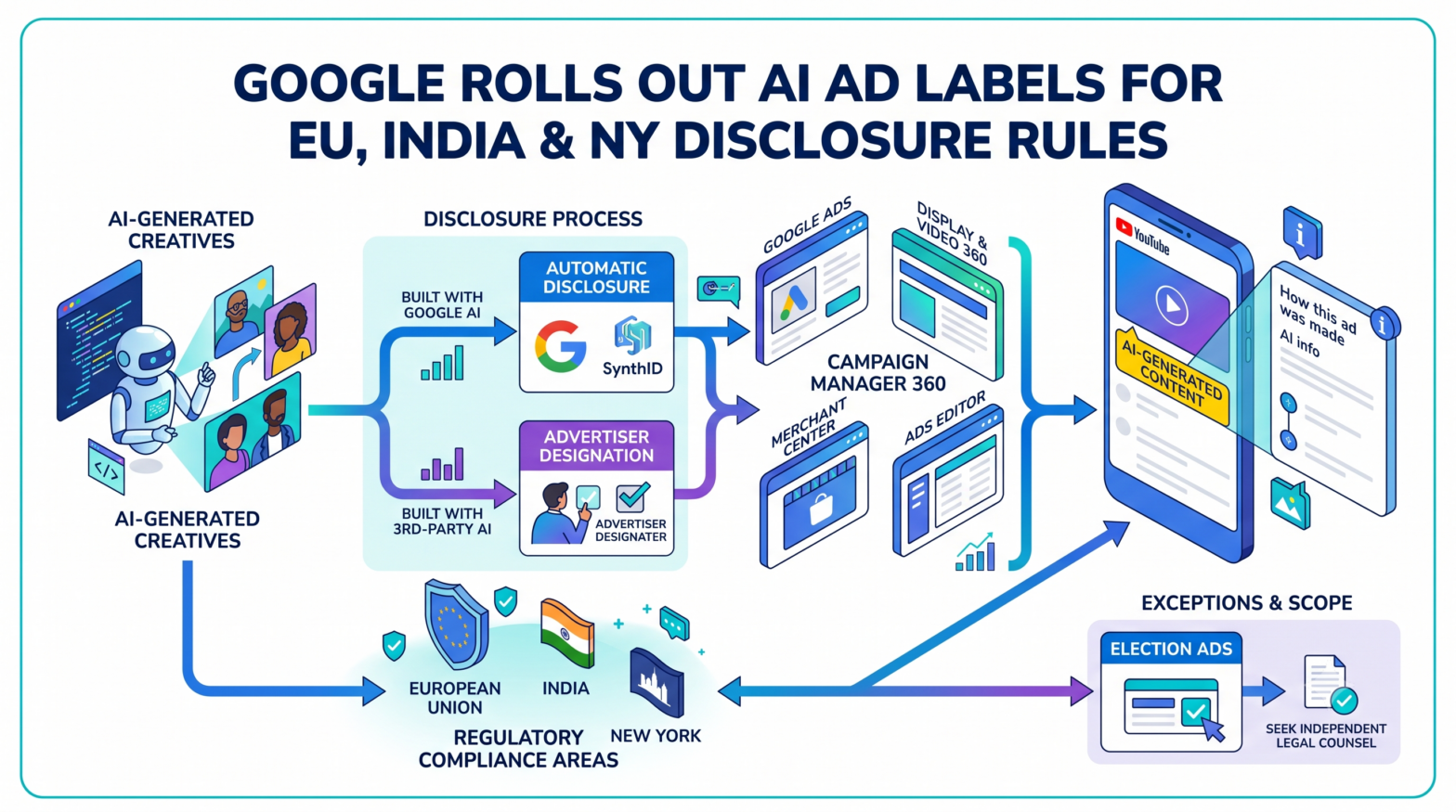
Starting in July 2026, Google permits adding text or visual labels directly within image and video ad creatives that were generated or modified using AI, to help advertisers comply with emerging AI transparency regulations. Google Ads may also automatically apply labels to certain assets generated by Google AI tools, and these labels will not be in violation of Google policies prohibiting text overlays and watermarks.
AI regulations in the European Union, India, and New York require that ads with certain AI-generated or edited assets include disclosures and/or labels that inform consumers that the ads were made with AI.
Which Platforms Are Affected
Advertisers can add labels directly to their creatives or use the AI label setting, which will launch gradually throughout July in Google Ads, Display & Video 360, Campaign Manager 360, Merchant Center, and Ads Editor.
The AI label setting allows advertisers to disclose assets as AI-generated or edited. Ads that contain assets designated as AI-generated or edited will then include a disclosure in the "How this ad was made" section in the My Ad Center panel. For Display & Video 360, the disclosure may also appear in the "About this Ad" feature on the ad itself. The panel is accessible globally and provides details on AI usage in ads, including whether the assets were AI-created or edited.
How Disclosure Works in Practice
Google's July 9 blog post describes two distinct disclosure paths depending on how the creative was produced. Ads built with Google's own generative AI tools receive the disclosure automatically, with no action required. Ads built with third-party AI tools depend on the advertiser designating the asset, and Google has said it will not check whether that designation is made accurately.
Depending on local requirements, an AI label may also appear directly on the ad, either automatically or after the advertiser uses that control. Google is making the "How this ad was made" panel available globally, but the visible treatment of AI-generated ads will not be uniform in every market. For campaigns targeting the European Union, India, or New York, assets designated as AI-created or edited can also receive a visible disclosure overlay directly on the ad.
The "How this ad was made" panel sits inside the My Ad Center panel, accessible via the three-dot menu or info icon on any ad, alongside existing panels such as "About this advertiser" and "Why this ad."
Scope of Google's Compliance Caveat
Google drew a direct line between the new tools and advertiser legal obligations, and then separated them. Use of the AI label setting in Google's advertising products does not guarantee compliance with specific regulations. Advertisers are advised to seek legal guidance and take measures as needed to ensure their ads and assets follow all local legal obligations and policies.
Existing ad rules still apply. Google said its ad policies continue to prohibit misleading or deceptive ads, whether AI was used or not. The update adds more transparency about how an ad was made, but does not change Google's requirement that advertisers clearly identify who they are and what they are promoting.
Election Ad Disclosures Remain Separate
The new AI label setting does not replace the existing political content disclosure process. Google's updated policy documentation specifies that election advertisers must continue to disclose all election ads containing synthetic or digitally altered content by selecting the checkbox in the "Altered or synthetic content" section of their campaign settings, as outlined in the Political Content Policy.
Implications for Advertisers
For teams managing campaigns that use AI-generated or AI-edited image and video assets, the practical requirement is now twofold: assets created through Google's own tools will be labelled automatically, while assets created through outside tools require a manual designation within the campaign interface. Campaigns targeting the EU, India, or New York carry the greatest compliance exposure, as those jurisdictions have enacted specific disclosure laws. Advertisers operating across multiple markets should map which assets require labelling by jurisdiction rather than applying a uniform approach, and should seek qualified legal guidance before assuming platform-level labelling satisfies any specific regional obligation.
Google already embeds imperceptible signals, including SynthID, into content created with its generative AI tools. Election advertisers must disclose synthetic or digitally altered content in political ads, a policy Google introduced in 2023. The July 2026 update extends that disclosure framework beyond political advertising for the first time, applying a comparable transparency requirement to commercial creatives across Search, YouTube, and Discover.