
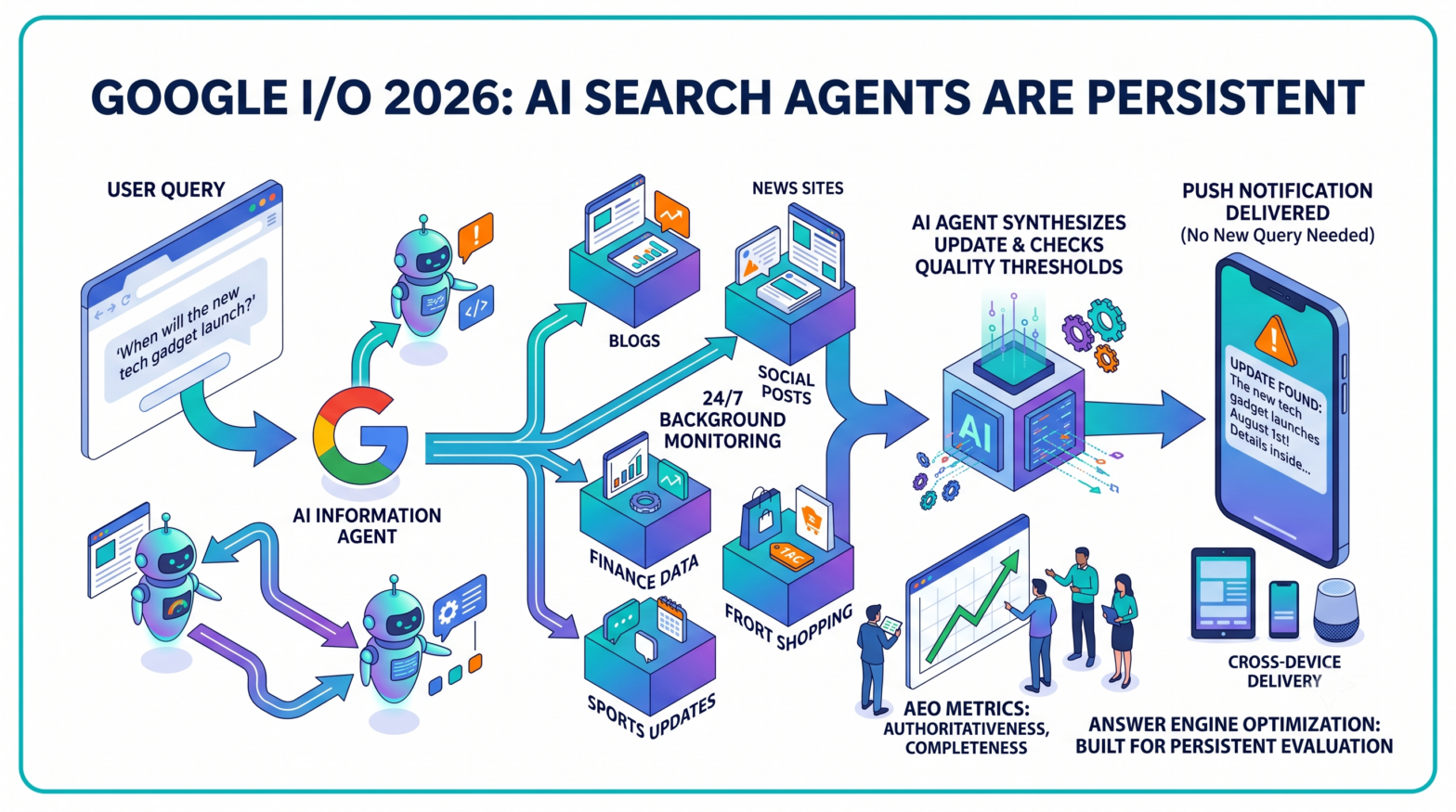
Google Search will no longer end when a user stops typing. At Google I/O 2026 on May 19, Liz Reid, VP of Search at Google, confirmed the launch of "information agents": persistent, background AI processes that continuously monitor the web and push synthesized updates to users without requiring a follow-up query.
Reid described the shift in direct terms at the event:
"We're entering the era of Search agents, where you can easily create, customize and manage multiple AI agents for your many tasks, right in Search."
The announcement marks the operational deployment of a search model that Google has been developing at the patent level for years, and it carries direct implications for how digital marketers and SEOs approach content discoverability.
What Google Announced at I/O 2026
Google announced "information agents" at I/O 2026, a new AI Mode feature that runs in the background around the clock to monitor topics and deliver synthesized updates via push notifications. Described as the next evolution of Google Alerts, the agents are set to roll out this summer to U.S. subscribers of Google AI Pro and Ultra, alongside the biggest redesign of the search box in over 25 years..
Information agents continuously scan the web after a user's initial query and send back what Reid called "an intelligent, synthesized update, with the ability to take action."
The announcement is part of Google's larger push toward agentic AI systems that can take initiative and assist with ongoing tasks instead of answering one question at a time. Unlike traditional search tools that respond only when prompted, Google's information agents are designed to operate continuously in the background, 24/7, helping users stay informed without needing to repeatedly search for the same information every day.
The agents work in the background 24/7, reasoning across blogs, news sites, social posts, and real-time data on finance, shopping, and sports to alert users when something relevant changes.
The Patent That Anticipated the Launch
The I/O 2026 announcement did not emerge without a technical paper trail. The patent, published in February 2026, is a continuation of an older patent, with the main changes being to apply this patent within the context of an AI assistant. The invention describes solving the problem of answering a question when no actual answer is available at the time a user makes the query. What it does is wait until there's a satisfactory answer, at which point it circles back to the user with the answer, without them having to ask again.
The USPTO formally published patent application US20260037585A1 on February 5, 2026. The United States Patent Office then published a further continuation of the patent in April 2026, one month before Google I/O.
The patent is titled "Autonomously Providing Search Results Post-Facto, Including in Assistant Context." Although the patent mentions quality thresholds, those thresholds are defined in the sense of whether the answer meets the user's needs.
The patent specifies six conditions that trigger the system to store a query and continue monitoring for an answer. These include: when no search results meet defined quality or authoritative-answer criteria; when results exist but fail to provide a definitive answer; when information does not yet exist at the time of the query; when a query seeks a specific answer and no result satisfies it; when a resource later satisfies the criteria after previously lacking required information; and when a previously available resource is refined or updated so that it now meets those criteria.
In each case, the system determines that no resources responsive to the query satisfy one or more quality criteria at the time of the query, then provides content to the user at a later time based on a resource that satisfies those criteria, which may be a resource in addition to those available at the original query time, or a refined version of an earlier resource.
How the System Operates Across Devices
The patent and the I/O product announcement align on cross-device delivery. The patent explicitly describes results being delivered on a device separate from the one used to make the original query. It also specifies that results can be delivered as visual or audible push notifications on mobile devices, and can be surfaced during an entirely unrelated conversation with an automated assistant, without the user submitting a new query.
Unlike traditional search, which requires a user to type a query each time, these agents operate continuously in the background, synthesizing information from multiple sources and delivering proactive updates via push notifications.
The underlying capability, a persistent, reasoning, web-monitoring process that understands nuanced criteria and synthesizes results rather than just surfacing links, represents a fundamentally different relationship between a user and a search engine.
Availability and Current Rollout Status
Users create agents by asking a question in AI Mode. The agent then monitors blogs, news, social posts, financial data, shopping, and sports for changes, and sends synthesized push notifications with explanations of why something matters, not just alerts.
The agents launch this summer for U.S. subscribers on Google AI Pro and Ultra paid tiers. Free-tier availability has not been confirmed.
Google's new information agents represent the most meaningful update to the company's alert-based services since Google Alerts launched in 2003. Where Alerts simply notified users of new mentions, these agents can analyze context, compare perspectives, and explain why a development matters.
Implications for Answer Engine Optimization
The shift Google is executing has a direct bearing on how content professionals and digital marketers should think about search visibility. When a search query no longer terminates at the results page, but instead persists in the background until a satisfactory answer is found, the standard transactional model of SEO gives way to something more consequential: whether a page meets the system's quality, authoritativeness, and completeness thresholds over time, not just at the moment of indexing.
Under the patent's framework, a page that does not meet the system's criteria at query time can still be retrieved and surfaced to a user later if it is updated or refined to meet those criteria. This means content that is accurate, specific, and structured to answer discrete questions, rather than broadly covering a topic, is better positioned to satisfy the system's authoritative-answer standard whenever new information becomes available.
Marketers tracking time-sensitive topics, including product launches, regulatory changes, financial data, or event availability, should consider whether their content is built to satisfy a persistent, re-evaluated query rather than a single crawl moment. The system's emphasis on specificity - the patent notes the invention applies to queries that "seek a specific answer" - means broad informational content is less likely to satisfy the trigger conditions than precise, timely, well-sourced responses.
Where Google Has Confirmed This Is Heading
Google confirmed at I/O 2026 that it is bringing advanced model capabilities to Search with new AI features, enabling users to use agents just by asking a question, alongside a new intelligent AI-powered search box marking its biggest upgrade in over 25 years.
AI Mode has surpassed one billion monthly users, with queries more than doubling every quarter since launch.
At one point during the I/O presentation, Reid stated plainly: "Google Search is AI Search." The information agents feature, and the patent infrastructure behind it, make clear that this is not a positioning statement; it is a description of the system Google is actively building.