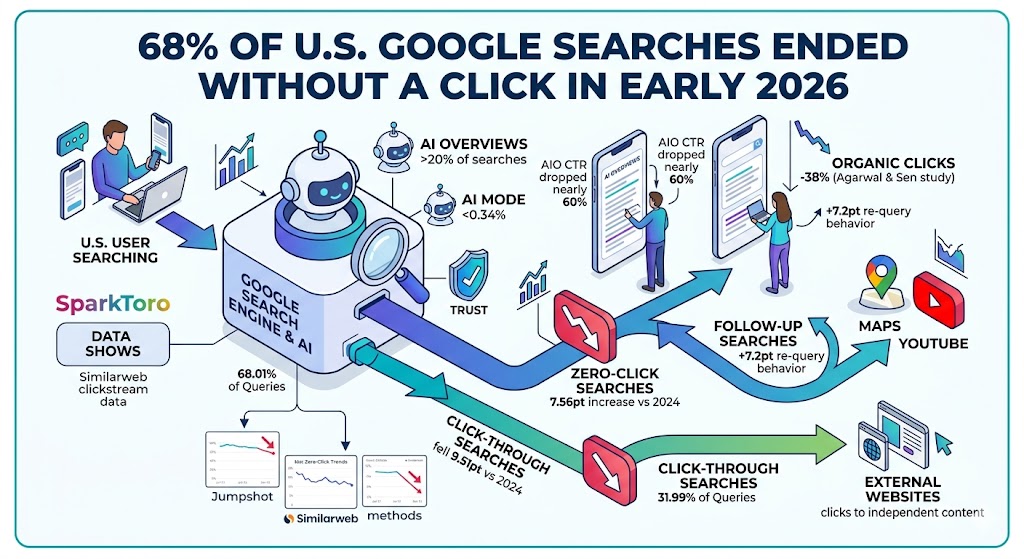
U.S. website owners are receiving a smaller share of Google search traffic than at any previously recorded point. Google searches ended without a click 68.01% of the time in the United States during the first four months of 2026, according to SparkToro research based on Similarweb clickstream data, up from 60.45% in 2024, a 7.56-percentage-point increase in two years.
A Rapid Acceleration in Clickless Queries
The share of searches generating at least one click fell 9.51 percentage points between 2024 and 2026, a 22.9% decline, according to SparkToro. That figure encompasses clicks to organic results, paid ads, and Google-owned properties such as Maps and YouTube, but excludes follow-up searches conducted within Google.
Over the same period, the share of searches that led to another Google search rose 7.2 percentage points. The increase in re-querying behaviour points to a search experience designed to keep users within Google's own ecosystem rather than directing them to external destinations.
The pace of the shift is notable when placed in historical context. SparkToro has tracked zero-click search behaviour for years, though its underlying data sources have changed over time. Because the studies rely on different providers, panels, and methodologies, long-term comparisons are not directly equivalent. Still, the available data consistently points to a rise in zero-click behaviour. In 2019, approximately 49% of Google searches ended without a click, based on data from the now-defunct Jumpshot clickstream panel. The 2026 figure of 68.01% represents a roughly 23-percentage-point increase over that period.
AI Overviews and Their Effect on Click-Through Rates
AI Overviews now appear on more than 20% of Google searches, according to the SparkToro research. When they do appear, click-through rates drop by nearly 60%.
SparkToro identified AI Overviews as a likely contributor to the rise in zero-click searches between 2024 and 2026, though the study does not isolate the precise share of the increase attributable to the feature. At Google I/O 2026, CEO Sundar Pichai confirmed that AI Overviews now has over 2.5 billion monthly active users globally.
A separate randomized field experiment by researchers Agarwal and Sen adds supporting evidence on the mechanism. Researchers randomly assigned 1,065 U.S. participants to see or not see AI Overviews during search over a two-week period in January–February 2026. When AI Overviews appeared, organic clicks dropped 38% and zero-click searches jumped from 54% to 72%, according to the study published on SSRN in April 2026.
AI Mode's Role Remains Limited, For Now
AI Mode appears to have played only a limited role during the January-to-April study period. SparkToro found that just 0.34% of searches transitioned into AI Mode during that time.
That figure is likely to grow. Google confirmed at I/O 2026 that just one year after its debut, AI Mode has surpassed one billion monthly users, with queries more than doubling every quarter since launch. Google also announced at I/O 2026 that it is bringing AI Overviews and AI Mode into one seamless AI Search experience.
Research from Semrush found that 92–94% of AI Mode sessions end without a click to an external website. If AI Mode usage continues its current trajectory, its contribution to overall zero-click rates could become considerably larger than what the January–April 2026 study period captured.
Methodology and Data Scope
The SparkToro study used Similarweb desktop and mobile web panel data covering U.S. Google searches from January through April 2026. SparkToro assumed that two-thirds of searches occurred on mobile devices and one-third on desktops. The analysis excludes searches conducted in Google's mobile search app, where SparkToro said zero-click behaviour may be even higher.
Because mobile clickstream data does not directly capture the percentage of clicks on paid links, SparkToro used ratio estimates from DigitalApplied's 2026 benchmark panel to complete that portion of the calculation.
Implications for Search and Content Strategy
The sustained rise in zero-click searches has practical consequences for marketers who rely on organic search traffic as a primary acquisition channel. For teams currently using raw traffic volume as a core KPI, the data suggests that metric may increasingly disconnect from actual brand performance or revenue outcomes. Query categories that continue to generate meaningful click-through, including branded searches, local business queries, and high-intent transactional searches, remain less affected by zero-click behaviour than informational content, according to SparkToro. Content that earns citation within AI Overviews may also generate measurable downstream value: Seer Interactive's 2026 data shows that brands cited in AI Overviews earned a 15.74% paid click-through rate on the same queries, compared to 11.19% when not cited.
SparkToro co-founder Rand Fishkin said in the published research that SEO remains relevant but that earning the same volume of referral traffic through organic search alone is increasingly unrealistic for many publishers. He recommended that marketers invest in building brand presence on the platforms where their audiences already spend time, independent of whether those efforts produce direct website visits.
Google CEO Sundar Pichai stated at I/O 2026 that when people use AI-powered features in Search, they use Search more, adding that "Search has become less about individual queries and feels more like an ongoing conversation."