

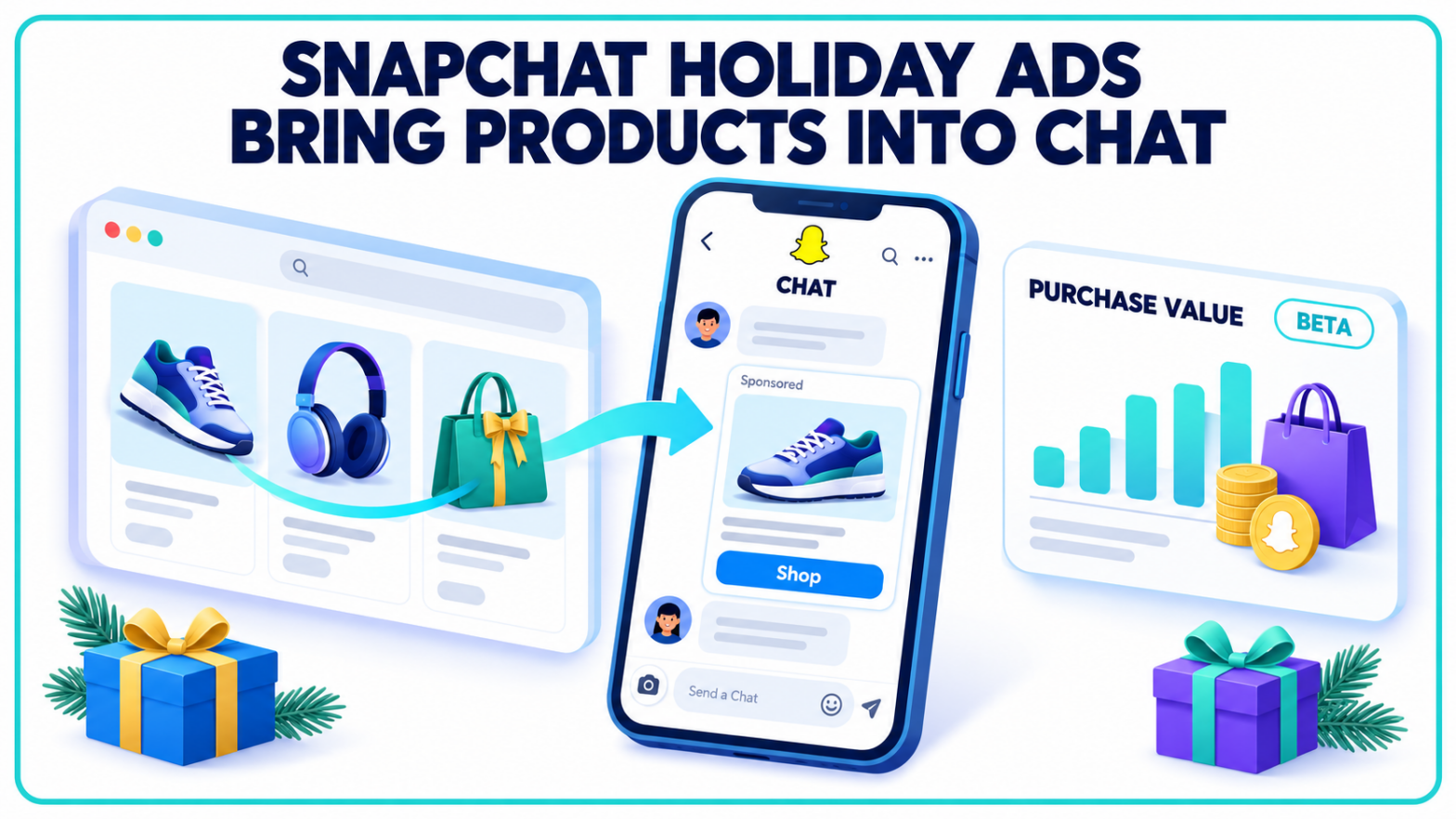
Holiday advertisers can now put catalogue products inside Snapchat’s Chat feed. Access to the tools meant to improve the value of those purchases is arriving on a different schedule.
Snap’s September 10 Commerce Power Pack announcement brings together a new product ad placement and several campaign optimization options ahead of the shopping season. For retailers, the immediate question is which capabilities are ready for a live campaign and which remain in testing.
Holiday Snapchat Advertising Arrives in Stages
Dynamic Product Ads for Sponsored Snaps are available to advertisers globally. Value Optimization is in beta for web and app advertisers, Third-Party Web Optimization is in open beta, and Omnichannel Optimization remains in alpha, according to Snap’s Commerce Power Pack announcement.
The distinction affects campaign planning. A retailer can evaluate the Chat placement now without assuming that every optimization feature announced alongside it has the same availability.
Omnichannel Optimization addresses businesses selling through both websites and apps. Snap says it can pursue purchases across those destinations within one campaign, according to where a shopper is most likely to convert. Its alpha status leaves that combined approach at an earlier testing stage.
The release extends a broader shift in Snapchat advertising, with automation taking on more campaign analysis and delivery work. This announcement puts the commercial objective closer to the transaction: deciding which product to show, where to show it and which purchase outcome to pursue.
Chat Placement Still Starts With Product Feeds
Sponsored Snaps already give advertisers access to the Chat feed. Snap’s format documentation describes image or video ads that open into a full-screen experience, with opportunities to reply or follow an advertiser’s link. Brands can enable an automatic response.
The placement does not send a push notification.
Snap says 85% of Snapchatters use Chat regularly. That figure comes from a commissioned 2024 Alter Agents survey of 12,000 users globally, based on respondents’ answers rather than observed activity inside the app.
Dynamic Product Ads add automated catalogue selection to that environment. Snap’s product overview says advertisers connect their catalogue and data sources, after which its system assembles personalized shopping ads. Product recommendations draw on behavioural, browsing, product-affinity and intent signals, while delivery also uses conversion and engagement data.
The AI component concerns product relevance and ad delivery. A retailer supplies the inventory that the system can select from.
That makes product feeds part of the campaign’s working infrastructure. Snap’s existing Dynamic Ads documentation describes catalogue information such as images and prices, with ads adjusting as synchronized product details change. It also explains how product sets limit which items are eligible for delivery.
Those controls matter for seasonal ranges, where a retailer may advertise only part of its inventory. Snap says its Dynamic Ads setup connects catalogue items with website or app events through matching product identifiers.
Return on Ad Spend Changes the Purchase Target
Value Optimization lets campaigns pursue higher-value purchases and optimize for ROAS. Snap says the beta supports both web and app advertisers and can work with Unified Attribution.
Purchase count and purchase value answer different business questions.
A campaign that generates many inexpensive orders may produce less revenue than one delivering fewer, larger transactions. Return on ad spend expresses the relationship between attributed conversion value and advertising cost. It does not establish profit unless the values used account for the relevant costs.
During holiday promotions, discounts and product mix can change that relationship. Revenue-based ROAS can improve while the margin retained from those sales remains under pressure.
Snap already provides infrastructure for sending purchase activity back to its advertising system. Its ecommerce advertising guidance describes Snap Pixel for measuring website actions and Conversions API for passing event data directly to the platform.
For marketing teams, the practical implication is a closer connection between catalogue management and measurement. Current prices, available inventory, matching product identifiers and reliable purchase values determine what the campaign can advertise and how its results can be assessed. A placement test is easier to interpret when those inputs and the attribution window remain consistent.
Outside Measurement Moves Into Campaign Delivery
Third-Party Web Optimization combines Snap’s first-party signals with external measurement signals to pursue the purchase outcomes advertisers use when comparing channels.
Snap reports that testing with Google Analytics produced 23% lower third-party cost per purchase and 37% higher third-party ROAS. These are advertiser results reported by Snap, rather than a forecast for holiday campaigns.
The approach has a counterpart in app advertising.
On August 31, Snap announced the global rollout of Unified Attribution for app advertisers using AppsFlyer or Adjust, with support for additional mobile measurement partners under development. It brings Snap’s platform metrics and partners’ cross-channel measurements into a shared view and uses partner conversion signals in optimization.
The operational change reaches beyond reporting. External measurement can help inform campaign delivery, rather than appearing only in a separate dashboard after spending has occurred.
That distinction explains why attribution is part of the holiday release. Advertisers evaluate channels using their measurement systems; Snap is expanding the ways those systems can inform the outcomes its campaigns pursue.
The Conversion Claims Predate the Holiday Rollout
Snap’s speed claim draws on TransUnion’s 2025 marketing mix modelling benchmark and meta-analysis. According to Snap, that research found conversion occurred half a day faster on Snapchat than on other leading social platforms.
It does not establish the effect of the newly released Chat product ads.
The Google Analytics results also predate the launch. Snap’s supporting research notes identify an internal testing period of May 18 to June 1, 2026. They do not disclose the advertiser sample size or full comparison design for those figures.
The distinction leaves retailers with two separate pieces of evidence: earlier performance findings cited to support Snap’s holiday proposition, and a newly available placement whose results will depend on the campaigns using it. Snap has not supplied a separate holiday performance benchmark for Dynamic Product Ads in Chat.