
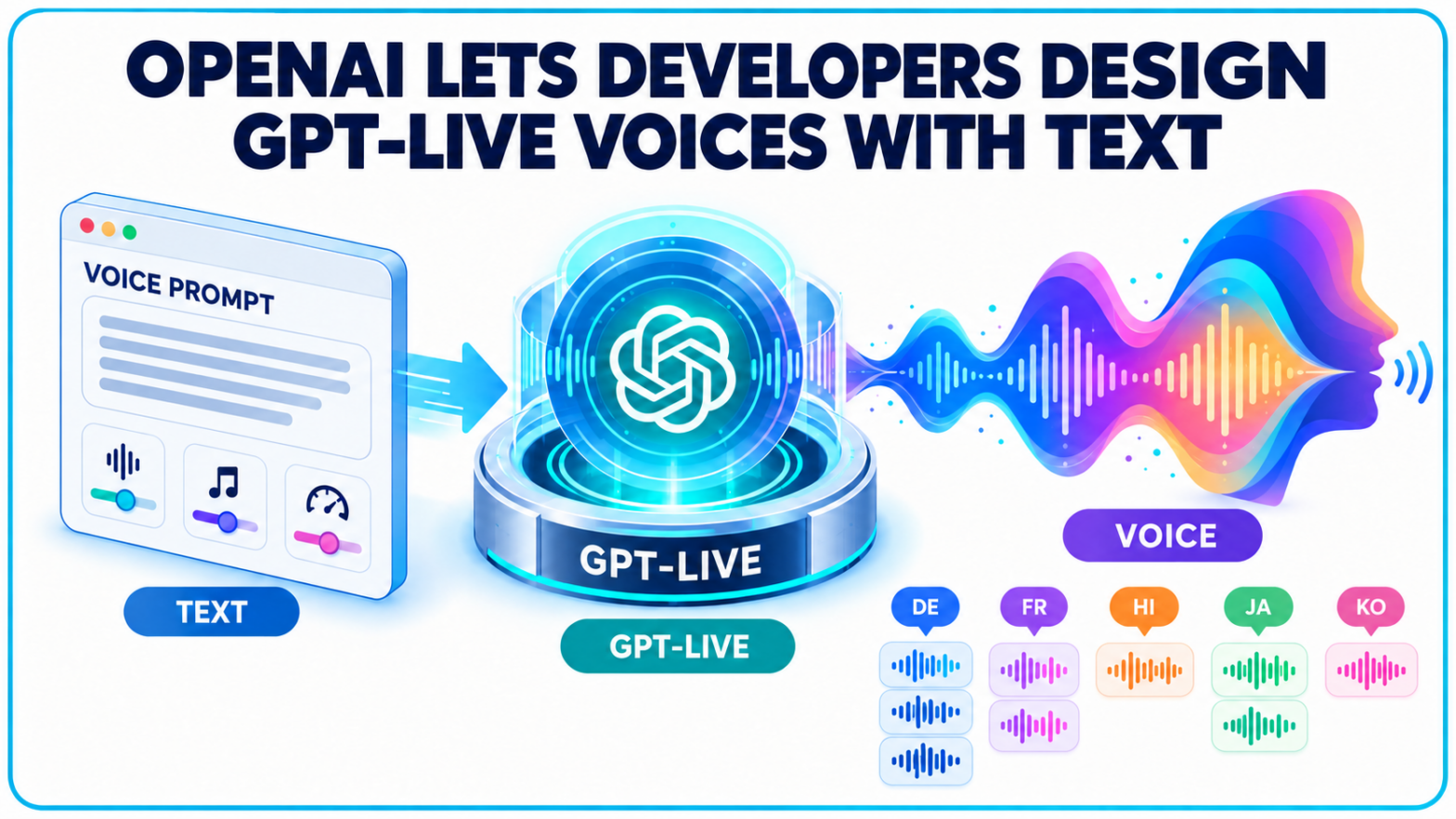
Voice AI can now be cast with a written brief instead of a recording session. OpenAI has released prompt-to-voice for GPT-Live and expanded its preset voice library, although the update adds nine voices across five languages, not nine new languages.
Prompt-to-Voice Turns a Description Into a Saved Voice
OpenAI released prompt-to-voice for all API customers on October 16, 2026, according to its API changelog.
The feature allows developers to describe the voice they want using ordinary text. A prompt can specify characteristics such as accent, pitch, tone, speaking pace, emotional quality and intended role.
OpenAI’s example describes a calm, reassuring adult voice for customer support, with an American English accent, medium pitch and steady conversational pace. Those qualities are written inside the prompt rather than submitted as separate configuration parameters.
Developers can create the voice through OpenAI’s voice Playground or send a request to the /v1/audio/voices endpoint with the voice type set to prompt. The API returns a voice identifier that can be saved and reused in subsequent GPT-Live sessions.
No voice actor sample or consent recording is required for prompt-generated voices. That separates the workflow from recording-based custom voices, which require an approved consent recording and a separate reference sample.
Organizations can create as many as 100 prompt-generated voices. The same limit applies when a company allows its own customers to generate voices through an application.
The feature gives developers a faster way to prototype the sound of AI voice agents without arranging and processing a recording session for every experiment.
Nine Voices Cover Five Languages, Not Nine
OpenAI also added nine preset natural voices to GPT-Live. They are distributed across German, French, Hindi, Japanese and Korean.
|
Language |
Voice |
Presentation |
|
German |
Nuri |
Feminine |
|
German |
Juni |
Feminine |
|
German |
Flitz |
Masculine |
|
French |
Brise |
Feminine |
|
French |
Sillage |
Masculine |
|
Hindi |
Nira |
Feminine |
|
Japanese |
Harema |
Feminine |
|
Japanese |
Shida |
Masculine |
|
Korean |
Noeul |
Feminine |
Calling the release a nine-language expansion would overstate the change. It is a five-language expansion containing nine distinct voices.
The distribution is also uneven. German receives three new voices, while French and Japanese receive two each. Hindi and Korean each receive one. OpenAI’s GPT-Live session documentation identifies each voice’s primary language and presentation but does not publish benchmark results comparing pronunciation, regional variation or conversation quality.
The new options join an existing GPT-Live library that includes natural and generated voices associated with English and Brazilian Portuguese. OpenAI advises developers to test voices against the languages and pronunciations their applications require.
A language label should therefore be treated as a starting configuration, not a guarantee that every regional accent, name or specialized term will be spoken correctly.
GPT-Live Is the Only Destination for Prompt-Generated Voices
Prompt-generated voices currently work only with GPT-Live.
They cannot be used with OpenAI’s Text to Speech API, Realtime API or Chat Completions API with audio output. Developers building on those products cannot create a voice from a text description and transfer it directly into their existing audio pipeline.
Recording-based custom voices have broader compatibility. Once created with the required consent and reference recordings, those voices can be used with GPT-Live, Text to Speech, Realtime and audio-enabled Chat Completions.
That product boundary matters because GPT-Live and the Realtime API use different architectures.
GPT-Live handles a continuous spoken conversation while delegating reasoning, tools and longer tasks to a separate backend model or agent. It is full duplex, allowing it to listen and speak at the same time. The backend can continue searching, checking records or completing a workflow while the voice model keeps the conversation active.
The Realtime API combines speech, reasoning and tool selection within a single realtime session. Applications already built around that model cannot assume their session events, voice settings or integration code will work unchanged with GPT-Live.
OpenAI provides migration guidance for teams moving from Realtime. The central change is to divide instructions between two systems: GPT-Live receives the short prompt governing conversational behaviour, while the backend receives detailed workflows, tool rules and business procedures.
Prompt-to-voice changes how the conversation sounds. It does not remove that architectural work.
Voice Creation Is Free, but Conversations Are Metered
Creating a prompt-generated voice is free. Generating speech with it is billed at the standard GPT-Live session rate.
OpenAI currently prices gpt-live-1 at US$0.05 per minute, calculated by the second rather than rounded to a full minute. The charge covers the live voice session, including periods when the user speaks, the assistant speaks, both remain silent or the backend is completing work.
Backend model and tool usage is billed separately.
A customer service conversation that relies on another model for web search, order retrieval or decision-making therefore has at least two cost layers: GPT-Live session duration and whatever the delegated backend consumes.
Muted input does not end the billing period. Developers must close completed sessions and use the duration reported by the API when calculating costs.
The practical implication for marketers and customer-experience teams is that a branded voice can now be prototyped without adding a voice-production cost to every test. Session length, backend activity and quality assurance still determine whether that experiment becomes economical at scale.
Teams should test more than whether a generated voice sounds appealing. Interruptions, silence, pronunciation, disclosure wording, tool delays and language switching all affect how a live customer conversation performs.
Synthetic Voice Controls Extend Beyond Brand Tone
OpenAI’s custom voice guidance prohibits using prompt-to-voice to create children’s voices and instructs developers not to impersonate people.
Applications must also tell listeners that the speech is AI-generated and preserve provenance metadata, watermarks or other indicators identifying synthetic audio. Generated voices are not guaranteed to be unique, so two organizations could independently produce similar results from comparable descriptions.
That limitation puts a boundary around branding claims. A company can describe a desired speaking style, but it cannot assume that the resulting voice will function like an exclusive audio trademark.
The new natural voices provide ready-made options for five languages, while prompt-to-voice gives developers finer control over vocal characteristics within GPT-Live. OpenAI has not announced when prompt-generated voices will extend to its other audio APIs.