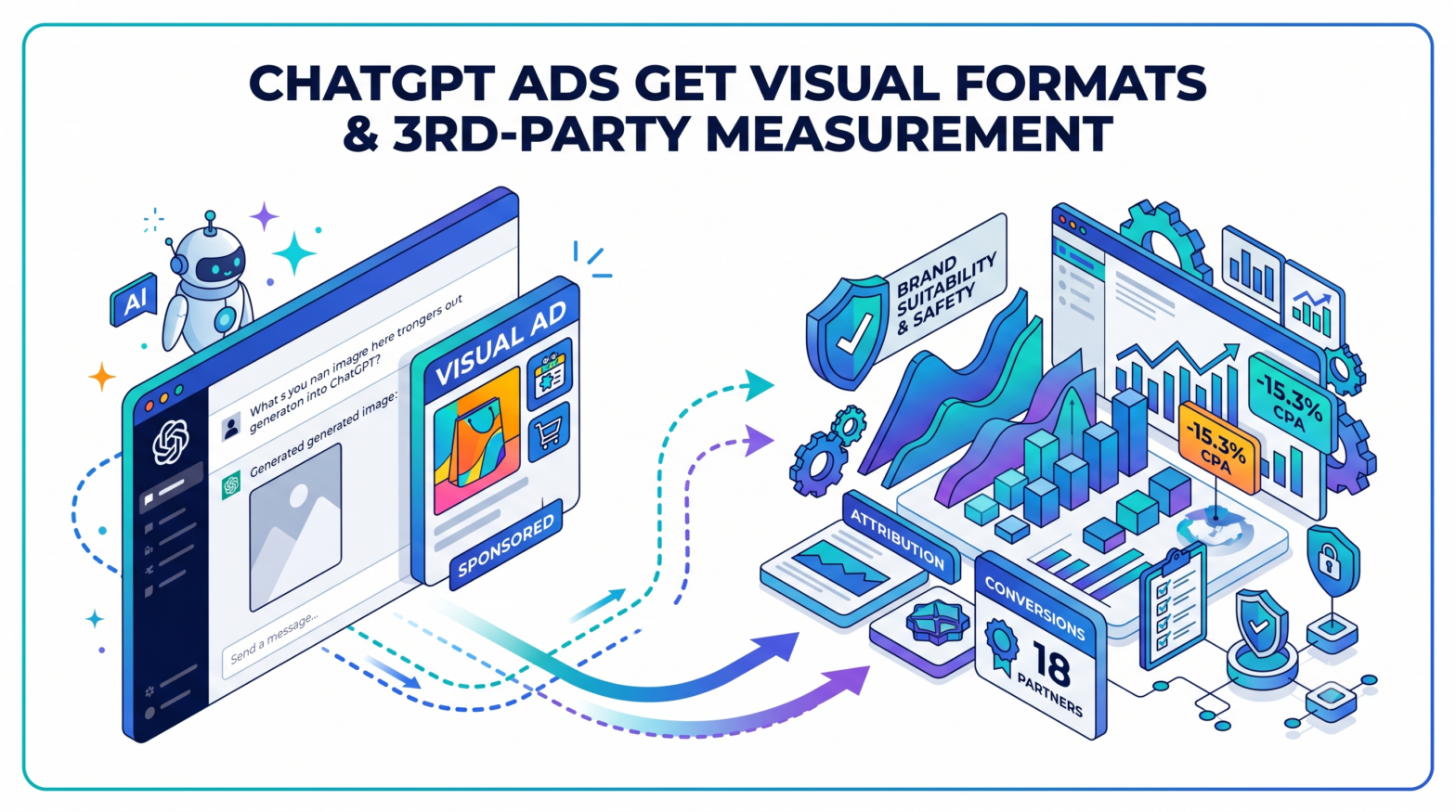
Advertisers using ChatGPT now have access to a new image-based ad format and a significantly expanded set of third-party measurement tools. OpenAI confirmed on October 5, 2026, that it is introducing a new visual ad format in ChatGPT alongside expanded measurement tools and partnerships, and new approaches to brand suitability.
New Visual Ad Format Enters Testing During Image Generation
OpenAI said it will test the new visual ad format during image generation in ChatGPT, starting later in October in the US with an initial group of advertisers. The format represents a departure from the text-based sponsored cards that have appeared beneath ChatGPT responses since the platform's ad rollout earlier this year.
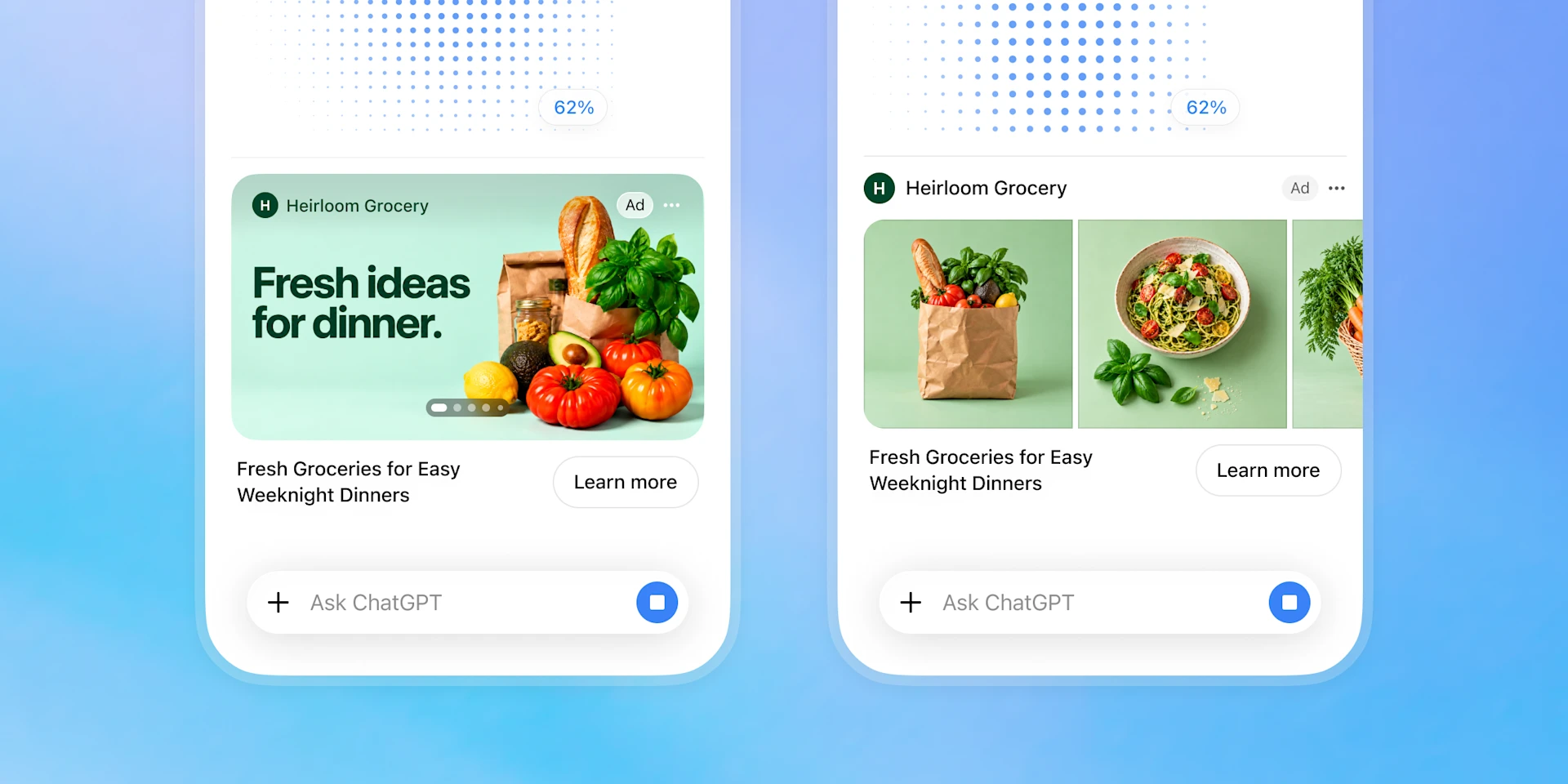
OpenAI first began displaying ads inside ChatGPT at the start of the year, with those ads appearing in a sponsored section beneath the chatbot's outputs, showing the sponsor's name, logo, and a link to its website. The new visual format is different in kind: instead of a text line, advertisers are able to show "product inspiration, product usage, or the experiences they make possible," according to the announcement.
The image ads are labelled and kept separate from the picture being generated, and OpenAI repeats that ads do not influence ChatGPT's answers. OpenAI also says it has implemented safeguards to ensure ads are only displayed alongside topics where it would be appropriate to advertise, meaning users will not see ads generated during conversations about sensitive topics such as personal health or mental wellbeing.
Measurement Partner Ecosystem Expands to 18 Partners
OpenAI announced integrations with Hightouch, Tealium, and LiveRamp, allowing advertisers to connect conversion data from their existing systems to ChatGPT Ads. Attribution partners now include AppsFlyer, Adjust, Branch, Triple Whale, and Kochava, among others, alongside brand-suitability pilots with DoubleVerify and Integral Ad Science.
The full partner count, as logged by this publication from OpenAI's post, includes ten attribution partners, three conversion-data integrations, three full-funnel partners (Fospha, Measured, and INCRMNTAL), and three geo-experiment partners: Haus, Measured, and WorkMagic.
On incrementality, OpenAI's October 5 announcement states that the work remains early-stage. The company said it is partnering with Haus, Measured, and WorkMagic to explore geo-based experiments designed to help advertisers understand the causal impact of ChatGPT Ads. Geo-based incrementality testing is intended to determine whether ads are generating additional conversions rather than simply receiving attribution credit for purchases that would have occurred regardless.
Early Partner Performance Data
OpenAI's October 5 post includes performance figures from three early advertiser partners. The findings cite, among them, a 15.3% lower attributed cost per acquisition for one brand. Specifically, the announcement states that DV Rockerbox measured WeightWatchers' attributed cost per acquisition from ChatGPT Ads at 15.3% below its blended paid-search benchmark. WorkMagic reported that 67% of incremental purchases for wellness brand Dose came from net-new customers. Triple Whale found that 93% of Portland Leather's visitors from ChatGPT Ads were new to the brand. These figures are partner-reported results from a limited test group and are not platform-wide benchmarks.
Brand Suitability Pilots Launched With DoubleVerify and IAS
Independent partners evaluating OpenAI's ad safeguards will not access private user conversations, the company said, and those safeguards are "designed to prevent ads from appearing in emotionally vulnerable, sensitive, or otherwise unsuitable conversations."
The October 5 announcement includes statements from the CEOs of both verification firms. Lidiane Jones, CEO of Integral Ad Science, said in the OpenAI post that the independent evaluation will assess "how OpenAI's safeguards perform across a broad and evolving range of scenarios." Mark Zagorski, CEO of DoubleVerify, described the ChatGPT environment as one "where context is defined by the conversation itself rather than a page or video."
For advertisers with more specific placement requirements, Negative Phrases are now also available to qualifying advertisers as part of the measurement and brand-safety expansion.
Platform Reach and Advertiser Access
OpenAI says ChatGPT reaches 1.2 billion people each week and that advertising lets it serve "a much larger market than subscriptions alone." The company frames the advertising expansion as monetization for its free and low-cost tiers, writing that "advertising helps us bring the benefits of AI to more people."
For advertisers and performance marketers, the practical implication of the October 5 update is that ChatGPT Ads can now be evaluated using many of the same third-party measurement tools already in use across paid search and social channels. The addition of incrementality partnerships and independent brand-suitability audits lowers a key structural barrier that had made direct budget comparisons across channels difficult, though the incrementality work is still in pilot phase and not yet available at scale.
Neither the company's announcement nor any supporting materials have disclosed pricing, the initial advertiser list, or whether paid-tier users will see the new visual ads. OpenAI's October 5 post states that businesses can register for ChatGPT Ads at ads.openai.com.