The expensive part of an AI workflow isn't always generating an answer. Sometimes, it's deciding what should happen next.
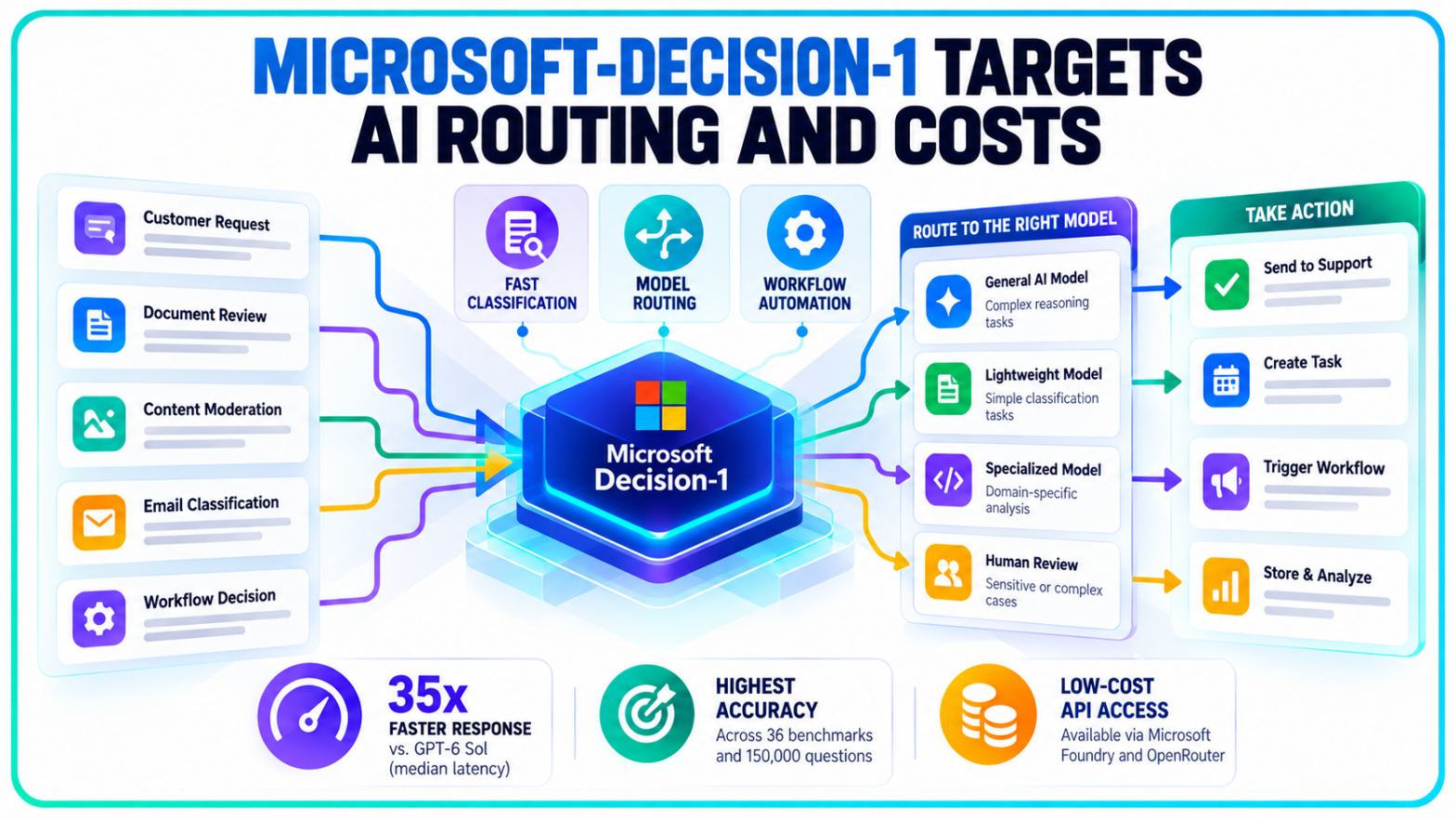
Microsoft is targeting those smaller decisions with Microsoft-Decision-1, a specialized AI model built to classify information, evaluate choices and direct automated workflows without relying on a full language-model response.
Introduced on October 9, 2026, the model is available through Microsoft Foundry and OpenRouter. Microsoft says it outperformed competing models in its own tests of decision accuracy and response speed, including a reported 35-fold speed advantage over GPT-6 Sol on median latency.
The release points to a growing distinction in enterprise AI: generating content is one job, but deciding which tool, model or action to use is another.
And Microsoft wants a dedicated model handling the second.
Microsoft-Decision-1 Makes Choices Instead of Writing Responses
Most large language models are designed to produce something. Give them a question, and they generate an answer. Ask for a campaign brief, and they write one. Present a technical problem, and they work through an explanation.
Microsoft-Decision-1 operates differently.
Instead of generating open-ended text, it evaluates a defined set of possible answers and assigns probability scores to them. Software can then use those scores to select an option, assign priority or decide whether another step is necessary.
Consider a customer support request that needs to reach the appropriate department.
A conventional AI system might interpret the message, explain its reasoning and recommend where to send it. Microsoft-Decision-1 can evaluate the same request against predefined categories, such as billing, technical support and account management, then return a structured classification.
The output is designed for software to act on, not for someone to read as a conversation.
According to Microsoft's official model announcement, the system supports yes-or-no questions, multiple-choice decisions, numerical ratings and rubric-based assessments.
It was developed by post-training Qwen3.5-9B, adapting an existing language model for single-pass decision scoring.
Microsoft plans to extend the approach to other underlying models, including technology from Microsoft AI and OpenAI.
The distinction is important. Microsoft-Decision-1 isn't being positioned as a replacement for conversational assistants or advanced reasoning models. It addresses the narrower decisions those systems repeatedly encounter while completing larger tasks.
AI Model Routing Becomes a Separate Job
An AI agent handling a complex request can move between several tools and models before finishing.
It might retrieve information, evaluate what it found, choose a model for analysis and determine whether an output satisfies the original request.
Each decision introduces another processing step.
Microsoft-Decision-1 is intended to make those choices faster through structured scoring, particularly when an application already knows which options are available.
One example is AI model routing, where software selects an appropriate model according to a task's requirements.
A simple classification request may not need the same processing resources as a complex financial analysis. A routing system can assess the request and choose between available models according to factors such as expected quality, processing time and cost.
The approach reflects a wider change in enterprise AI infrastructure.
Google's recently introduced Gemini agent for enterprise also incorporates model routing, allowing its system to select models for different tasks.
Microsoft's announcement concentrates on the decision layer itself rather than introducing another general-purpose agent.
The company identifies additional applications, including checking whether an AI-generated answer meets specified standards, determining when an agent should stop or retry an action, and selecting whether a task requires human review.
These are operational controls.
A decision model can recommend a next step, but the surrounding application still determines what actions are permitted and how those recommendations are executed.
Microsoft's Speed Benchmarks Come With Important Limits
Speed is central to Microsoft's case for a dedicated decision model.
The company reports that Microsoft-Decision-1 achieved the highest accuracy in a comparison spanning 36 benchmarks and nearly 150,000 questions.
The evaluations covered tasks including classification, ranking, reasoning, multilingual inputs, safety and situations involving information outside the model's training distribution.
Microsoft also reports that the model processed decisions 2.5 times faster than H2O-Lightning-4B v1.1, the next-fastest model in its comparison.
Against GPT-6 Sol, it reported approximately 35 times lower median latency.
Those figures come from Microsoft's own benchmarking. They have not been established as universal performance advantages across independent production environments.
The comparison also concerns a particular type of task.
A model designed to select among fixed options isn't performing the same work as a language model asked to produce detailed explanations or complete open-ended assignments. Faster classification does not establish stronger general reasoning capabilities.
Microsoft examined consistency as well.
The company tested whether small changes to prompts affected decisions, including reordered answer options and paraphrased descriptions. It reported an average decision-change rate of 1.3% across the tested variations.
The release also addresses probability calibration, which concerns how closely a model's reported confidence matches its actual correctness.
A model assigning high confidence to an answer needs that confidence to be meaningful if applications are going to use it for automated decisions.
Microsoft's testing provides evidence for its performance claims, but organizations evaluating the model would still need to establish how it behaves with their own categories, data and decision thresholds.
Low-Cost AI Decisions Could Change Workflow Economics
Repeated decisions create a different cost problem from occasional chatbot conversations.
An application handling thousands of incoming requests may need to classify each message, assign urgency, determine the next action and check whether the outcome meets specific requirements.
Using a large generative model for every step can add processing costs even when the expected answer is a simple category or numerical score.
Microsoft lists Microsoft-Decision-1 at $0.042 USD per million input tokens, with no output-token charges.
That pricing applies to the decision model's specified API usage, rather than to every AI service involved in a larger workflow.
The company has already tested the model in several internal applications.
Xbox Research used Microsoft-Decision-1 to organize more than 10,000 pieces of feedback and reviews into predefined themes. Microsoft reported that the system delivered quality competitive with GPT-6 Sol while operating more than 14 times faster and at one-two-hundredth of the cost in that workload.
The Copilot team has tested it for evaluating AI responses and agent behaviour. Microsoft also described applications in incident response and scientific research, where repeated evaluations can determine which information or experiment should receive attention next.
For marketing operations, comparable decision tasks already exist in lead classification, customer feedback analysis, support routing and content categorization.
These are also areas where vendors have been expanding AI workflow automation, including Salesforce's agent-based marketing and lead qualification systems.
Microsoft has not announced native integrations that would automatically bring Decision-1 into advertising platforms or marketing dashboards.
Organizations would need to connect the model to their own software and define the available decisions.
Decision Models Add Another Layer of AI Control
Microsoft-Decision-1 arrives as AI developers are paying closer attention to how automated systems select and execute actions.
An agent that produces a questionable answer presents one kind of problem. An agent that acts on an incorrect classification can create another, particularly when it controls access to data, external tools or business systems.
Decision models are intended to provide structured judgments that applications can evaluate before proceeding.
Microsoft says it tested Decision-1 against 5,250 requests across 11 safety benchmarks, including harmful-content requests, jailbreak attempts and prompt injection.
The company reported that the model could refuse harmful behaviour while preserving usefulness on legitimate tasks. Those results remain part of Microsoft's own evaluation.
The model's probability-based output also provides a way to distinguish uncertain classifications from stronger ones.
For example, an application could use a defined confidence threshold to determine whether a support request should be routed automatically or referred for review.
Microsoft's Foundry implementation documentation instructs developers to validate thresholds against labelled examples before automating such decisions.
The company is not alone in developing this category.
OpenAI's Decisions API also supports structured evaluations using predefined choices, numerical scoring and probability-based outputs.
Both approaches separate decision scoring from traditional text generation, although their models, interfaces, pricing and deployment options differ.
For marketers and developers implementing AI systems, the practical implication is a more specialized workflow architecture. Routine decisions such as intent classification, priority assignment and output evaluation can be handled separately from content generation and complex reasoning. Any gains in cost or responsiveness depend on the number of decisions involved, the accuracy required and the performance of the complete application rather than the scoring model alone.
Microsoft-Decision-1 is available now through the Microsoft Foundry model catalogue and OpenRouter.
Microsoft has indicated that future versions will incorporate other foundation models and additional evaluation data. No release schedule has been confirmed for those versions.