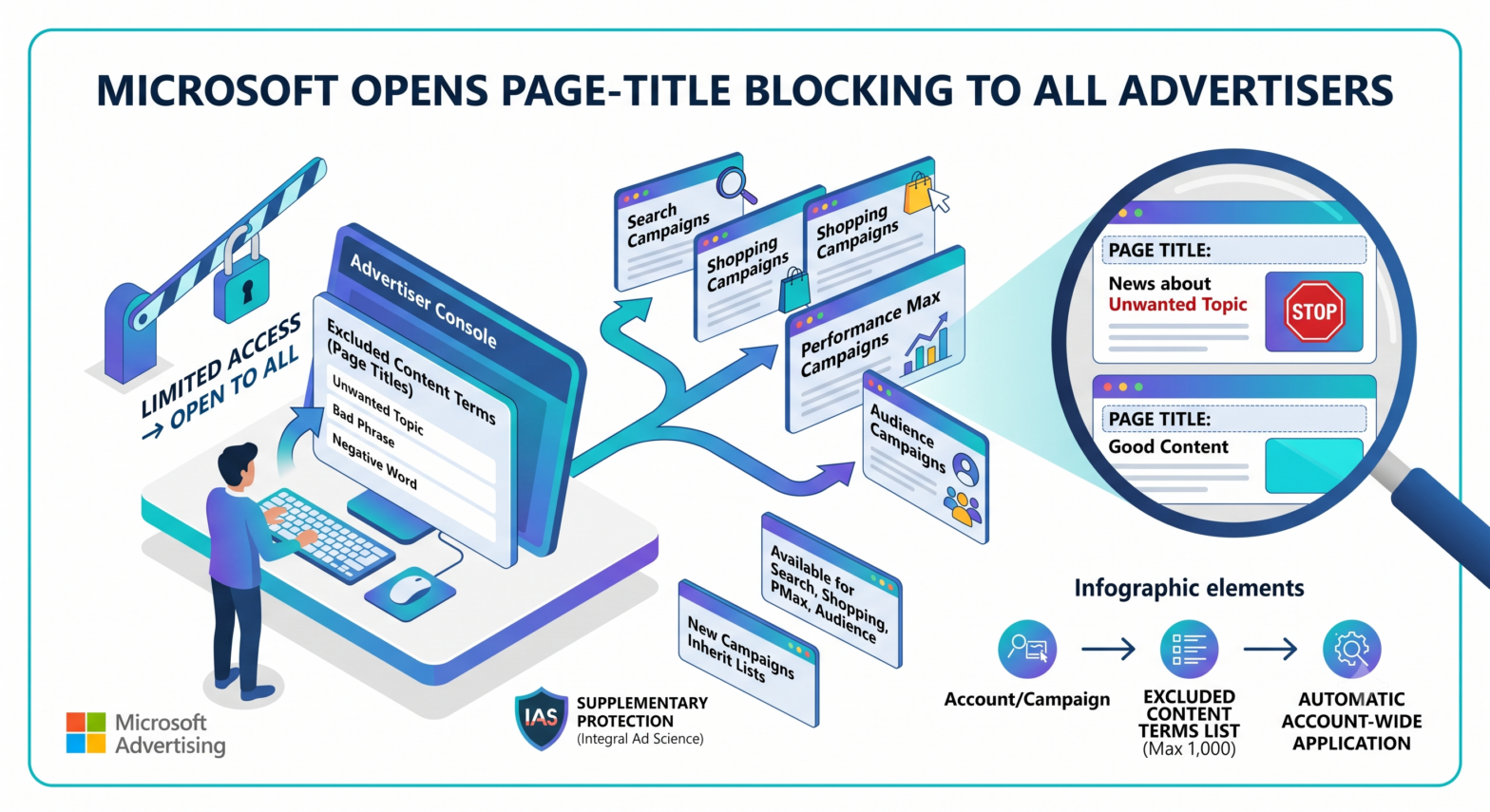
Microsoft Advertising has removed the limited-availability restriction on Excluded Content Terms, extending page-title-based ad blocking to all advertisers on the platform. Microsoft's content suitability help page, as of September 28, 2026, no longer carried the notice that not every account had the feature yet. Microsoft issued no separate announcement; the help page is the primary record of the change.
What the Feature Does
Excluded Content Terms block ads from showing next to unwanted terms matched against page titles. They can be added at the account or campaign level, with a maximum of 1,000 terms. The control operates differently from Microsoft's two other content suitability tools. Microsoft now documents three separate content suitability controls that operate on different objects: website control lists prevent ads from showing on named domains; content exclusions prevent them from appearing alongside categories of sensitive subject matter; and Excluded Content Terms block them from showing next to unwanted terms, defined by Microsoft as page titles.
While website exclusion lists block specific domains and content exclusions filter broad sensitive categories, Excluded Content Terms offer more granular control; brands can avoid appearing next to page titles that mention topics, products, or phrases they consider unsuitable, even if the page itself does not fall into a blocked content category.
How Exclusions Propagate Across Campaigns
Terms can be added at the account or campaign level, with a maximum of 1,000 terms. Any terms added to a campaign are automatically applied to all campaigns in the account. This account-wide propagation applies regardless of where the terms are originally entered. Microsoft notes that campaign-level exclusion lists carry an added benefit: any new campaign created will inherit the lists from existing campaigns, eliminating the need to repeat the same exclusions and saving time for advertisers managing multiple campaigns.
Campaign Types Supported
The feature is available for Audience, Performance Max, Search, and Shopping campaigns. Premium Streaming campaigns are not yet supported.
Existing Brand Safety Infrastructure
Excluded Content Terms sit alongside Microsoft's broader content suitability framework, which already includes automated protections. Microsoft partners with Integral Ad Science (IAS) to protect ads from serving with selected content categories. Content exclusions provide additional safeguards alongside IAS's automatic brand protection, which by default helps prevent ads in audience placements from appearing with content that is never suitable for advertising, with IAS checking websites for certain content and Microsoft automatically blocking ads on sites deemed medium or high risk.
Those content categories broadly align with the Global Alliance for Responsible Media (GARM) framework for unsafe content. Excluded Content Terms function as a supplementary layer that advertisers configure themselves, independent of IAS category filtering.
Rollout Status and Access
The removal of the limited-availability notice from the main content suitability help page signals broader access, but the rollout may not be fully complete. As of September 29, 2026, Microsoft's Performance Max setup page still indicated that not everyone has Excluded Content Terms yet. Microsoft is rolling out the feature gradually, and advertisers who do not yet see it should check under Tools, then Content suitability, and check back periodically.
For advertisers who do have access, the setting is configured through the platform's content suitability menu. Excluded Content Terms can be added during Performance Max campaign creation via the Targeting settings dropdown, or through the navigation menu by selecting Tools, then Content suitability.
Implications for Advertisers
Advertisers managing campaigns across Audience, Search, Shopping, and Performance Max can use Excluded Content Terms to define brand-safety boundaries at the keyword level, beyond what domain blocks or broad content categories provide. Because terms entered at the campaign level apply account-wide automatically, teams managing multiple campaigns or brands within a single account should review their exclusion lists carefully before adding terms, as there is currently no documented per-campaign opt-out mechanism.
Microsoft's documentation does not specify whether matching is exact, by phrase, or by close variant, which advertisers should test before relying on a large exclusion list.