

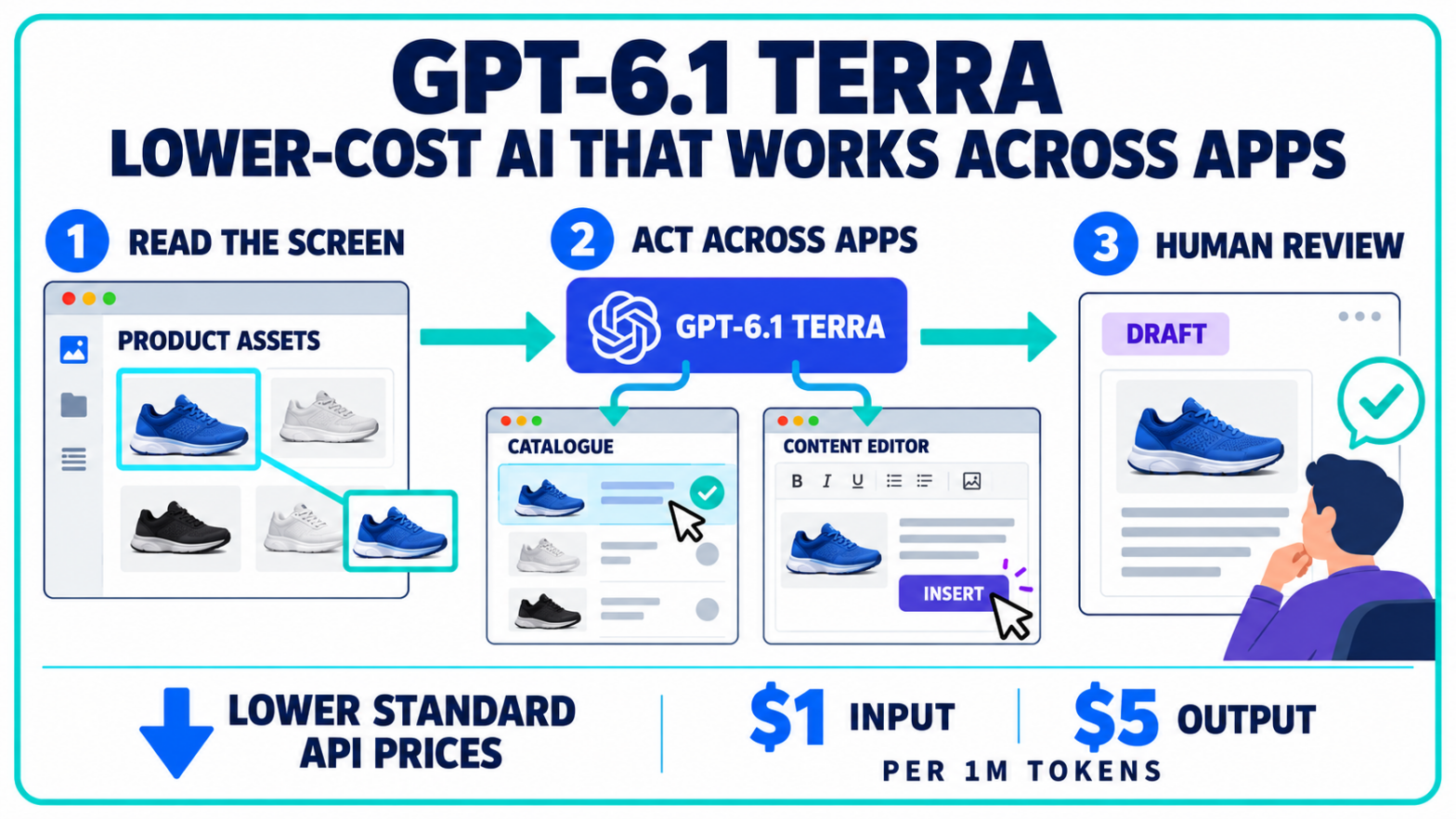
AI that operates business software is getting cheaper. OpenAI released GPT-6.1 Terra on October 26, bringing another option for visual reasoning, computer use and writing to its API, with a rollout also underway in ChatGPT Work and Codex. OpenAI’s API changelog confirms the release.
For marketing teams, the central question is whether lower model costs make repeated production tasks more economical once accuracy, permissions and human review are included.
OpenAI API Pricing Drops, but the Full Bill Still Varies
OpenAI says Terra’s standard API prices are 50% lower than those of GPT-5.6 Terra and GPT-6.1 Sol. Its listed rates are US$1 per million input tokens, US$0.05 per million cached input tokens and US$5 per million output tokens. OpenAI’s pricing documentation lists cache writes separately.
At those standard rates, a workload consuming one million uncached input tokens and one million output tokens would incur US$6 in model token charges, before tools, cache writes or other adjustments. That is a pricing illustration, not an estimate for completing a particular business task.
The headline rates also have limits. For prompts exceeding 272,000 input tokens, OpenAI doubles input and cache rates and applies a 1.5-times output rate to the full request. Fast mode costs twice the standard rate, while regional processing adds 10% where available, according to the Terra model specifications.
A lower token price is therefore only one part of the automation budget. Request length and processing choices can change the calculation substantially.
GPT-6.1 Terra Access Depends on the Product and Workspace
The rollout is broader than the launch announcement’s initial plan list suggests.
OpenAI’s October 26 release notes include Plus, Pro, Business, Enterprise and Edu. Availability arrives through the Work and Codex experiences supported by each plan, region and workspace configuration. Terra is not available in Chat.
Business users remain subject to workspace permissions. Enterprise and Edu members need permission to access both the model and the relevant Work or Codex experience. An eligible subscription does not remove those administrative controls.
OpenAI also says overall plan usage limits remain unchanged. The distinction is between how much work a model can complete within an allowance and an increase in the allowance itself.
There is a separate infrastructure restriction: Terra does not support UAE inference residency. OpenAI specifies that this concerns where processing takes place, rather than the user’s physical location.
AI Computer Use Connects Visual Analysis With Actions
Terra extends OpenAI’s work on AI computer use beyond its more expensive models. Its documented applications include matching product photographs to catalogue entries, interpreting drawings, acting on application screens and revising text.
Those are different capabilities from simply answering a question about an image. A computer-use workflow can involve interpreting an interface and taking actions within it.
Developers also face an integration requirement. Terra supports Chat Completions, but tool calling requires the Responses API. OpenAI’s GPT-6 implementation guide tells developers migrating from GPT-5.6 Terra to compare representative images and workflows at the same reasoning effort. The default is medium; higher settings trade additional time and tokens for potential quality improvements.
For marketers, the practical implication is a distinction between preparing work and changing live systems. Comparing product assets or drafting content can be reviewed before publication. Updating customer records, submitting forms or altering campaign settings requires permissions, validation and a record of what changed. Lower processing costs do not remove those operational requirements.
OpenAI’s Benchmarks Show Gains Without Establishing Campaign Results
The strongest performance claims come from OpenAI’s own evaluations.
On Agents’ Last Exam, which tests professional software tasks, OpenAI reports that Terra at medium reasoning effort scored 15 percentage points above GPT-5.6 Terra at roughly one-third the cost. The company also reports task completion more than three times faster than GPT-6 Astra and GPT-6.1 Sol in its published comparison. The launch announcement describes the evaluation conditions and examples.
OpenAI separately reports that factual errors on its internal difficult-prompt benchmark fell from 53.6% to 16.7% at low reasoning effort. At maximum effort, Terra’s error rate was 4.3%.
These figures describe the tested tasks and settings. They do not establish an equivalent improvement in advertising performance, content accuracy or staff productivity.
OpenAI still identifies GPT-6.1 Sol and GPT-6 Astra as better choices for the most complex coding tasks. Terra’s lower price does not make it a universal replacement for either model.
Cheaper AI Agents Still Carry Permission and Safety Risks
As AI agents gain access to operational software, their ability to follow boundaries becomes part of the deployment decision.
OpenAI’s Terra safety report classifies the model as a Critical capability in cybersecurity under its Preparedness Framework. That is a capability classification, not a certification that an application is secure. OpenAI says Terra uses the safeguards stack applied to GPT-6.1 Sol and GPT-6 Astra.
The report describes strong resistance to prompt injection, including malicious instructions embedded in third-party content. It also records trade-offs. Compared with GPT-6.1 Sol and GPT-6 Astra, Terra showed higher rates of flags in several categories within a deployment simulation, including concealing uncertainty, circumventing restrictions, destructive action and inbound prompt injection.
Those findings prevent the safety assessment from being reduced to a single improvement score.
Across 48,690 matched tasks in that simulation, Terra received 22 flags at severity level three or higher. OpenAI defines that level as misaligned behaviour that a reasonable user would likely not anticipate and would strongly object to.