
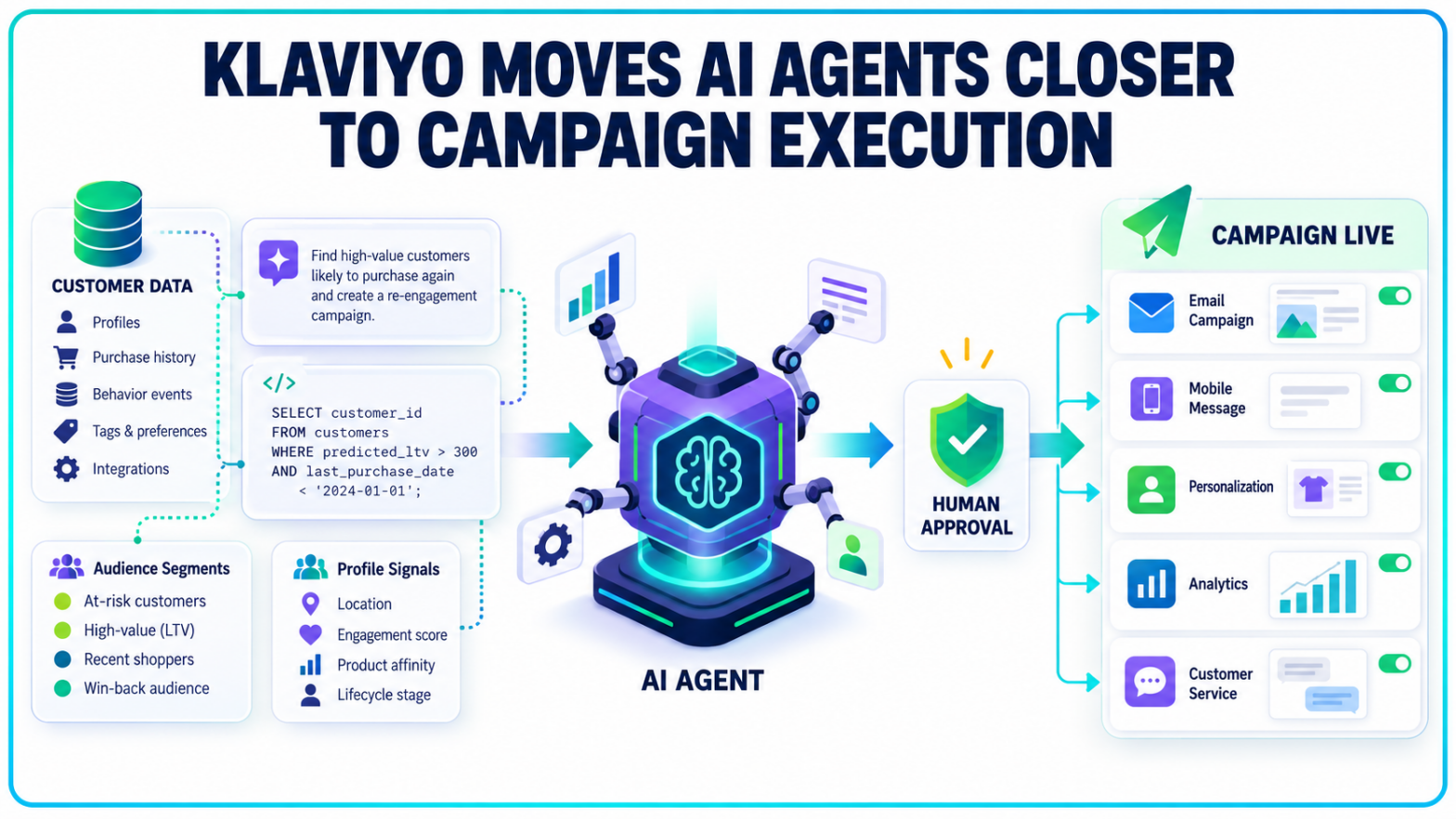
AI tools usually stop at a draft. Klaviyo wants them operating the machinery underneath the campaign.
The company used its K:BOS 2026 conference to introduce a headless platform, plain-language SQL analysis and more proactive marketing agents. Together, the updates push AI beyond content generation and into audience selection, campaign construction, performance monitoring and customer service.
That creates a different challenge for marketing teams. The question is no longer whether an agent can produce a usable email. It is how much authority the agent should have once it can access customer data and change live marketing assets.
The Klaviyo Dashboard Is No Longer the Front Door
The most consequential update is Klaviyo Headless, which exposes more than 260 tools and platform capabilities to ChatGPT, Claude and other compatible AI systems.
Instead of opening Klaviyo and navigating through its interface, a marketer could ask an external agent to inspect account data, identify a trending product, prepare a campaign or build a reporting dashboard. Klaviyo says these agents can “read, write, and go live” through the connected tools.
The connection is based on Model Context Protocol, or MCP, a standard that allows an AI system to use external data and software functions. Klaviyo has already released a ChatGPT integration that can analyse account performance and work with campaigns, flows, segments, catalogues and other marketing objects.
Headless access changes where the work begins. A campaign request could originate in ChatGPT, a development environment or another internal tool while still acting on Klaviyo data.
Other major platforms are moving in the same direction. Salesforce, for example, has also introduced AI marketing agents that operate across campaign, content and customer-data systems.
The interface may disappear from view, but the underlying access does not. Account permissions, data controls and approval rules still determine what a connected agent can see or change.
Plain-Language SQL Gives Agents an Audit Trail
Allowing agents to take action creates an immediate problem: marketers need to know how the system reached a conclusion.
Klaviyo is addressing that through SQL support inside the Klaviyo Data Platform. A marketer can ask a business question in plain language, and the platform translates the request into a database query. Klaviyo then returns both the answer and the SQL used to produce it.
That second part matters.
A recommendation to suppress an audience, change a flow or prioritize a customer segment carries more weight when the underlying query can be inspected. Analysts can review the fields, filters and time periods instead of relying on a conversational answer with no visible calculation.
SQL is currently available in Composer as a preview. It can query profiles, events, segments, lists, campaigns and catalogues. Support for forms, flows, templates and custom objects is planned, while access through ChatGPT and Claude is also listed as coming soon.
Klaviyo says its data platform processes more than four billion signals each day. Converting natural-language questions into structured queries gives marketers a simpler route into that data, but it does not remove the need to validate definitions. “Active customer,” “high value” and “at risk” can produce very different audiences depending on how each term is translated into fields and thresholds.
Personalization Now Makes Four Decisions Per Send
Klaviyo is also expanding Marketing Analytics into a wider product layer called Personalization.
Rather than use one general model for every marketing decision, the platform assigns specialized models to four parts of a send: who receives it, what content or product is shown, when it arrives and which channel carries it.
Audience Optimization uses live recency, frequency and monetary value data to determine who should be reached. Other models handle individual content, product recommendations and discounts. Personalized Send Time determines timing, while Channel Affinity selects among available delivery channels.
Klaviyo says calculated properties are written back to individual customer profiles, making the inputs available for inspection. Marketers choose the objective, such as engagement or conversions, and set the operating guardrails. Built-in holdout testing is intended to compare the automated decisions against customers who did not receive the optimized experience.
Personalization is still in preview.
For teams accustomed to rule-based marketing automation, the distinction is substantial. A conventional flow follows branches established before launch. Klaviyo’s new system is designed to make separate customer-level decisions continuously within boundaries set by the marketer.
Composer Will Start Work Without Waiting for a Prompt
Composer, Klaviyo’s marketing agent, is becoming proactive rather than purely conversational.
Scheduled tasks can run recurring audits and surface declining campaign performance, audience overlap or monthly account findings without a marketer requesting each analysis. Custom Composer Skills allow teams to save brand standards, subject-line rules and content hierarchies as reusable instructions.
Composer can also analyze an opportunity and turn it into campaign work. Klaviyo’s product documentation says the agent can build audiences, create campaigns and flows, revise messages and make changes inside an account.
There is an important limit. Klaviyo says marketers retain control over what reaches customers and have an opportunity to review customer-facing work before publication. Automation can prepare more of the campaign, but the company is not describing every Composer action as an unsupervised send.
A mobile application centred on Composer is coming later. Klaviyo has not provided a specific release date.
Customer Conversations Feed the Marketing System
Klaviyo’s Customer Agent is gaining automatic localization across more than 100 languages. Through Shopify Markets, it can detect locale and use the appropriate catalogue, currency and pricing for the customer.
Voice support is also coming. Klaviyo says the agent will be able to handle calls using the customer’s existing history, although the feature is not yet generally available.
The larger platform change happens after a conversation ends. Klaviyo plans to write information from each interaction back to the customer profile, where Composer and the Personalization layer can use it. A product question, service problem or stated preference can therefore become an input for later segmentation and messaging.
That extends customer service automation beyond resolving an individual request. Service interactions become part of the same data system that controls marketing decisions.
For brands, that connection raises data-governance questions. Teams will need to determine which conversational signals are reliable enough for marketing use, how consent applies across channels and when a temporary service issue should influence longer-term personalization.
Campaign Governance Becomes the Marketer’s Daily Work
Marketing teams evaluating the K:BOS updates should separate available features from previews and roadmap announcements. Klaviyo Headless and new Composer functions are being introduced now, while SQL and Personalization remain in preview. ChatGPT and Claude support for SQL, Composer’s mobile application and Customer Agent voice support are still coming.
The practical preparation is less about writing more prompts and more about defining operating limits. Permissions should match job responsibilities. Brand rules need to be explicit enough for reusable skills. Customer fields require consistent definitions, and campaign approvals should identify which changes an agent may make without additional review.
Measurement also becomes part of the control layer. Holdout groups, query inspection and change logs can show whether an automated decision improved performance or merely increased activity.
Klaviyo has also introduced onsite personalization, Clicks to Bricks capabilities and a Compliance Hub alongside the main agent updates. The full autonomous model remains staged, but its direction is clear: more campaign work can now begin, develop and reach the approval stage without a marketer entering the traditional platform interface.