Advertisers using Google Tag and Google Tag Manager will soon manage both tools through a single unified interface. Google published the announcement on May 20, 2026, via the Google Tag Manager Help Center, coinciding with Google Marketing Live 2026, confirming the most significant architectural change to its tagging infrastructure in several years.
What Google Is Changing
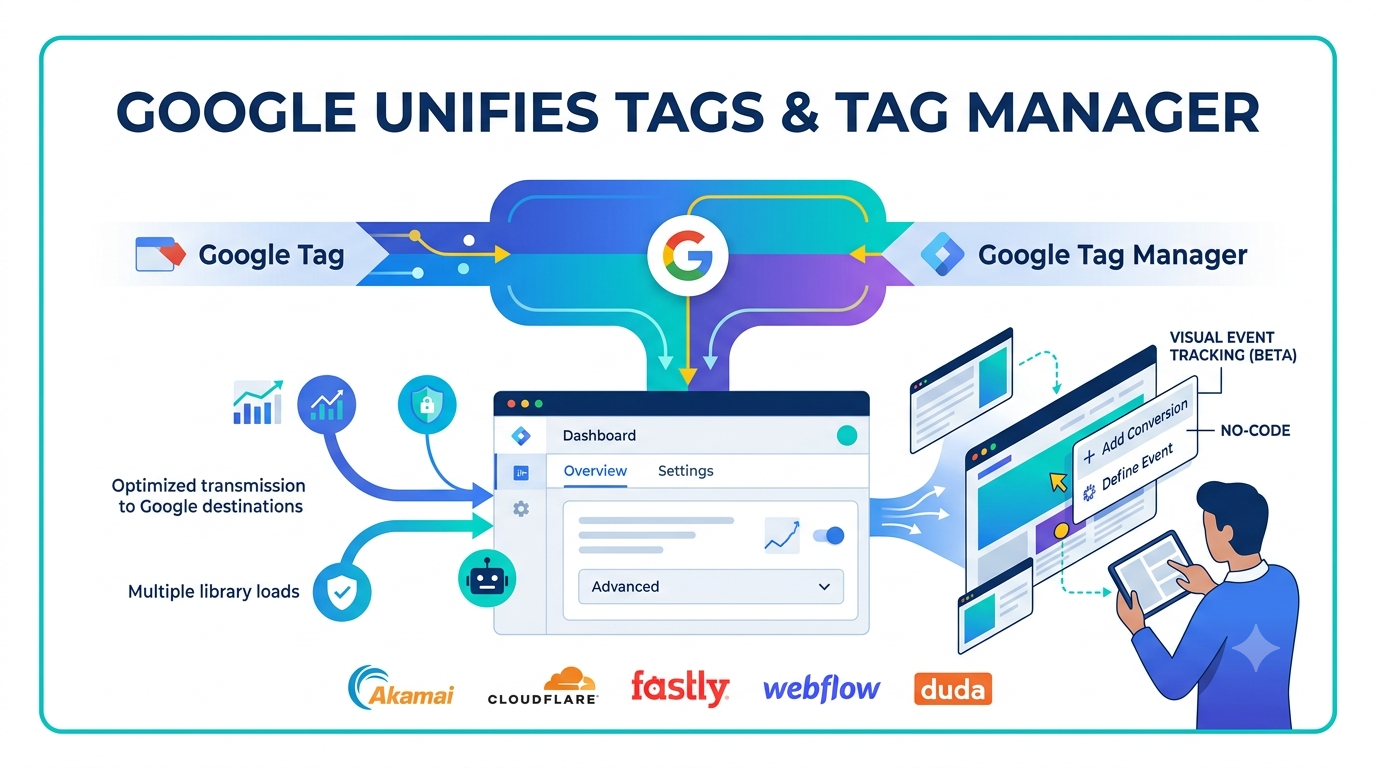
Google announced a forthcoming set of changes to Google Tag Manager and the Google tag that will merge the two products into a shared infrastructure, redesign the Tag Manager interface, and introduce a no-code visual tagging system for setting up purchase conversions directly on a website.
Google tags will be upgraded to fully capable Google Tag Manager containers, giving websites that currently use only Google tags the ability to access Tag Manager's interface-driven tagging features, debugging, and version control, without changing the in-page behaviour of existing Google tags.
Google says the upgrade will not change how existing Google tags behave on webpages. Each Google destination will also retain its own tag, preserving existing setups and automation event triggers.
The announcement does not carry a fixed rollout date but signals the most substantive architectural change to Google's tagging stack in several years.
Redesigned Tag Manager Interface
Google is redesigning Tag Manager's Overview page and reorganizing its existing functionality. A new Settings section will provide a centralized place for container-wide settings, while more technical features, including triggers, variables, templates, and folders, will sit within a collapsible Advanced section. No existing functionality is being removed as part of the redesign.
The opt-in container optimization also changes how data is transmitted. Tag Manager containers will be able to send data directly to Google destinations, resulting in faster website performance. Previously, Google Tag Manager loaded extra JavaScript (gtag.js) to send data to a Google destination, which could cause latency in measurement transmission.
Under the current system, every Google tag in a container loads its own separate gtag.js file. For containers running GA4, Google Ads, and Floodlight tags simultaneously, that represents three additional library loads on top of the GTM container script. After the upgrade, destinations are handled entirely through the single container JavaScript file, with no additional gtag.js loads per destination.
The Google Tag Manager Help Center also confirmed that new deployment snippets will no longer include the `gtag config` command, and that advertisers wishing to preserve legacy initialization behaviour can do so using the `gtm init` trigger.
Container Optimization Is Opt-In
Google confirmed in the May 20, 2026 Help Center documentation that no changes will be made automatically to existing setups. Advertisers will be able to update and optimize their Google Tag Manager containers to gain access to these features from an optimization banner in their account, and will be able to preview all changes before publishing to their workspace.
The Settings tab centralizes container-wide settings and can be overridden per tag. The change adds no automatic data collection, does not alter in-page behaviour, and is reversible.
Linking a container to Google destination accounts grants "Read" access by default, with the ability to adjust user permissions at any time through Tag Manager's user management settings, as confirmed in the Help Center documentation.
Visual Tagging Now in Beta
One of the more significant additions is visual tagging, which will allow advertisers to create events and set up conversions without manually writing code. Advertisers will be able to navigate through their website and select elements directly to define events. Google will then handle technical components such as selectors and triggers behind the scenes.
This feature is currently available in beta for purchase conversions in Google Ads and will be progressively rolled out for additional use cases throughout the year.
New CDN and CMS Partner Integrations
Google is also expanding its tagging ecosystem with integrations involving Akamai, Cloudflare, Duda, Fastly, and Webflow, intended to help businesses maintain accurate and secure measurement data.
The integrations with Akamai and Fastly, confirmed available as of May 14, 2026, in the Google Tag Manager release notes, allow advertisers to authorize Google to automatically detect CDN zones and inject routing rules directly from the Google tag interface, eliminating the need for manual configuration in the Akamai Control Center or Fastly dashboard. By automating the deployment of first-party measurement paths and geolocation headers, these integrations are designed to improve the accuracy of Google Analytics reporting and drive conversion uplift through enhanced signal recovery.
What This Means for Advertisers and Marketing Teams
The unification has practical implications for how measurement responsibilities are divided within advertising and analytics teams. Advertisers currently relying on Google tag alone will gain access to debugging tools, version control, and interface-driven configuration without any changes to their existing on-page implementation. For teams already running sophisticated Tag Manager setups, the container optimization is an opt-in process, and Google's own Help Center documentation recommends reviewing all proposed changes before publishing, rather than assuming a simplified configuration will behave identically to a custom-built legacy setup. The shift to direct data transmission, removing gtag.js as an intermediary load, may be most consequential for high-traffic e-commerce sites where measurement latency has a direct effect on conversion attribution accuracy.
Google confirmed in the May 20, 2026 Help Center announcement that the upgrade will not alter in-page tag behaviour, and that each Google destination will retain its own individual tag within the unified container structure.