

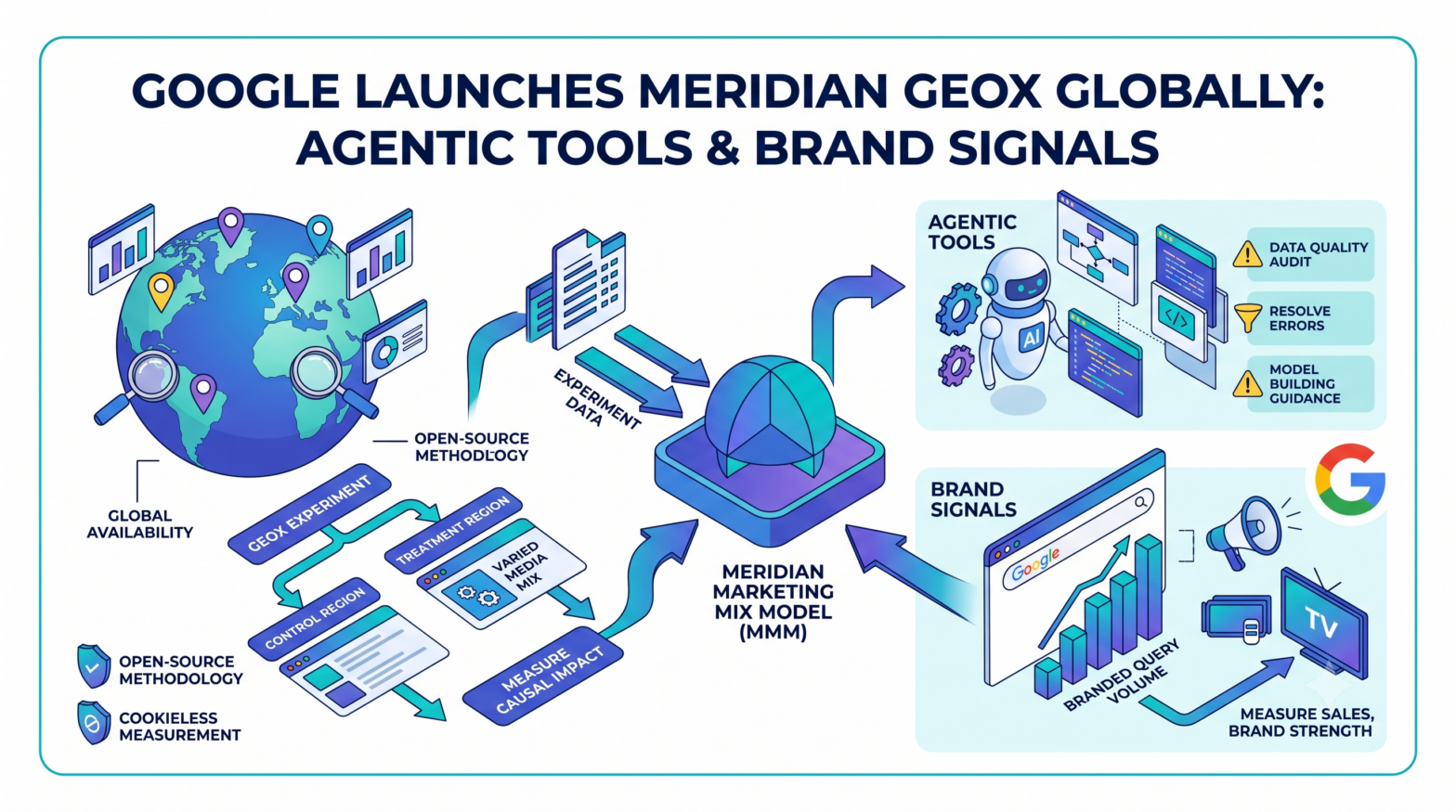
Advertisers using Google's open-source marketing mix model can now run causal geographic experiments and feed those results directly into their models. Google confirmed in its September 10, 2026 blog post on blog.google that Meridian GeoX, introduced earlier in 2026 as a beta, is now generally available globally within Meridian.
The announcement was published by Nipoon Malhotra, VP of Ads Analytics, Insights, and Measurement, and covers three areas Google frames as a single sequence: a data foundation, multiple measurement signals, and causal proof. The Meridian-specific changes include global availability for GeoX, new agentic model-building tools, and support for brand signals including Branded Google Query Volume.
GeoX Moves From Beta to Global Availability
Google first named GeoX in a pre–Google Marketing Live measurement announcement on May 5, 2026, with testing set for later in the year. On September 9, 2026, Google marked GeoX general availability through a developer community livestream, detailing the full-funnel framework, an agentic skills repository, and an automated calibration module, and citing a claim of 31 percent cheaper geo experiments. The September 10 blog post restated that global availability for a marketer audience.
Geo experimentation is a measurement methodology that isolates the causal impact of marketing campaigns by running controlled tests across distinct geographic regions, comparing regions where a marketing variable was changed against regions where it remained the same. Meridian GeoX is an open-source solution for measuring cross-publisher incrementality that provides cookieless and publisher-agnostic measurement, closing data gaps and generating experiment data used to calibrate marketing mix models.
The publisher-agnostic scope is a meaningful design choice. GeoX enables publisher-agnostic geo experiments to isolate the incremental impact of media spend across any platform or channel globally. That means advertisers can test campaigns running on platforms other than Google, or across several channels simultaneously, within the same experiment.
How GeoX Results Feed Into Meridian Models
GeoX experiment results feed into Meridian as Bayesian priors, and the model in turn nominates which channels would gain most from being tested. Extensive empirical benchmarking cited by Google Research indicates that Meridian GeoX delivers lower minimum detectable effects and reduced budget requirements, while its placebo inference maintains control over false positive rates.
The library offers cost-effective, multi-cell testing with flexible methodologies and integrates with Meridian MMM by suggesting new GeoX experiments based on MMM results. Using multi-cell designs, GeoX allows the comparison of multiple treatments, such as different publishers, tactics, or channels, in a single study against a common control group, reducing total cost and time to insight.
GeoX also addresses practical measurement constraints created by privacy changes. GeoX runs causal geo experiments by holding some geographic regions back from media exposure and comparing outcomes against regions that received it, producing evidence about whether a channel caused the results attributed to it rather than merely correlating with them. Because the methodology operates on aggregate regional data rather than individual user tracking, it functions independently of cookies and is not affected by iOS restrictions or third-party cookie deprecation.
Technical Requirements for Running GeoX
Advertisers intending to use GeoX face specific data and infrastructure requirements. The library requires daily time-series data; weekly aggregations are not supported and will trigger validation errors. A minimum of 10 geographic units is required for a single-cell design, with Google's documentation recommending 50 or more geos for effective stratification and robust matching. For go-dark and heavy-up experiment types, daily geo-level spend data is mandatory during the design phase.
Python 3.11 or higher is required to run Meridian GeoX alongside Meridian MMM, and the library relies on JAX for high-performance vectorized computations, with CPU-based JAX installed automatically. For heavy simulations or use cases combining GeoX and Meridian, GPU support is recommended.
The media cost of running an experiment also needs to be factored in. Depending on the design type, holdback, go-dark, or heavy-up, advertisers may need to increase, reduce, or withhold spend in selected markets to establish the treatment and control conditions required for a valid test.
Agentic Tools Added to Meridian Model-Building
In the September 10 announcement, Google describes agentic capabilities brought into Meridian that the company says help audit data quality, resolve errors, and guide model building in real time, alongside back-end changes intended to make analyses run faster.
A repository of agentic skills for Meridian was demonstrated during Google's September 9 livestream, running inside the Antigravity CLI, giving step-by-step modelling guidance grounded in Google's developer documentation and surfacing best-practice guidance at each stage of the workflow.
These additions do not alter what data a model requires. Advertisers still need to determine which business and media data to include and how to weight the outputs. The agentic tools are designed to reduce manual troubleshooting during the build process, not to substitute for decisions about model inputs.
Brand Signals Now Supported in Meridian Models
Meridian now supports the inclusion of relevant brand signals, including Branded Google Query Volume, directly in models so advertisers can measure the full effect of brand building and show how upper-funnel video and TV campaigns lead to future sales.
That capability could help advertisers demonstrate how upper-funnel investments, including TV commercials and out-of-home advertising, influence brand demand and eventually contribute to sales.
Advertisers should apply appropriate caution when interpreting this signal. An increase in branded search volume does not by itself establish that a campaign caused future sales. Competitor activity, seasonality, promotions, and news coverage can all influence branded demand during the same period. Branded query volume is a Google-owned signal, measured on a Google surface, and is now positioned as the recommended proxy for brand strength inside a model that allocates budget across Google and non-Google channels. Advertisers whose brand searches concentrate on other engines, or whose categories generate little branded search at all, will find the signal a poorer fit.
Practical Implications for Measurement Teams
For advertisers already running Meridian models, GeoX provides a mechanism to add experimental evidence to modelled findings before acting on a significant budget shift. Standard MMM relies on historical data and statistical assumptions. Where a geo experiment independently produces findings consistent with what the model shows for a specific channel, those results give measurement teams additional evidence to bring into internal budget discussions.
The combination is most practical for advertisers with enough geographic scale and data density to design a reliable experiment. Smaller advertisers or those operating in markets with limited geographic variation may face structural constraints in using GeoX effectively.
Meridian opened globally on January 29, 2025, following testing with hundreds of brands. Google added non-media variables such as pricing and promotions and channel-level contribution priors in September 2025, and launched a no-code Scenario Planner in February 2026 to make budget planning outputs accessible to non-technical users. The September 10 updates represent the next stage in that build-out.
In the September 10 blog post, Google confirmed that GeoX can be used to run independent experiments or to incorporate incrementality results into an existing MMM to help boost accuracy.