

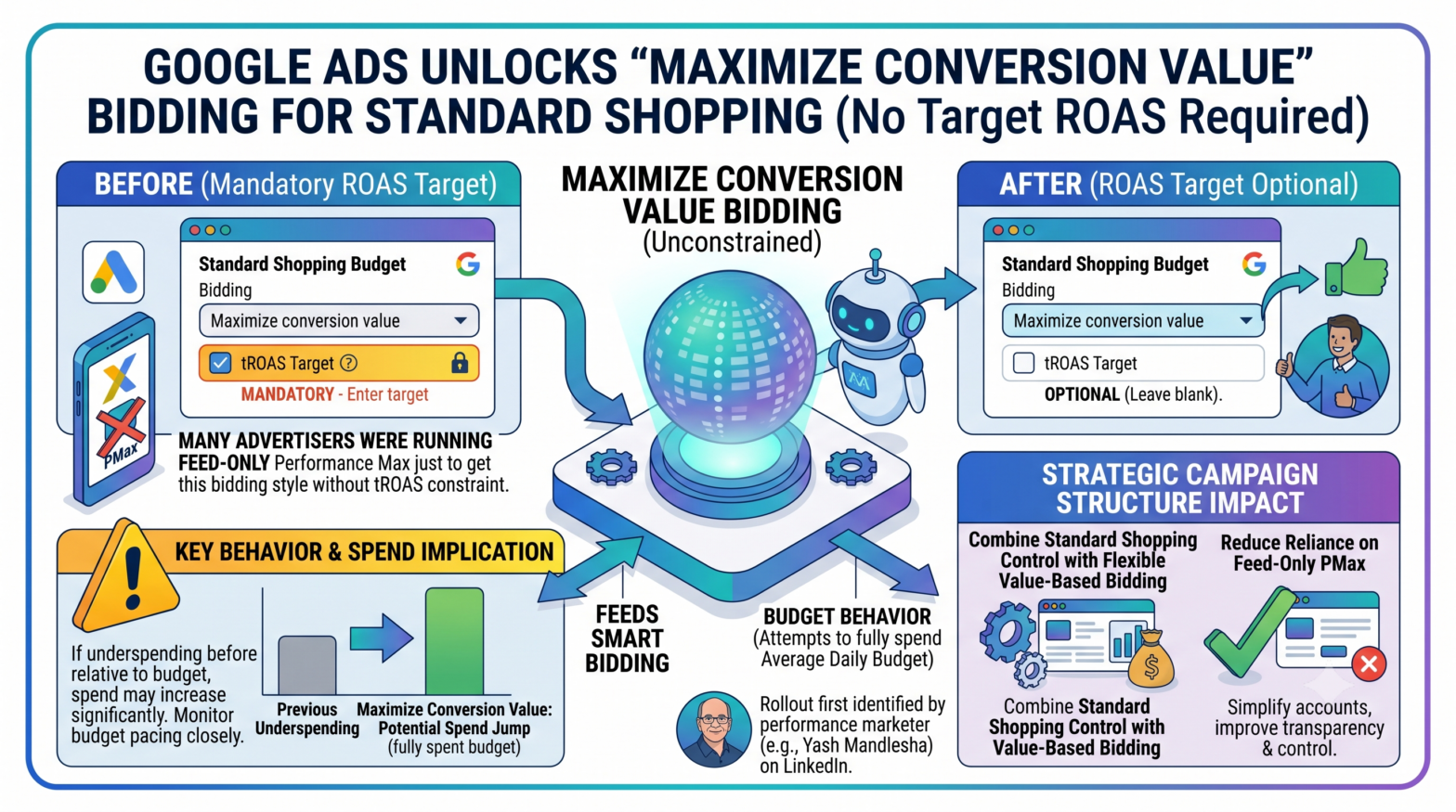
Google is expanding the bidding options available to Standard Shopping advertisers. The platform is rolling out Maximize Conversion Value as a selectable bid strategy within Standard Shopping campaigns, without requiring advertisers to set a Target ROAS, a constraint that had previously made this strategy unavailable in that campaign type.
A Bidding Option Previously Locked Behind a ROAS Target
Until now, Standard Shopping advertisers looking to optimize for conversion value were required to use a Target ROAS bidding strategy. Maximizing conversion value as a standalone option, without a ROAS target attached, was not available within Standard Shopping.
The new option surfaces under the Budget and Bidding Optimization settings for Standard Shopping campaigns, where advertisers can now select "Maximize conversion value" as a bid strategy.
The rollout was first identified by performance marketer Yash Mandlesha, who shared a screenshot of the new bidding option on LinkedIn, noting:
"Until now, if you wanted to optimize towards conversion value, you had to use a Target ROAS. Now it appears you can optimize for conversion value without setting a tROAS target."
Google has not published a formal announcement as of the time of writing. The change is appearing in advertiser accounts as a live rollout.
How Maximize Conversion Value Works
According to Google Ads Help documentation, Maximize Conversion Value bidding finds an optimal bid for each ad each time it is eligible to appear, using historical performance and contextual signals present at auction time. Google sets these bids to help get conversions that are most valuable for the campaign while spending within the budget.
The strategy uses advanced AI to optimize and set bids, and offers auction-time bidding capabilities that tailor bids for each individual auction.
Advertisers should note an important budget behaviour documented by Google: if a Target ROAS is not set, Maximize Conversion Value will attempt to fully spend the average daily budget, meaning campaigns currently underspending relative to their budget could see a significant increase in spend upon switching.
The Feed-Only Performance Max Workaround
The Standard Shopping restriction on value-based bidding had a practical consequence for many advertisers running e-commerce campaigns. As Mandlesha explained on LinkedIn:
"The problem was that if you wanted Google's value-based bidding, you had to give it a ROAS target. Many advertisers were running feed-only PMax campaigns just to get access to Maximize Conversion Value bidding without that constraint. That may no longer be necessary."
Many advertisers have continued to favour Standard Shopping because it offers greater control and transparency than Performance Max. The absence of unconstrained value-based bidding within Standard Shopping was one of the few remaining functional advantages Performance Max held over it for e-commerce use cases.
What This Means for Campaign Structure
For advertisers running Standard Shopping campaigns alongside feed-only Performance Max campaigns created specifically to access value-based bidding, this update may enable a simpler account structure. Advertisers can now combine the control of Standard Shopping with a more flexible value-based bidding strategy, and for some accounts, it could simplify campaign structures and reduce reliance on feed-only Performance Max campaigns.
In practice, advertisers switching from Target ROAS or manual-based strategies to Maximize Conversion Value should monitor budget pacing closely after the transition, ensure conversion tracking is reporting transaction-specific values, and allow adequate time for the bidding algorithm to enter and exit its learning period before drawing performance conclusions. These implications follow from standard Google Ads Smart Bidding behaviour as documented in Google Ads Help.
Google Ads is also separately updating how bidding strategy labels appear in the interface starting in June 2026. "Maximize conversion value with a Target ROAS" will be relabeled as "Target ROAS," while the underlying bidding behaviour will remain unchanged. Advertisers will not need to take any action in their accounts as a result of those labelling changes.