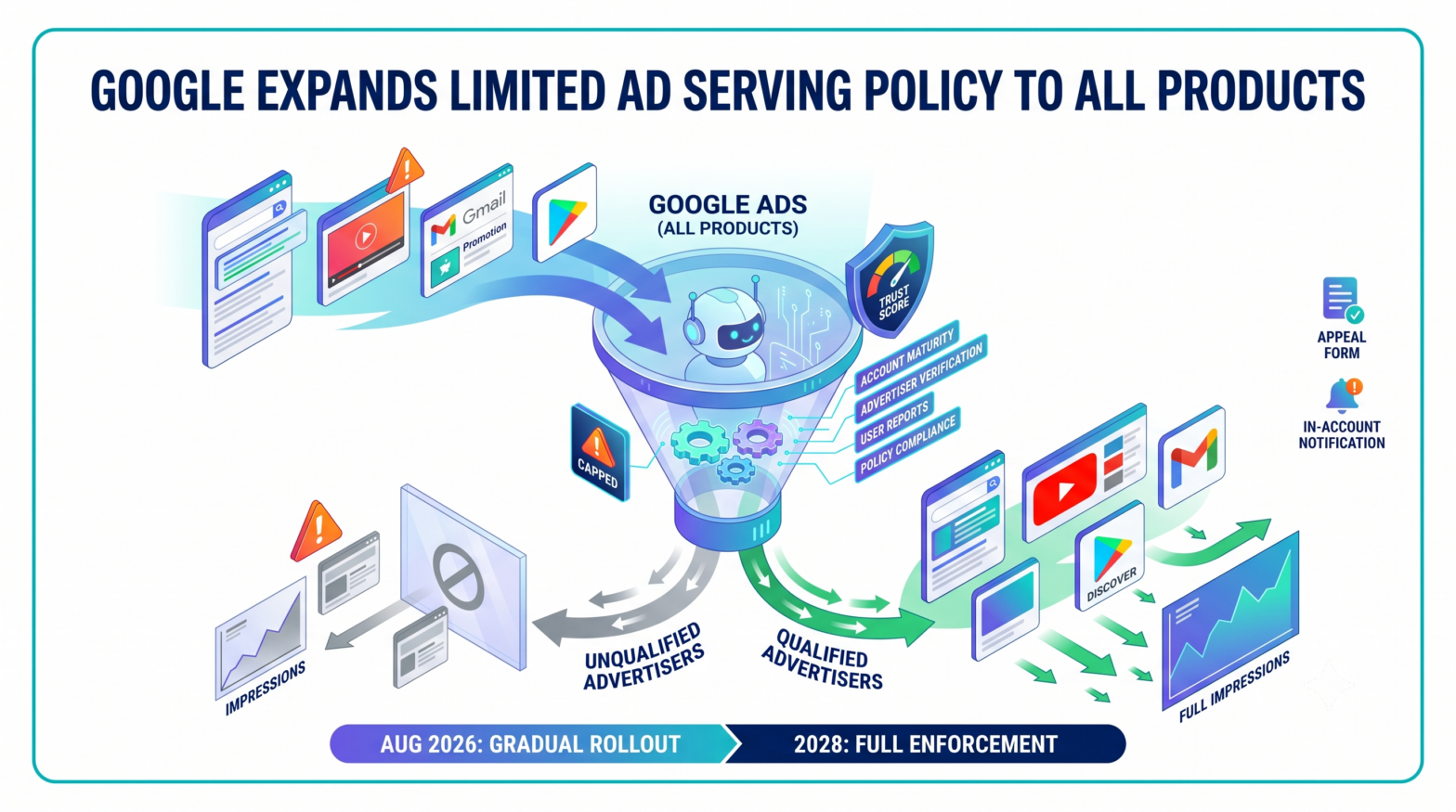
Advertisers across every Google Ads product now face the possibility of having their impressions capped based on account trust signals. Google published a change log entry on August 5, 2026, stating that the company will update its Limited Ad Serving policy during August 2026 to cover all Google Ads. Implementation will begin gradually and will be completed by 2028.
What the Policy Change Covers
Google has widened its Limited Ad Serving policy from a Search-specific control into a rule covering every Google Ads product, with phased enforcement running to 2028 and no published timetable for individual accounts. The August 5 document sets out a revised layout of the policy, a list of qualification factors, and two separate sets of best practices: one for Google Search, and one covering YouTube, Gmail, Play Store, and Discover.
The policy is not a blanket restriction on all advertisers. Google's updated policy documentation states that it limits impressions of ads more likely to result in negative ad experiences, and that the policy is specific to a certain set of ad-serving scenarios, in which only qualified advertisers will be able to serve ads without impression limits. Advertisers not running ads within those scenarios will not be affected by the policy.
How Google Determines Advertiser Qualification
When deciding whether an advertiser is qualified, Google states it takes user reports about that advertiser especially seriously. When users have persistently and disproportionately reported that an advertiser's content, products, or behaviour do not meet their expectations, Google may consider that advertiser unqualified and limit its impressions.
Beyond user reports, Google evaluates a broader set of account-level signals. The August 5 policy document lists account maturity, advertiser verification status, history of policy compliance, ad format usage, advertiser industry, account attributes, and user activity as factors in the qualification assessment.
Google states that advertisers should continue to build campaigns and creatives with positive user engagement while their account is assessed, and that Google Ads will automatically update ad serving limits based on that assessment and review.
How Affected Advertisers Are Notified
The mechanism Google uses to restrict delivery is distinct from standard ad disapproval. Unqualified advertisers who have a meaningful proportion of impressions in scope of the policy will receive an in-account notification, and individual ads will not be disapproved. Advertisers can contest the restriction by submitting Google's Limited Ad Serving Appeals Form. Google states it will reinstate an advertiser once they become qualified, though the company has noted it cannot specify how long the review process may take.
Platform-Specific Qualification Guidance
Google has published two separate sets of best practices under the updated policy: one for Google Search, and one covering YouTube, Gmail, Play Store, and Discover.
For Search, Google's August 5 policy document recommends that advertisers complete advertiser verification, maintain clear branding in ads and on landing pages, avoid generic ad copy, and, particularly for newer or less-established brands, pin their domain to the first headline position in responsive search ads.
Google has stated that it wants to ensure the identity of the advertiser a user chooses to engage with is unambiguous, noting that ads referencing other brands or ads with no branding at all may confuse users about the identity of the advertiser, and that in such cases it may limit impressions on certain searches for all branded and generic ads for that advertiser.
For YouTube, Gmail, Play Store, and Discover, Google's guidance centres on completing advertiser verification, complying with advertising policies, and continuing to build campaigns that accumulate positive user interactions while Google evaluates account quality.
Policy History and Rollout Trajectory
This August 2026 expansion is the latest in a series of incremental extensions to the Limited Ad Serving framework. The policy originated in September/November 2023, initially targeting first-time advertisers who referenced specific brands in their campaigns. It expanded to YouTube on August 16, 2024. The June 12, 2026 update extended the policy to Search, and the August 2026 revision now brings all remaining Google Ads products under the same framework.
Practical Implications for Advertisers and PPC Managers
For paid media practitioners managing Google Ads accounts, the August 2026 update means impression volume is now subject to an additional layer of platform assessment beyond standard policy compliance. Accounts with incomplete advertiser verification, thin campaign history, or low user engagement metrics are more likely to fall within the scenarios Google has identified as higher risk. Agencies managing multiple client accounts should audit verification status and review branding consistency across ad copy and landing pages as a baseline response to this policy change. Because Google has not published account-level enforcement timelines, the effects may not be immediately visible, but the qualification framework is now active and will scale through 2028.
Google has noted that best practices may differ depending on the Google product, and that examples provided in the policy are illustrative and do not guarantee that an advertiser will become qualified.