

Google is changing how advertisers manage audiences, inventory deals and campaign settings through Display & Video 360. Some previously supported operations now require a different API altogether.
The company released Display & Video 360 API v5 in public beta on October 22, 2026, introducing additional controls for YouTube advertising and Digital Out of Home campaigns while restructuring several existing automation functions.
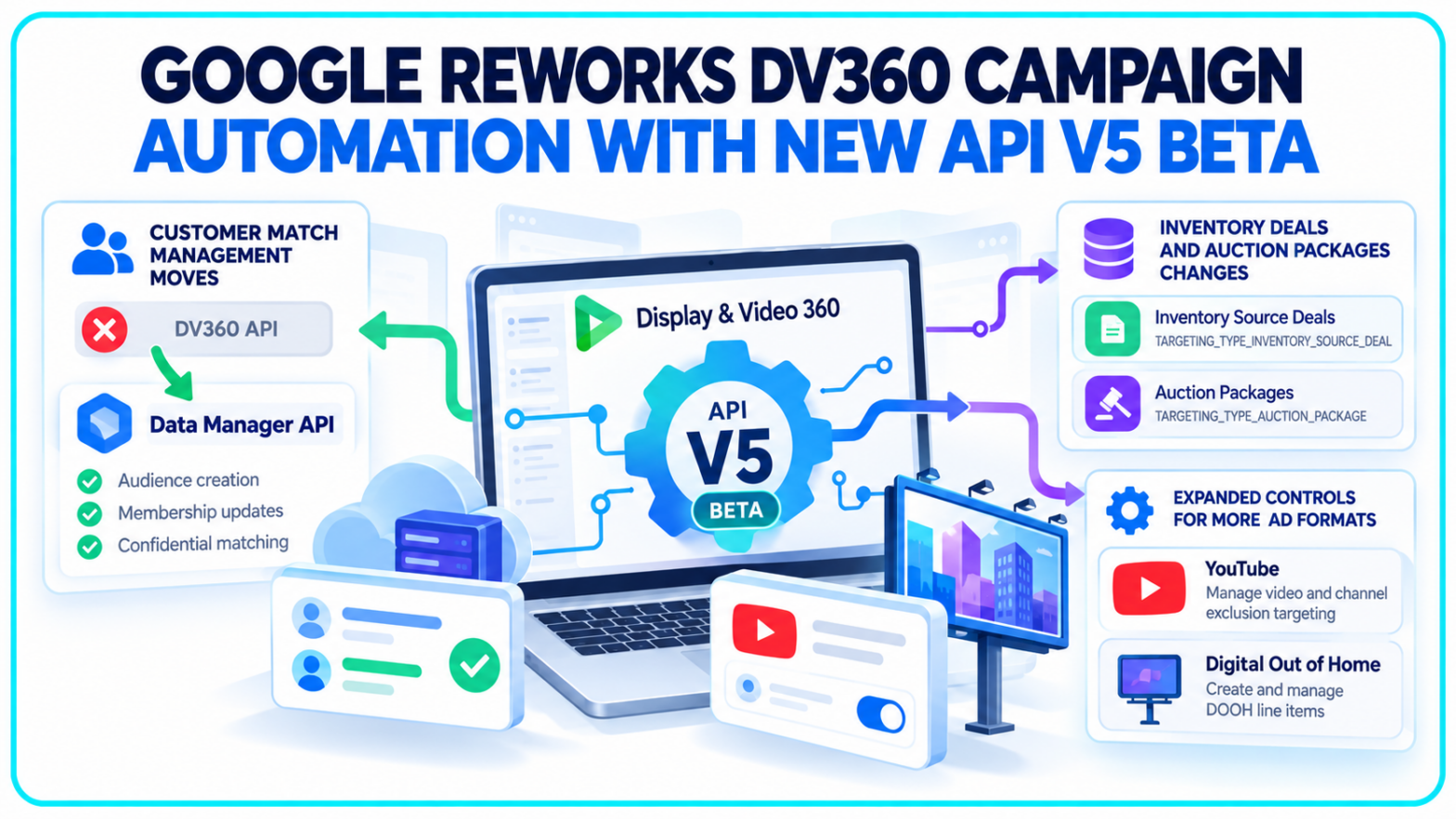
Among the most significant changes is the removal of Customer Match audience creation and membership-management methods from the new DV360 API version. Google is directing developers to its Data Manager API instead.
The release also changes how inventory deals and auction packages are identified, introduces a different audience-targeting structure for Demand Gen and YouTube ad groups, and expands support for managing certain campaign resources programmatically.
For advertisers using third-party platforms or custom-built campaign management systems, the changes affect how those integrations communicate with Google's advertising infrastructure.
Customer Match Management Moves Outside the DV360 API
The most consequential change for existing integrations concerns first-party audience management.
Previously, developers could use the Display & Video 360 API to create Customer Match audiences and update their membership through dedicated methods.
Version 5 removes three of those methods: firstPartyAndPartnerAudiences.create, firstPartyAndPartnerAudiences.editCustomerMatchMembers and firstPartyAndPartnerAudiences.patch.
Google now directs advertisers to the Data Manager API for these operations.
The change does not remove Customer Match targeting from Display & Video 360. Advertisers can continue using eligible first-party audiences, but integrations built to create lists or upload customer information through the DV360 API must use a different workflow when migrating to v5.
The Data Manager API supports audience creation, membership updates and ingestion diagnostics. It also provides confidential matching, encryption capabilities and a unified data model across supported Google advertising products.
That approach reflects Google's broader effort to consolidate customer data ingestion rather than maintain separate audience-upload systems for every advertising platform.
TechWyse recently covered Google's expansion of Customer Match identifiers in Google Ads. Those additional IP address matching capabilities are distinct from the DV360 change and are not supported for DV360 Customer Match uploads.
The migration to Data Manager concerns where Customer Match audiences are maintained, not an automatic expansion of the data advertisers can use for matching.
Inventory Deals and Auction Packages No Longer Share One Structure
The new API also changes how advertisers retrieve and target programmatic inventory.
Under version 4, inventory source deals and auction packages were handled through the same InventorySource resource structure.
That arrangement changes in v5.
Google now distinguishes inventory source deals from auction packages, assigning them separate targeting types and retrieval mechanisms.
Deals use TARGETING_TYPE_INVENTORY_SOURCE_DEAL, while auction packages use TARGETING_TYPE_AUCTION_PACKAGE.
Developers also need to account for revised resource identifiers.
According to Google's migration guide, previously cached inventory source IDs cannot be reused after upgrading to v5 because the identifiers for existing deals and auction packages have changed.
A platform that stores these IDs for recurring campaign updates may therefore need to retrieve and remap the relevant inventory before applying targeting changes.
Google has also removed methods for creating, updating and editing accessors of inventory sources through the new API.
These revisions matter most to agencies and advertisers managing programmatic buying through automated systems rather than the DV360 interface.
The changes follow other adjustments to Google's bulk campaign management tools. TechWyse previously reported on Display & Video 360 Structured Data Files v11, which introduced revised targeting structures and file-format changes.
The two releases affect different tools, but both require developers to account for changes in how campaign resources are represented.
YouTube Exclusions Gain Write Controls as Outdoor Advertising Support Expands
Not every change in v5 removes or restructures functionality.
Google has expanded the operations available through the API, particularly for YouTube placement exclusions.
Developers can now fully manage advertiser-level YouTube video and channel exclusion targeting.
Previously, these advertiser-level targeting settings were read-only through version 4.
With the new controls, authorized systems can create and remove the relevant exclusions programmatically instead of only retrieving existing settings.
For advertisers managing multiple campaigns under one DV360 advertiser, this provides another way to maintain consistent exclusion configurations through centralized automation.
The release also expands Digital Out of Home support.
Google has added the ability to create Digital Out of Home insertion orders through the API, alongside support for retrieving these resources.
Digital Out of Home advertising involves digital screens in physical environments, including supported programmatic inventory.
The new API capabilities concern how these campaigns are managed technically. Google has not described them as the launch of a new outdoor advertising inventory network.
The distinction matters because existing integrations already had some ability to retrieve line items associated with Digital Out of Home insertion orders.
Version 5 extends those workflows while changing which insertion-order resources can appear in API responses.
Google's migration documentation advises developers to account for insertion orders carrying the OUT_OF_HOME type when retrieving campaign structures.
Demand Gen Audience Targeting Gets a More Granular Model
Audience targeting is another area receiving structural changes.
In version 4, the API managed audience targeting through the TARGETING_TYPE_AUDIENCE_GROUP structure.
For YouTube and Demand Gen ad groups, version 5 introduces individual assigned targeting options based on the audience type.
These options distinguish between Google audiences, combined audiences, custom lists, first-party and partner audiences, and lookalike audiences.
The revised structure affects how developers retrieve, assign and remove audience targeting for eligible ad groups.
Line items, however, continue using the existing audience-group targeting approach.
That difference requires attention from systems that manage both line-item and ad-group targeting.
Google has also introduced methods to create and retrieve lookalike audience resources directly through the API.
The changes build on the Demand Gen API expansion TechWyse covered in June, when Google made Demand Gen campaign resources available to DV360 partners more broadly.
The latest release does not introduce Demand Gen to the platform for the first time. It revises the structure used to manage certain targeting settings within an already supported campaign type.
Additional changes affect creative assignments and synthetic-media information.
New fields support ad groups that generate ads from assigned creatives, while the containsSyntheticMedia field has been added to the AdGroupAd resource.
Google's documentation identifies these as API-level changes, not newly announced advertising formats.
API v5 Is Available, but Its Beta Status Matters for Migration
The public beta is available now, although Google has warned that breaking changes may still be introduced before the version reaches general availability.
Developers moving from v4 must update endpoint references, review affected methods and fields, and use the latest supported client libraries.
A migration involves more than replacing /v4/ with /v5/ in API requests.
Existing integrations may rely on removed methods, stored inventory IDs, deprecated fields or targeting configurations that are represented differently in the new version.
For marketing teams, the practical concern is whether campaign automation continues to handle audiences, exclusions, inventory assignments and insertion orders correctly after an upgrade. Systems managing Customer Match also need a separate Data Manager integration for the operations removed from v5.
Google has published a detailed migration guide and version 5 release notes covering the changes.
The company has not announced a mandatory migration deadline from v4 as part of the October 22 beta release.
Version 4 remains the generally available API version, while v5 provides access to the new functionality under beta conditions.
Google says any further breaking changes to the beta will be documented in its release notes. A general availability date for Display & Video 360 API v5 has not yet been specified.